When should you use RAG instead of fine-tuning?
RAG retrieves fresh knowledge at query time, while fine-tuning bakes behavior into the weights. Here is a clear framework for when to use each, with tradeoffs and what interviewers probe for.
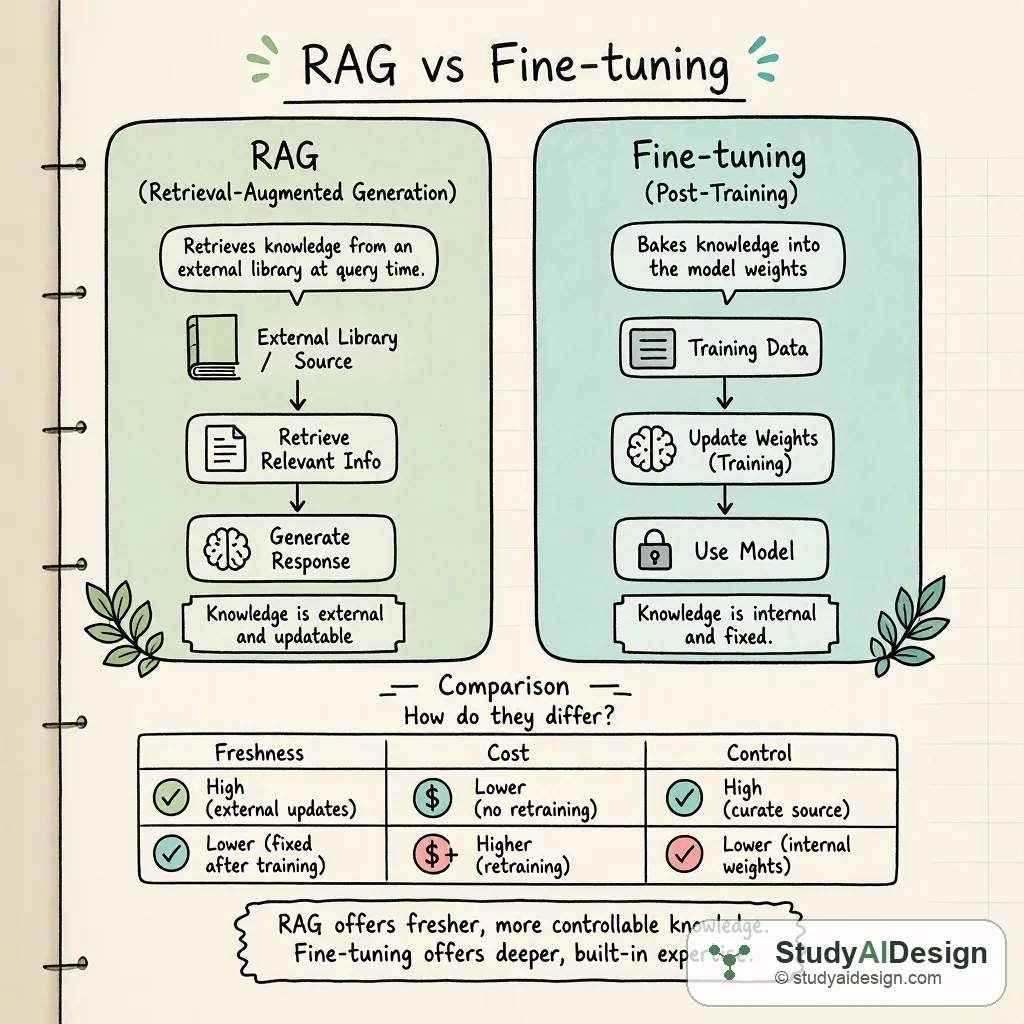
TL;DR
- Use retrieval augmented generation when your knowledge changes often, is large, or you need low-cost updates without re-training a model.
- Use fine-tuning when you need deterministic style or task behavior, offline latency, or higher end-to-end accuracy for a narrowly defined distribution.
- RAG combines a retriever plus a generator. It keeps the model small and updates cheap but adds retrieval complexity and potential retrieval errors. Key tradeoffs: update cost versus inference simplicity, latency, and control over model behavior.
In this question, we will learn when RAG is a better choice than fine-tuning for production NLP tasks. We will compare costs, accuracy drivers, update patterns, latency, and practical failure modes. You will get one concrete worked example so you can argue tradeoffs clearly in an interview.
We will cover the following:
- Direct answer
- The intuition
- How it actually works (worked example with numbers)
- When to fine-tune instead
- Tradeoffs and failure modes
- Questions the interviewer might ask
- What the interviewer is really testing
Use RAG when your knowledge base is large, changing frequently, or you want fast, low-cost updates; use fine-tuning when the behavior you need must be baked into the model itself, or when you need strict offline latency or deterministic outputs. RAG lets you update facts by changing the index, while fine-tuning requires re-training. If you need high precision on a narrow task and can afford the re-training and validation, fine-tuning can win on consistency.
The intuition (an analogy that makes it click)
Think of RAG like a smart librarian plus a writer. The librarian (the retriever) finds relevant passages from a huge, living bookshelf. The writer (the generator) composes the final answer from what the librarian found. If the bookshelf changes often you only restock shelves, not re-teach the writer.
Fine-tuning is like teaching the writer every tiny detail. That yields fluent, consistent output, but each time you want to change facts you must sit down for a new training session.
How it actually works (the real mechanics, with one concrete worked example)
RAG has two main parts: an embedding retriever and a generator. At query time we embed the query, run a nearest neighbor search over vectors, fetch the top passages, then condition the generator on those passages.
Key costs and scalings:
- Embedding cost roughly proportional to storage and per new doc embed.
- Retrieval complexity depends on the index. Approximate methods like HNSW give query latency roughly in practice.
- Fine-tuning cost scales with model parameters and the number of training steps.
Worked example
- Problem: product support knowledge base with documents, average doc size KB.
- Retriever: embedding dimension , float32 storage per vector bytes bytes \approx KB per vector.
- Vector store size .
- Embedding update cost for a single new document is one embedding forward pass. If embed cost is ms on a CPU/GPU, updating docs is about seconds of embed time plus index rebuild overhead.
Fine-tuning alternative
- Model size parameters. A full fine-tune could take on the order of hundreds to thousands of GPU hours depending on dataset size and training schedule. Re-training to incorporate new docs means a full retrain or expensive parameter-efficient fine-tuning.
Comparison table
| Metric | RAG | Fine-tune |
|---|---|---|
| Update cost for docs | Embed + index update: ~minutes | Re-train: hours to days |
| Storage for knowledge | MB | Model parameters: hundreds of GB for weights |
| Typical latency per query | Retrieval + generation: 100 ms to 500 ms | Pure generation: 50 ms to 300 ms |
| Consistency / determinism | Dependent on retriever; can vary | Higher once trained properly |
| Maintenance complexity | Index ops, embeddings | Training pipeline, validation |
This shows RAG is vastly cheaper to update and store for growing knowledge bases. Fine-tuning may be better if you can accept long update cycles and you need the model to internalize rules or stylistic constraints.
When to fine-tune instead
We choose fine-tuning when:
- The task requires consistent, repeatable style or strict adherence to constraints that are hard to enforce via prompts.
- Offline or very low-latency inference is required and you cannot afford retrieval time.
- The domain is small and static enough that re-training is manageable and yields measurable quality gains.
You can use parameter-efficient methods like adapters or LoRA to reduce re-training cost. Those methods blur the line: they are cheaper than full fine-tuning but still require training to change model behavior.
Tradeoffs and failure modes
RAG tradeoffs
- Pros: cheap updates, scalable to large , easier to fix factual errors by editing documents.
- Cons: retrieval errors lead to wrong context, longer and more variable latency, complexity in maintaining an index and relevance tuning.
Retrieval failure is a common silent failure mode. If the retriever returns irrelevant or partial passages, the generator can confidently produce incorrect answers that look fluent. Make sure to monitor retrieval quality and add verification steps or attribution to mitigate hallucinations.
Other failure modes
- Staleness if you do not update the index.
- Privacy leakage if sensitive documents are in the vector store without proper access controls.
- Performance drift if retriever or generator updates fall out of sync.
Questions the interviewer might ask:
Some follow-up questions you might get:
- How do you measure whether retrieval is the bottleneck? Run ablation tests: measure generator-only latency and quality with oracle passages, versus end-to-end with the retriever. Inspect recall@k and end-task metrics.
- When is hybrid retrieval useful? When you need both sparse keyword signals and dense semantic hits. A hybrid score often improves recall on long-tail queries.
- How do you reduce hallucinations in RAG? Techniques include grounding with multiple passages, answer verification models, fact-checking against knowledge bases, and prefacing outputs with evidence snippets.
- Can fine-tuning replace retrieval completely? Sometimes for small static corpora, but scaling to large, changing knowledge is costly. Fine-tuning also risks forgetting older facts without continual re-training.
- What is a practical to fetch for RAG? Common choices are to . Higher can help recall but increases token usage and latency.
Some things to note:
- Monitor retriever recall metrics like recall@k and aggregate them with downstream task scores.
- Consider combining RAG with a small fine-tuned model for task-specific behavior plus retrieval for facts.
What the interviewer is really testing
They want to see you balance systems-level concerns against model behavior: cost of updates, scale of knowledge, latency, and how errors manifest. They also check whether you know practical mitigations for retrieval errors and can defend a design choice with quantitative reasoning.
Further reading in the curriculum
Go deeper on the fundamentals behind this question.
- Fine-Tuning and Adaptation How to adapt pretrained language models to specific tasks using full fine-tuning, LoRA, instruction tuning, and preference alignment, and when each approach is the right tool.
- RAG Fundamentals Why retrieval-augmented generation works, and how to build a pipeline that actually grounds answers.
- Evaluating AI Systems How to measure, monitor, and improve LLM system quality from offline eval sets through production observability.
Related questions
How would you rate the quality of this article?
Prepare for your AI engineering interview
This is one of many detailed questions and explainers on StudyAIDesign. Browse the full set, work through the curriculum, and walk into your interview ready.