What is tree-of-thought prompting?
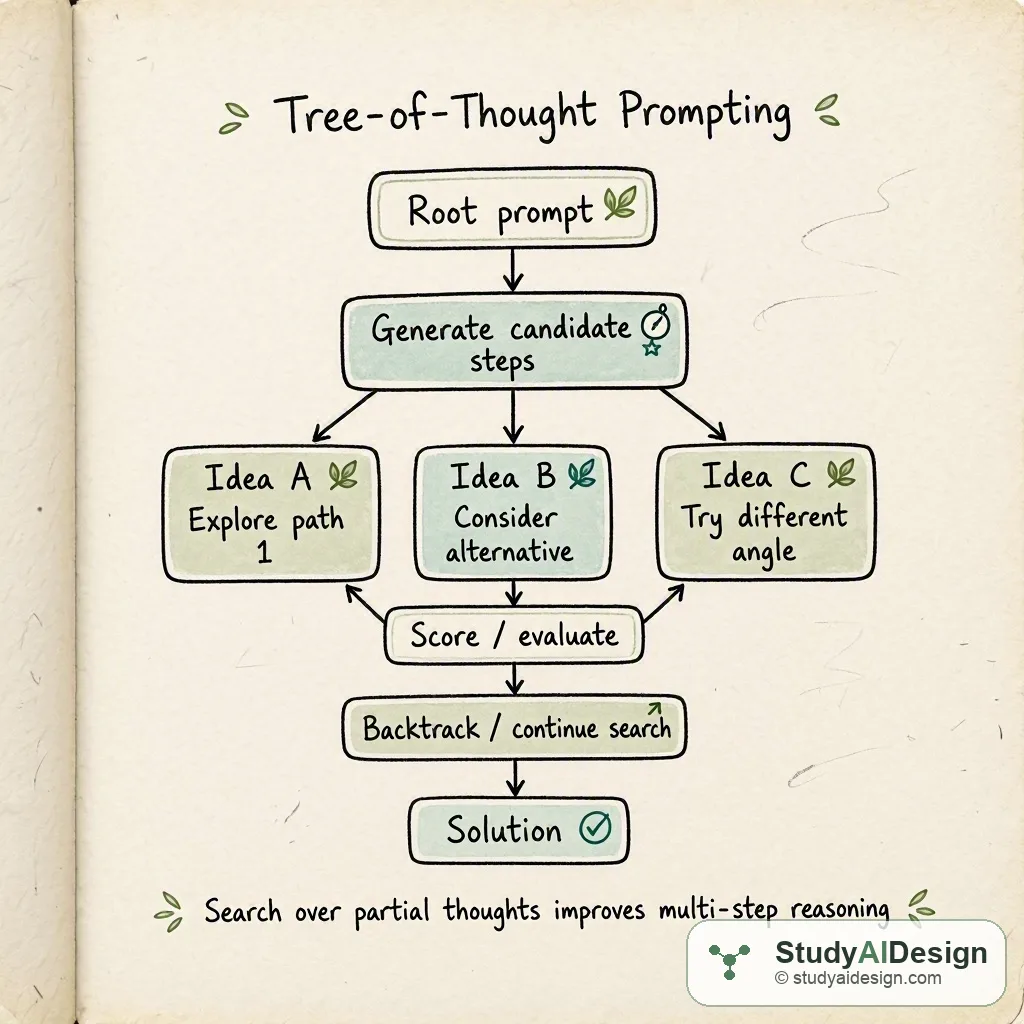
Tree-of-thought prompting explains a search-based prompting method that expands reasoning into a branching tree of partial solutions. It shows how we ask a model to propose branches, evaluate them, and backtrack so it can solve multi-step logical, mathematical, or planning problems more reliably than a single chain-of-thought.
TL;DR
- Tree-of-thought prompting expands reasoning into a search tree of partial steps rather than a single linear chain.
- We ask the model to propose branches, evaluate candidates, and backtrack, so it can explore multiple solution paths.
- This method improves success on multi-step puzzles, planning, and hard logic where one-pass chain-of-thought gets stuck. Key tradeoffs: more compute, more prompt engineering, and potential for noisy branches.
In this question, we will learn what tree-of-thought prompting is and why it helps with hard multi-step problems. We will keep examples concrete so you can explain the approach clearly in an interview.
We will cover the following:
- The intuition
- How it actually works
- Practical patterns
- Tradeoffs and failure modes
- Questions the interviewer might ask
- What the interviewer is really testing
Direct answer: Tree-of-thought prompting is a prompting strategy that turns reasoning into an explicit search over partial thoughts by asking the model to generate candidate next steps, evaluate or score them, and continue exploration along promising branches, including backtracking when needed. It improves reliability on multi-step reasoning by exposing alternative lines of thought and by using evaluation to prune poor branches, at the cost of extra rounds of model calls and prompt engineering.
The intuition (an analogy that makes it click)
Think of solving a maze. Chain-of-thought is like walking forward while narrating your steps; if you hit a dead end you may not remember all the choices you skipped. Tree-of-thought is like exploring branches systematically: you step into one corridor, mark how promising it looks, back up, try another corridor, and keep the best partial routes. That explicit branching and evaluation lets you recover from local dead ends and combine partial discoveries into a complete solution.
How it actually works (the real mechanics, with one concrete worked example)
At its core the method alternates three operations: expansion, evaluation, and selection. Expansion asks the model to propose candidate continuations from a partial state. Evaluation asks the model or an external function to score those continuations. Selection chooses which branches to continue, prune, or backtrack from.
Concrete toy example: reach the target number 11 starting from 1 using two allowed moves: add 3 or multiply by 2, with a maximum of 4 steps. We treat each partial result as a node.
Start node: 1
Expansion level 1 proposes: 1+3=4, 1*2=2
Expansion level 2 from 4: 4+3=7, 42=8; from 2: 2+3=5, 22=4
We can evaluate nodes by a simple heuristic: distance to target absolute difference |node - 11|. We prefer nodes with lower distance.
Table of nodes after expansion to depth 2 and their heuristic scores:
| Node | Path | Heuristic |
|---|---|---|
| 7 | 1 -> 4 -> 7 | $ |
| 8 | 1 -> 4 -> 8 | $ |
| 5 | 1 -> 2 -> 5 | $ |
| 4 | 1 -> 2 -> 4 | $ |
A beam-style selection with width 2 keeps nodes 8 and 7. Continue expansion from those, and you may reach 11 in depth 3: from 8, 8+3=11. The system returns the path 1 -> 4 -> 8 -> 11.
Computationally, if is the branching factor and is the search depth, the naive node count is
Tree-of-thought reduces wasted exploration by scoring and pruning, similar to classic search algorithms.
Practical patterns
- Depth-first with backtracking: expand one branch deeply, evaluate, and back up when it fails. Useful when solutions are long but narrow.
- Beam search: keep the top candidate partial thoughts at each depth to limit compute. Beam width is a key hyperparameter.
- Best-first / heuristic search: use a heuristic score to guide expansion, similar to A-star when you can estimate distance to goal.
- Self-evaluation: ask the model to rate its own partial thoughts or to generate criticisms; combine this with external validators when possible.
Comparison table: breadth-first vs beam vs depth-first for a fixed budget
| Strategy | Memory | Exploration style | When to use |
|---|---|---|---|
| Breadth-first | High | Wide, finds shortest depth | Short solutions, small branching |
| Beam () | Medium () | Keeps top promising paths | Constrained compute, need diversity |
| Depth-first | Low | Deep, may miss shallow solutions | Long solutions, low branching |
Implementation tips and prompt patterns
- Prompt to generate candidates: frame a partial state and ask for N distinct next steps, each as a short thought. Example: "List three plausible next steps and the new partial state." Keep answers structured.
- Prompt to evaluate: ask for a score, probability, or short rationale for each candidate. Use numeric scores when you will sort candidates automatically.
- Combine model-based evaluation with cheap heuristics: a small heuristic function can cut many bad branches before expensive evaluations.
- Log and limit branch size: cap total nodes to stay within latency and budget constraints.
Tradeoffs and failure modes
Tree-of-thought increases search power but comes with costs. It requires multiple model calls, more careful prompt design, and a robust evaluation signal. Poor evaluation leads to wasted exploration, and models can produce plausible but incorrect evaluations or fabricated justifications.
Common failure modes:
- Evaluation hallucination: the model rates incorrect partials highly because of surface fluency.
- Combinatorial blowup: branching factor times depth can exceed budget without aggressive pruning.
- Overfitting prompts: a search tuned to one problem type may not generalize.
Questions the interviewer might ask
Some follow-up questions you might get:
How is tree-of-thought different from chain-of-thought? Chain-of-thought produces a single linear explanation. Tree-of-thought explicitly explores multiple partial explanations in parallel or in sequence and uses selection and backtracking to find a solution.
How do you choose the branching factor or beam width? Pick based on available compute and problem difficulty. Start small (2 to 5) and increase until marginal gains stop justifying cost. Use validation problems to tune.
What evaluation signals can you use? You can ask the model for a score or confidence, use heuristic distance functions, or run external verifiers or small unit-tests for substeps.
When should you avoid tree-of-thought? If the problem is short and straightforward, tree search wastes time. Also avoid it when you cannot design any reliable evaluator for partial states.
Can tree-of-thought be combined with fine-tuning? Yes. You can fine-tune a model to produce better candidate expansions or to evaluate partials more reliably, which reduces hallucination in the evaluation step.
Some things to note:
- Always validate critical steps with deterministic checks when possible.
- Budget and latency constraints often determine the practical beam width and depth.
What the interviewer is really testing
They want to see that you understand structured multi-step reasoning, can map prompting to classical search concepts, and recognize practical limits like evaluation reliability and compute. Show that you can design a simple workflow: generate candidates, score them, and control search budget, and that you can argue about tradeoffs and validation strategies.
Further reading in the curriculum
Go deeper on the fundamentals behind this question.
- Prompting and Context Engineering How to structure prompts and fill the context window so models produce reliable, grounded, and cost-efficient outputs.
Related questions
How would you rate the quality of this article?
Prepare for your AI engineering interview
This is one of many detailed questions and explainers on StudyAIDesign. Browse the full set, work through the curriculum, and walk into your interview ready.