What is QLoRA, and how does it enable fine-tuning on consumer hardware?
QLoRA enables fine-tuning large language models on consumer hardware by combining 4-bit quantization with low rank adapters and memory efficient optimizers. QLoRA reduces the memory footprint by quantizing model weights to 4 bits while keeping low rank parameter updates in higher precision so you can fine-tune models on a single GPU.
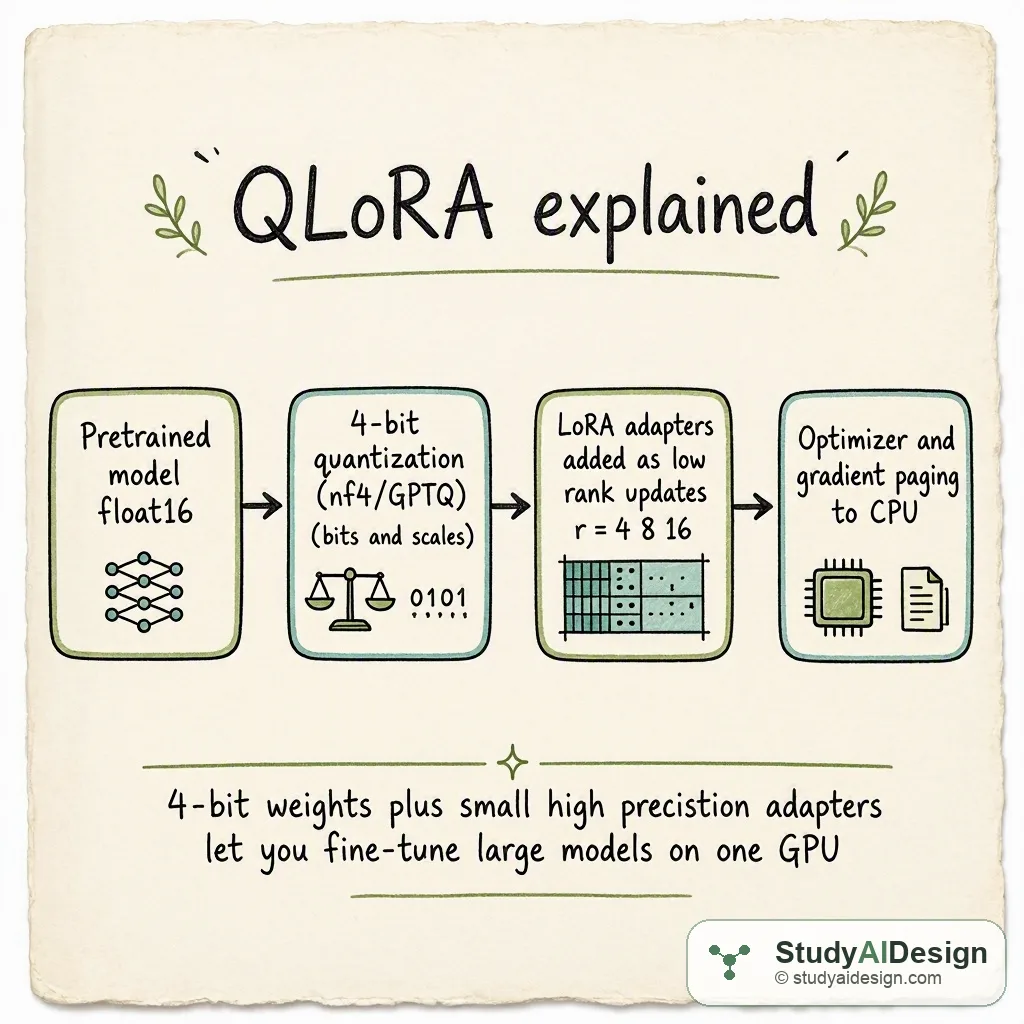
TL;DR
- QLoRA is a recipe that lets you fine-tune large language models on a single consumer GPU by combining 4-bit quantization with LoRA low rank adapters and memory aware optimizers.
- The model weights are stored in 4 bits, adapters store the trainable deltas in higher precision, and optimizer state is paged to the CPU when needed.
- This reduces GPU memory use by several times at the cost of modest quantization error and some extra implementation complexity. Key tradeoffs: lower memory and cost versus small accuracy changes and more careful calibration of quantization and training settings.
In this question, we will learn what QLoRA is, why it saves so much memory, and how it makes fine-tuning feasible on consumer GPUs. We keep it practical so you can explain tradeoffs and walk through a simple memory calculation.
We will cover the following:
- What QLoRA is, in plain terms
- The intuition that makes it work
- How it actually works, with a concrete example and a comparison table
- When to use QLoRA and common implementation details
- Tradeoffs and failure modes
Direct answer: QLoRA is a memory efficient fine-tuning recipe that stores base model weights in 4-bit quantized format while training only small low rank adapter matrices in higher precision, and uses paged or CPU-backed optimizers to keep optimizer memory off the GPU. This enables training large models on single consumer GPUs by dramatically reducing GPU memory needs while retaining most of the original model quality. It requires careful quantization, a sensible LoRA rank, and sometimes tuning to avoid small accuracy regressions.
The intuition (an analogy that makes it click)
Imagine the full pretrained model weights as a large hardcover textbook. Carrying that whole book on your lap is heavy. QLoRA says: compress the book into a very dense pocket edition that keeps the content but uses much less space, and then carry a small notebook with the notes and corrections you actually write while studying. The compressed book is the 4-bit quantized weights. The notebook is the small LoRA low rank updates in higher precision. The heavy backpack of optimizer states is left at your desk, paged to CPU. You can study and make edits with little memory on your lap.
How it actually works (the real mechanics, with one concrete worked example)
QLoRA is three ideas working together:
- Quantize pretrained weights to a high quality 4-bit format that preserves signal, often using a scheme like nf4 or GPTQ style quantization. This stores each parameter in 4 bits plus a per-block scale and offset.
- Keep the pretrained weights frozen and inject trainable LoRA adapters. A LoRA adapter replaces weight updates with low rank matrices A and B so you only learn 2rd parameters per adapted matrix where r is small. Those adapter parameters stay in higher precision, typically float32 or float16.
- Use optimizers that do not require full optimizer state on GPU, or page optimizer state to CPU, so memory heavy states like Adam moments do not consume GPU RAM.
Concrete example comparing approximate GPU memory footprint for a single forward pass and storing model weights only. We show rough numbers to illustrate the scale of savings.
| Setup | Parameters | Storage per param | Model weights on GPU |
|---|---|---|---|
| Float16 baseline | 13 billion | bytes | 26 GB |
| QLoRA 4-bit weights | 13 billion | bytes | 6.5 GB |
| LoRA adapters added | roughly 13 million additional params | bytes | 52 MB |
We arrived at these numbers with simple arithmetic. For parameters stored as bits, memory in bytes is . For a 13B model, float16 is bytes about 26 GB. A 4-bit representation uses bytes per parameter, so about 6.5 GB. LoRA adapter parameters are tiny relative to the full model; a realistic LoRA rank like or produces on the order of millions of extra parameters, not billions, so their storage is tens of megabytes.
The optimizer memory depends on algorithm. Adam keeps two moments per parameter if kept on GPU. Paging these to CPU or using 8-bit optimizers can avoid keeping that on GPU, which is essential when you have millions of trainable adapter parameters and want to fit everything on a single 24 GB GPU.
When to use QLoRA and implementation notes
When to use it:
- You have a large pretrained model that you want to adapt for a task and you only have one or a few consumer GPUs with 24 GB or less.
- You want rapid iteration without renting multi GPU clusters.
Implementation notes:
- Use a high quality quantization format, for example nf4 or GPTQ derived blocks, because naive 4-bit quantization hurts model quality.
- Freeze the quantized base model and add LoRA modules to the attention and feedforward weight projections most likely to benefit from tuning.
- Page optimizer state to CPU or use optimizer implementations that keep minimal GPU state. The bitsandbytes library is commonly used because it supports 4-bit weight kernels and optimizers that are GPU memory efficient.
Tradeoffs and failure modes
QLoRA reduces GPU memory dramatically but it is not free. The main tradeoffs are:
- Slight accuracy or convergence differences compared to full precision fine-tuning because quantization introduces approximation error.
- Extra engineering complexity to choose quantization blocks, adapter ranks, and paging strategies.
Questions the interviewer might ask
Some follow-up questions you might get: Why not just quantize and fine-tune all weights in 4-bit? You could, but training gradients and optimizer state become problematic in 4-bit. QLoRA avoids that by freezing quantized weights and training a small set of high precision parameters, which is more stable. How does LoRA change the parameter count and compute? LoRA replaces dense updates with low rank updates. It adds roughly parameters per adapted matrix, which is small for modest . Compute overhead for the forward pass is small relative to the base model. What is nf4 and why is it used? nf4 is a 4-bit quantization type tuned for LLM distributions that uses non uniform scaling to reduce quantization error. It often preserves model accuracy better than plain 4-bit linear quantization. How do you pick the LoRA rank r? Start with small ranks like or and validate. Higher r increases capacity and memory linearly, and may be needed for complex tasks. How do you handle optimizer hyperparameters and learning rates? Treat LoRA parameters like a small new head. Use conservative learning rates, warmup, and validation. Adam-style optimizers on adapter weights are common. Can QLoRA be used for inference-time quantization? QLoRA is a fine-tuning recipe. The base quantized weights can serve for inference, but inference quantization is a separate concern about kernel support and accuracy.
Some things to note:
- Test quantization quality on downstream tasks, not just perplexity.
- Keep a float copy of a few checkpoints early until you are confident in the setup.
What the interviewer is really testing
They want to see that you understand memory and compute tradeoffs when fine-tuning large models. Explain the interaction between weight quantization, low rank parameter efficiency, and optimizer state. Show you can do back of the envelope memory math and propose practical mitigation strategies for accuracy and speed.
Further reading in the curriculum
Go deeper on the fundamentals behind this question.
- Fine-Tuning and Adaptation How to adapt pretrained language models to specific tasks using full fine-tuning, LoRA, instruction tuning, and preference alignment, and when each approach is the right tool.
Related questions
How would you rate the quality of this article?
Prepare for your AI engineering interview
This is one of many detailed questions and explainers on StudyAIDesign. Browse the full set, work through the curriculum, and walk into your interview ready.