What is LoRA (Low-Rank Adaptation), and how does it work?
LoRA (Low-Rank Adaptation) explains a parameter-efficient fine-tuning method that adds small low-rank update matrices to frozen model layers. The description shows how LoRA represents updates as a product of two small matrices, how that reduces stored parameters and GPU memory, and the tradeoffs when choosing the rank.
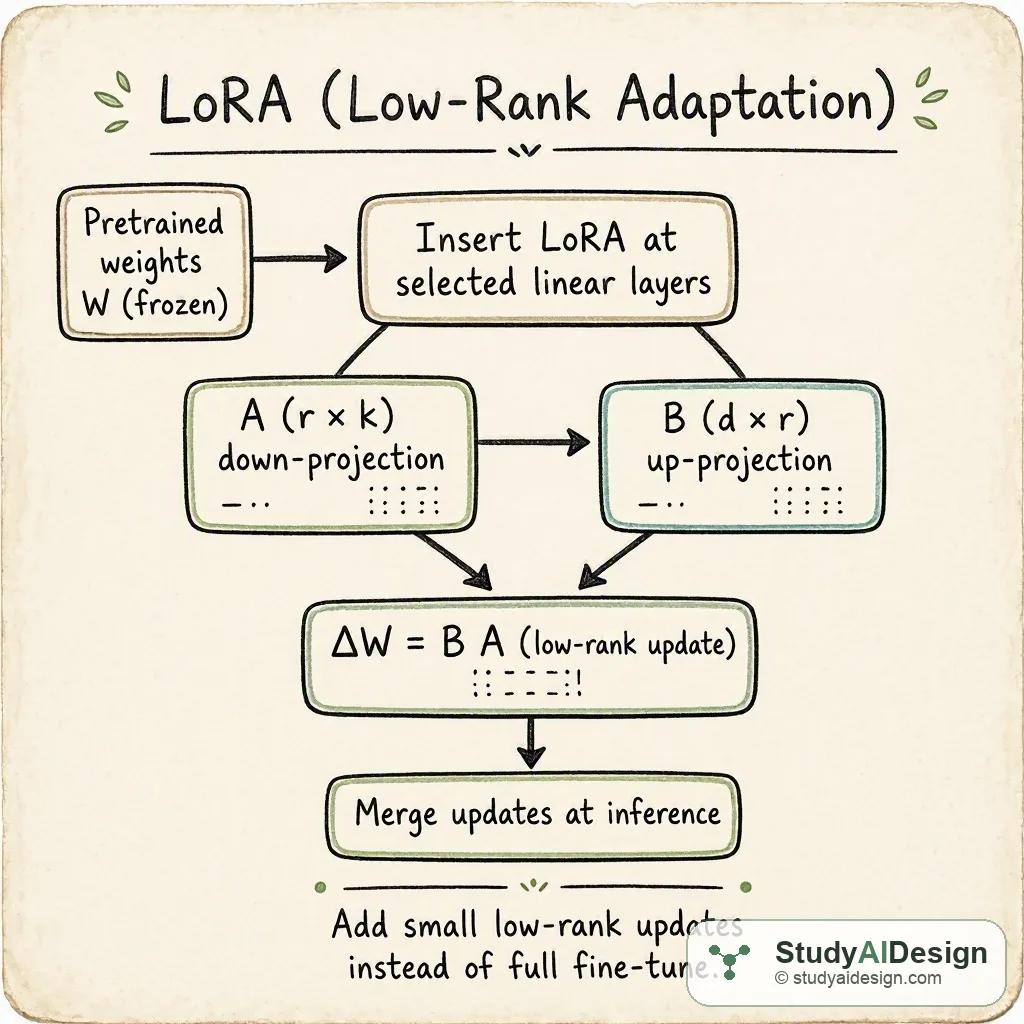
TL;DR
- LoRA (Low-Rank Adaptation) adds small, trainable low-rank matrices to frozen model weights so you fine-tune with far fewer parameters.
- It models the weight update as a product of two small matrices and , often scaled by a factor , so and you store only numbers instead of .
- You keep the base model frozen, reduce GPU memory during training, and merge updates into weights for cheap inference. Key tradeoffs: choose rank to balance adaptivity versus parameter cost, and pick which layers to adapt based on task sensitivity.
In this question, we will learn what LoRA is, why it is parameter efficient, and how to reason about rank and placement when fine-tuning real models.
We will cover the following:
- The intuition
- How it actually works
- Where and when to apply LoRA
- Tradeoffs and failure modes
- Questions the interviewer might ask
- What the interviewer is really testing
LoRA (Low-Rank Adaptation) is a method that keeps the pretrained model weights frozen and instead learns a low-rank additive update represented as . It reduces the number of trainable parameters dramatically and can be merged into weights at inference, but the rank and which layers to adapt control performance.
The intuition (an analogy that makes it click)
Think of a large weight matrix as a complex machine with many knobs already tuned by pretraining. Full fine-tuning turns many of those knobs, which needs time and storage. LoRA instead adds a small sub-board of adjustable dials that can steer the machine in new directions without rewiring the whole thing. If the new task needs only a few directions of change, a low-rank board covers them and saves effort.
How it actually works (the real mechanics, with one concrete worked example)
We target a linear layer with weight . LoRA freezes and parameterizes the update as a product of two smaller matrices
with and . Often training uses a scaling factor and applies
This reduces the number of extra parameters from to . For a concrete example, consider adapting a projection with and .
| Item | Parameter count |
|---|---|
| Full weight | |
| LoRA with | |
| Compression factor |
Training only and cuts memory for gradient storage and checkpoints. Typical practice: initialize from a small random distribution and to zeros so the model starts at pretrained behavior. You can insert LoRA into query, key, value, or feed-forward projections depending on the task.
Where and when to apply LoRA
LoRA shines when tasks can be expressed as low-dimensional changes to representations. Good use cases include domain adaptation, instruction tuning, and adding modalities where pretrained features are largely useful.
Compare common choices:
| Layer to adapt | When to choose |
|---|---|
| Attention projections (Q,K,V) | If the task needs new attention patterns or instructions |
| Output projections or FFN | If the task needs new token-level transformations |
| Many shallow layers | If broad but small changes are needed |
Pick small for constrained tasks like style transfer or instruction-following, and larger if the task requires richer changes. You can also combine small across many layers rather than one big at a single layer.
Tradeoffs and failure modes
LoRA reduces storage and training cost, and you usually get similar or better sample efficiency compared to full fine-tuning. But there are limits.
If the task requires changing many independent directions of the weight matrix, a very small rank will underfit and degrade performance. Other failure modes include choosing too large a learning rate for the adapter parameters, which can destabilize training, and poor placement of adapters in layers that do not control the needed behavior.
Other tradeoffs:
- Inference cost is usually unchanged when you merge into , but if you keep adapters separate for modularity, extra matmuls apply.
- LoRA assumes updates are approximately low rank. For tasks that need full-rank reconfiguration, full fine-tuning or other adapter types may be necessary.
Questions the interviewer might ask
Some follow-up questions you might get:
How do you choose the rank r? Start small, for example or , and increase until validation stops improving. Consider the target task complexity and available memory.
Why freeze the base weights instead of updating all of them? Freezing reduces gradient memory and avoids catastrophic overwriting of pretrained knowledge. It also lets multiple adapter sets be stored and swapped cheaply.
What is the role of the scaling factor alpha? The factor scales the adapter output to control effective magnitude relative to . It stabilizes training and acts like a learning-rate adjusment for the update.
Can LoRA be combined with other adapters or prompt tuning? Yes. People commonly stack LoRA with prompt tuning or small task-specific layers to get complementary benefits.
How do you deploy LoRA-updated models for inference? You can merge into by adding them and save the merged weights, which yields identical inference cost to the original model.
When would you avoid LoRA? If the task clearly needs large, diverse parameter changes across many dimensions, or if you need to modify low-level embedding tables, LoRA may be insufficient.
Some things to note:
- Initialization of to zeros often preserves pretrained behavior early in training.
- LoRA works well with mixed precision and gradient checkpointing because only adapter gradients need storage.
What the interviewer is really testing
They want to see that you understand parameter-efficient adaptation, the math behind low-rank updates, and practical considerations like where to insert adapters, how to pick rank, and how to deploy. Demonstrate you can reason about memory and compute tradeoffs with numbers and that you know common failure modes and mitigations.
Further reading in the curriculum
Go deeper on the fundamentals behind this question.
- How LLMs Actually Work A ground-up tour of tokens, embeddings, attention, and why transformers scale.
- Fine-Tuning and Adaptation How to adapt pretrained language models to specific tasks using full fine-tuning, LoRA, instruction tuning, and preference alignment, and when each approach is the right tool.
Related questions
How would you rate the quality of this article?
Prepare for your AI engineering interview
This is one of many detailed questions and explainers on StudyAIDesign. Browse the full set, work through the curriculum, and walk into your interview ready.