How do you design for latency vs quality trade-offs in AI systems?
How do you design for latency vs quality trade-offs in AI systems? This question asks how you balance model accuracy, response time, batching, and infrastructure to meet latency budgets. It covers measurement, architecture patterns, and practical knobs to tune in production AI services.
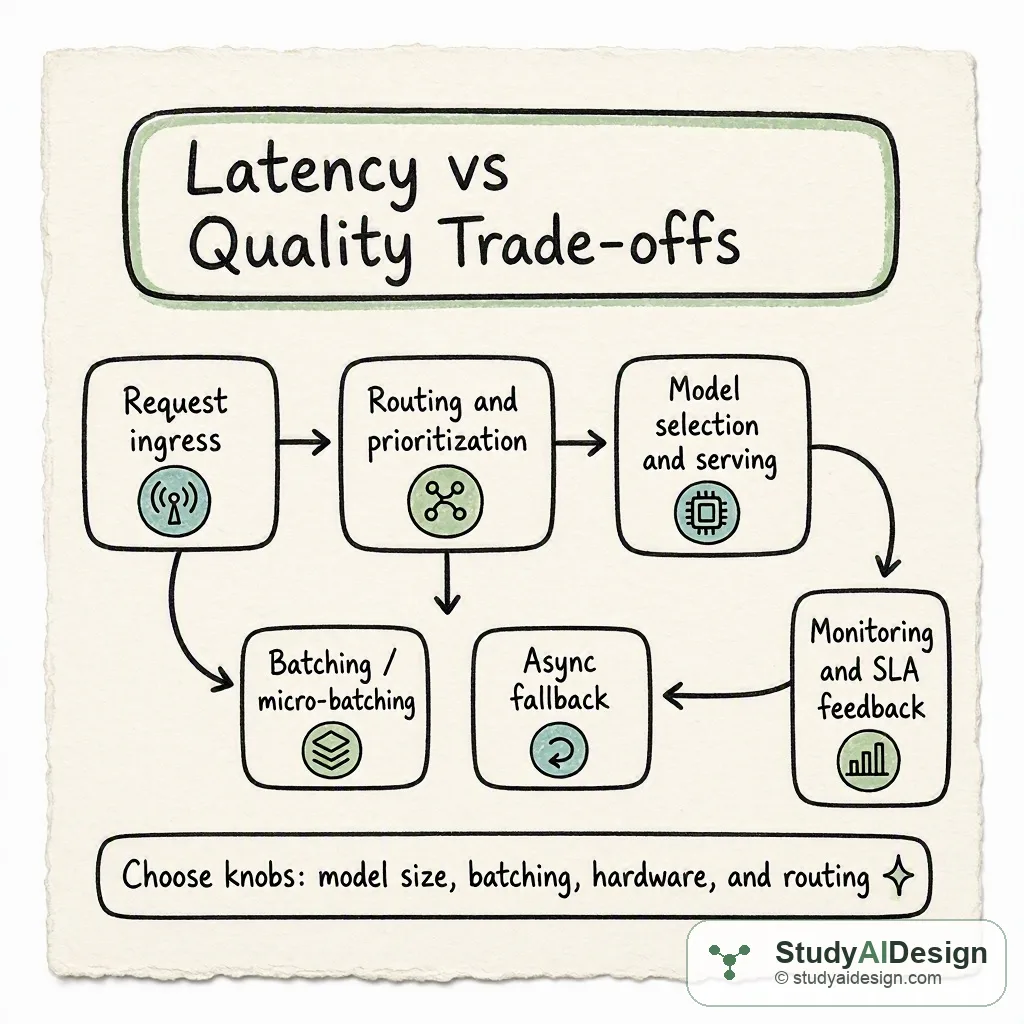
TL;DR
- Identify and measure your latency budget end to end, including network, queuing, and model compute.
- Use model selection, adaptive routing, and graceful fallbacks to trade quality for lower latency when needed.
- Tune batching, concurrency and hardware, and add observability to keep tail latency in check. Key tradeoffs: latency vs quality, throughput vs cost, deterministic latency vs peak efficiency.
In this question, we will learn how to design systems that balance latency against model quality so you can meet service level objectives while keeping predictions useful. We will treat latency as an engineering budget to spend across components and quality as the variable you can trade for faster responses.
We will cover the following:
- The intuition
- How it actually works
- Design patterns and knobs
- Tradeoffs and failure modes
- Questions the interviewer might ask
- What the interviewer is really testing
Direct answer: measure latency components, set an end-to-end budget, and apply staged techniques: faster smaller models, adaptive routing, early-exit or cascading classifiers, batching with latency-aware timers, and hardware scaling, instrumenting everything for feedback. Use fallbacks and SLO-driven routing to protect tail latency while preserving quality for tolerant requests.
The intuition (an analogy that makes it click)
Think of serving a prediction as sending a document through a postal system. The total time includes sorting, transit, and final delivery. We can speed delivery by using express lanes at higher cost, sending a shorter summary, or replying with a quick postcard and offering a detailed letter later. In the same way, we can use smaller faster models, route urgent queries to low-latency paths, or return a quick approximate result and compute a higher-quality result asynchronously.
How it actually works (the real mechanics, with a worked example)
Break latency into measurable pieces. Let total latency be . We model it as the sum of components: network, ingress, queuing, model compute, and postprocessing.
Queueing can dominate tail latency under load. For a simple single-server queue with service rate and arrival rate under light assumptions, average wait scales as
so as load approaches capacity, latency explodes. That motivates elastic capacity and backpressure.
Worked example: target 200 millisecond 95th percentile for an image classification API. Measure median components: client to edge 20 ms, edge processing 5 ms, model compute 100 ms, postprocessing 10 ms. We have a 65 ms headroom for queuing and variability. If traffic spikes, must stay below 65 ms. Options:
| Option | Effect on | Effect on quality | Cost |
|---|---|---|---|
| Reduce model to smaller architecture | decreases to 40 ms | quality drop | low cost |
| Enable micro-batching with 2 items | increases batch wait by ~1/(2*arrival_rate) but halves compute per item | small quality change | efficient hardware use |
| Route high-priority traffic to GPU nodes | reduces and | same quality | higher cost |
For example, switching to a smaller model bringing to 40 ms yields new total median 20+5+40+10=75 ms, plenty of headroom. If we need higher quality for a subset, route those to the larger model with admission control.
Design patterns and knobs
- Model cascades and early exit
Use a fast lightweight classifier to handle easy cases, reserve the heavyweight model for hard ones. That gives average low latency while retaining high quality on ambiguous inputs. Implement a confidence threshold so that if the cheap model's confidence is above , you return immediately.
- Adaptive routing and SLO-driven admission
Route requests based on priority and estimated cost. Keep a low-latency pool with reserved capacity for high-priority traffic. Use admission control to reject or queue low-priority traffic when load is high.
- Batching with latency-aware timers
Batching improves throughput but adds waiting latency. Use dynamic timers: close a batch when it reaches a size cap or after a maximum wait . Choose to meet percentile SLOs. The per-request added wait for a batch of expected size with arrival rate is about .
- Model quantization and distillation
Quantize weights or use distilled models to reduce . Distillation can preserve much of quality while reducing compute. Test on your data to know the real quality loss.
- Hardware and placement
Use GPUs, TPUs, or inference accelerators to reduce . Co-locate model shards near edge nodes to reduce . Each option increases cost, so balance against SLOs.
When to apply each pattern
- Use cascades when input difficulty varies and you can cheaply estimate confidence. This lowers average latency without sacrificing worst-case quality for hard requests.
- Use batching for high throughput steady traffic where slightly increased median latency is acceptable and SLOs allow per-request waits.
- Use dedicated low-latency pools for tail-critical traffic such as interactive UIs or voice assistants.
Tradeoffs and failure modes
The main tradeoffs are latency versus average quality, operational cost, and predictability. Aggressive batching or autoscaling delays can improve cost but risk tail latency spikes. Cascades can misclassify low-confidence hard cases if thresholds are poorly tuned.
Questions the interviewer might ask
Some follow-up questions you might get:
How do you pick a confidence threshold for a cascade? Use calibration on a validation set to map raw scores to expected error rates. Choose a threshold that balances the fraction of requests handled by the cheap model against the target end-to-end error.
How do you set batching timeouts in practice? Simulate traffic at realistic arrival rates and optimize the timer to satisfy your latency percentile SLO while maximizing throughput. Use adaptive timers that change with current arrival rate.
How do you measure the real cost of switching to a smaller model? Run A B tests measuring downstream user metrics and offline evaluation on representative data. Measure both accuracy and impact on business metrics.
What metrics do you track to detect latency regressions? Track P50, P95, P99, mean, error rates, queue lengths, CPU/GPU utilization, and tail latencies per component. Correlate with traffic type and model version.
When would you prefer asynchronous responses? When users accept eventual results, for high-latency tasks like large batch processing. Use asynchronous patterns when strict real-time response is not required.
Some things to note:
- Measure before optimizing: blind changes can harm quality more than they help latency.
- Tail percentiles and workload shape matter more than medians.
What the interviewer is really testing
They want to see practical tradeoff reasoning, the ability to break down end-to-end latency into components, and familiarity with concrete techniques like cascades, batching, quantization, and routing. They also want to confirm you will instrument and test changes, consider tail behavior, and balance cost against SLOs in real systems.
Related questions
How would you rate the quality of this article?
Prepare for your AI engineering interview
This is one of many detailed questions and explainers on StudyAIDesign. Browse the full set, work through the curriculum, and walk into your interview ready.