What are the key components of a RAG pipeline?
RAG pipeline key components: retriever, vector store, encoder, reranker, and generator and how they fit together. Learn what each piece does, a worked similarity example, common tradeoffs and what interviewers expect.
TL;DR
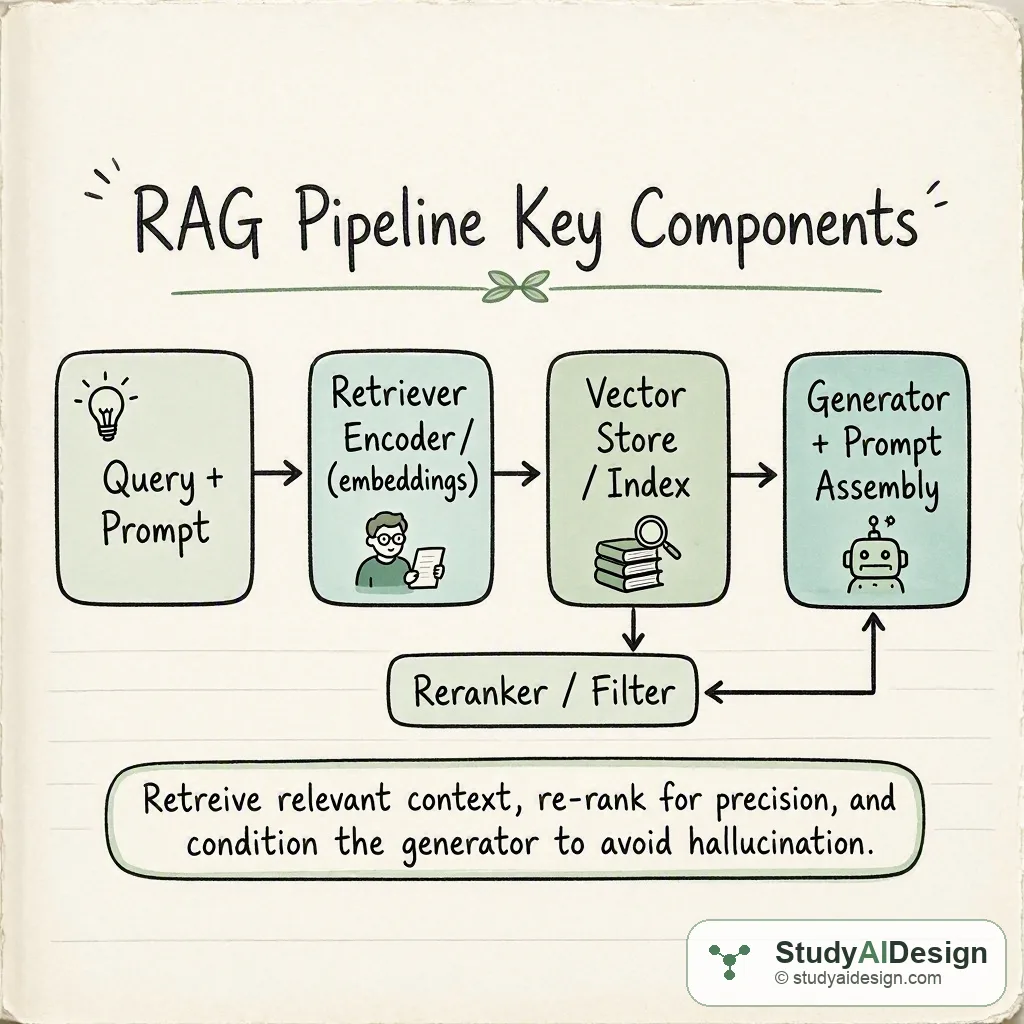
- RAG pipeline key components are the query and prompt assembly, encoder/retriever, vector store or index, optional reranker and filter, and the generator that produces the final output.
- The retriever finds candidate passages using embeddings and similarity scoring, the reranker improves precision for the generator, and prompt design decides what context the generator sees.
- Important knobs are embedding quality, top-k sizes, chunking strategy, freshness of the index, and latency versus accuracy tradeoffs.
Key tradeoffs: precision versus recall, latency versus context size, and update cost versus indexing complexity.
In this question, we will learn what the key components of a RAG pipeline are and how they work together to produce grounded answers. We will walk through the pieces, a concrete similarity example, and the operational tradeoffs you need to defend in an interview.
We will cover the following:
- Components overview
- The intuition
- How it actually works: a concrete similarity example
- Retrieval vs reranking and generator conditioning
- Tradeoffs and failure modes
- Questions the interviewer might ask
Direct answer: A RAG pipeline is composed of a query and prompt assembly layer, an encoder and retriever that produce and search embeddings, a vector store or index, an optional reranker and filter stage, and a conditional generator that uses retrieved context to produce the final answer. These components must be tuned together: embedding model and chunking affect recall, top-k and reranker affect precision, and prompt strategy plus context window determine the generator output and latency.
The intuition (an analogy that makes it click)
Think of RAG as asking a well-organized librarian for supporting documents before writing a short essay. You give the librarian a question and some instructions. The librarian quickly scans an indexed shelf of summarized cards, hands you the most relevant cards, a second reader double-checks the top cards for accuracy, and then you use those cards to write the essay. Each step reduces the chance the essay invents facts and speeds up finding the right references.
How it actually works (the real mechanics, with a worked example)
High level components and roles:
- Query and prompt assembly: prepares the natural language query and any system prompt that will guide the generator.
- Encoder / embeddings: converts documents and the query into vectors in a shared space with dimension .
- Vector store / index: holds vectors and supports nearest neighbor search, often approximate for speed.
- Reranker / filter: optional model that takes candidate passages and scores them for relevance or factuality.
- Generator: a conditional language model that receives the prompt plus retrieved context and returns the final text.
Worked similarity example. Suppose we have three candidate passages embedded as vectors and a query embedding. We compute cosine similarity as the similarity metric.
The cosine similarity formula is
Example embeddings (small synthetic numbers, dim ):
| Passage | Embedding | Query embedding | Cosine score |
|---|---|---|---|
| A | [0.9, 0.1, 0.0] | [0.8, 0.2, 0.0] | 0.99 |
| B | [0.1, 0.9, 0.0] | [0.8, 0.2, 0.0] | 0.30 |
| C | [0.0, 0.1, 0.9] | [0.8, 0.2, 0.0] | 0.22 |
We would retrieve top-1 or top-3 depending on recall needs. In this toy example passage A is clearly most similar and gets returned to the generator. In practice embeddings are higher dimensional and scores less extreme, so we tune top-k and reranker.
Reranker example: after retrieving top-10 by vector similarity we apply a cross-encoder that scores passage-query pairs for fine-grained relevance. We then return top-3 after reranking. That reduces noise sent to the generator and reduces hallucination risk.
Retrieval versus reranking and generator conditioning
Retrieval strategy choices:
| Option | Strengths | Weaknesses |
|---|---|---|
| Sparse (BM25) | Fast, simple, interpretable | Poor semantic matching for paraphrase |
| Dense (embeddings + ANN) | Good semantic match, robust to paraphrase | Needs embedding models, more storage and indexing complexity |
Typical pipeline sizes and knobs:
- Index all documents in chunks sized by tokens or sentences. Chunk size matters because small chunks may lose context and large chunks may exceed prompt budgets.
- Choose top-k retrieval, commonly depending on generator context window and desired recall.
- Optionally rerank top- candidates with a cross-encoder and keep top- for the generator where .
- Construct final prompt by concatenating the top passages and a concise instruction. Prefer numbered citations or metadata to allow traceability.
Operational considerations
Freshness and updates: updating a vector store requires re-embedding affected documents or using incremental indexing. If your use case needs low-latency updates, design for partial reindexing or use append-only strategies with periodic rebuilds.
Latency versus accuracy: approximate nearest neighbor search like HNSW gives low latency at some recall cost. Reranking increases accuracy but adds compute. Choose based on SLOs.
Cost and scale: large corpora and high-dimensional embeddings increase storage and memory. Compression, product quantization, or hybrid sparse+dense pipelines help reduce cost.
Tradeoffs and failure modes
Common failure modes:
- Poor chunking leads to partial facts returned out of context.
- Outdated index causes stale answers for time-sensitive queries.
- Overly large context causes the model to ignore the highest-quality passages.
Mitigations include better chunking strategies, expiration and metadata for freshness, and careful top-k and rerank tuning.
Questions the interviewer might ask
Some follow-up questions you might get:
Why use both dense retrieval and a reranker? Dense retrieval is efficient for recall at scale but can return noisy candidates. A reranker provides more precise relevance scoring using richer interaction between query and passage.
How do you choose chunk size? Chunk by semantic boundaries when possible. Keep chunks small enough to be precise but large enough to preserve necessary context; typical sizes are a few hundred tokens depending on the task.
How do you prevent hallucinations in RAG? Ensure high-quality retriever recall, use a reranker, include provenance metadata in prompts, and instruct the generator to respond "I do not know" when no evidence is found.
How do you handle updates to the document set? Use incremental re-embedding for new or changed documents, keep timestamps and selective reindexing, and consider a short-lived cache for recent docs.
When would you use BM25 instead of embeddings? Use BM25 when computational resources are limited, or when queries rely heavily on keyword matching and exact terms, or to combine signals in a hybrid approach.
Some things to note:
- RAG performance is as good as the weakest link: index quality, retrieval recall, and prompt design must be aligned.
- Always include provenance and a clear fallback for missing evidence.
What the interviewer is really testing
They want to see system-level thinking about how retrieval and generation interact, and awareness of practical tradeoffs like latency, freshness, and hallucination risk. They expect you to name the core components and explain tuning levers such as embedding model, top-k, reranking, and prompt construction, and to reason about operational concerns like updates and scaling.
Further reading in the curriculum
Go deeper on the fundamentals behind this question.
- Memory and State How AI systems store, retrieve, and manage information across tiers, from the context window to persistent knowledge stores.
Related questions
How would you rate the quality of this article?
Prepare for your AI engineering interview
This is one of many detailed questions and explainers on StudyAIDesign. Browse the full set, work through the curriculum, and walk into your interview ready.