How do you handle embedding drift when the embedding model is updated?
Embedding drift when the embedding model is updated is about what happens to your vector index and retrieval quality after you change the encoder. This question asks how you would migrate or mitigate drift with minimal downtime and cost while preserving search quality. It focuses on operational strategies and technical tradeoffs.
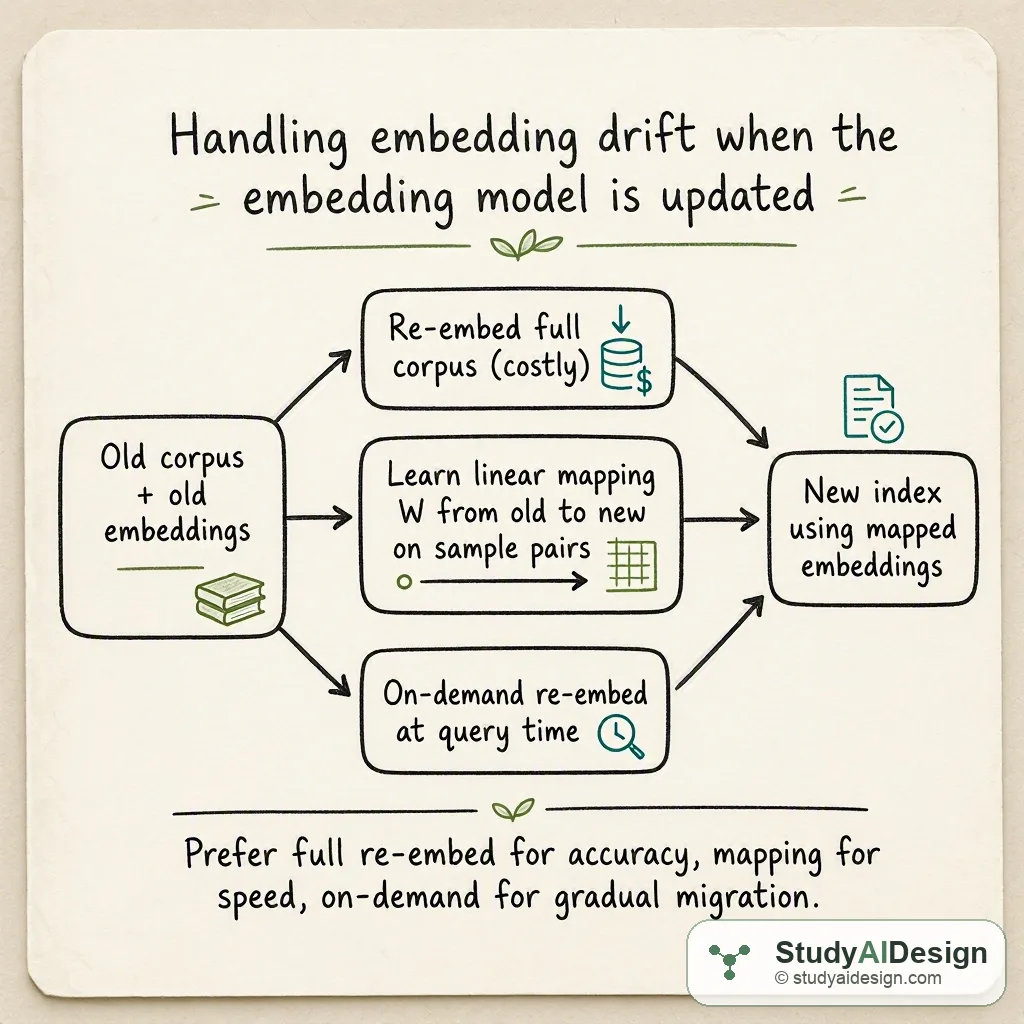
TL;DR
- Embedding drift when the embedding model is updated means stored vectors no longer match the new encoder space, hurting nearest-neighbor retrieval.
- Options: full re-embed, on-demand re-embed, learn a mapping from old to new, or maintain dual-index and route queries.
- Each option trades cost, downtime, and retrieval accuracy; pick based on corpus size, latency tolerance, and availability of a paired sample set. Key tradeoffs: cost and accuracy versus operational complexity and query latency.
In this question, we will learn how to handle embedding drift when the embedding model is updated and keep retrieval accurate with minimal disruption. We will treat the problem as both an engineering migration and a modeling problem so you can explain practical choices in interviews.
We will cover the following:
- TLDR recap and a direct answer
- The intuition
- How it actually works with a concrete worked example
- Practical strategies and comparison table
- Tradeoffs and failure modes
- Questions the interviewer might ask
- What the interviewer is really testing
Direct answer: When the embedding model changes, you either re-embed the corpus, use on-demand re-embedding, learn a mapping from old to new embeddings using a paired sample set, or run dual indexes and route queries. Re-embedding gives the best accuracy but costs time and compute; learned mappings and on-demand strategies reduce cost but can reduce retrieval quality. Choose by weighing corpus size, latency constraints, and available compute.
The intuition (an analogy that makes it click)
Think of embeddings as language-specific labels you hung on every book in a library. If you switch label conventions, the labels no longer guide patrons to the right shelves. You can relabel every book, relabel only when someone asks, or build a converter that translates old labels into the new convention. Each choice changes how quickly people find the right books and how much work your staff needs to do.
How it actually works (the real mechanics, with one concrete worked example)
When you change an embedding model, you alter the vector space geometry. Distances and neighbor relationships change. Suppose the old model produced vectors in dimension and the new model produces . Your stored vectors do not match , so nearest-neighbor queries against using new-query vectors will produce suboptimal results.
Common strategies:
- Full re-embed: run the new encoder on every item and rebuild the index.
- On-demand re-embed: keep , but when a document is retrieved or updated, compute its new embedding and update the index incrementally.
- Learned mapping: train a function such that on a paired dataset of items encoded by both models.
- Dual-index routing: maintain both old and new indexes and route queries to the appropriate index during a transition.
Worked example numbers. Suppose corpus size documents, inference cost per doc 5 ms, and you have 32 CPU/GPU workers. Full re-embed wall time approx ignoring IO. Mapping training uses a sample pairs and takes minutes to hours.
We can compare options using a simple table of practical attributes.
| Strategy | Accuracy | Cost (compute) | Downtime | Latency impact |
|---|---|---|---|---|
| Full re-embed | Highest | High ( encoding) | Possible brief routing pause | None after rebuild |
| On-demand re-embed | Near-high over time | Low amortized | None | Higher for first-time items |
| Learned mapping | Medium-high (approx) | Low (training on sample) | None | Minimal |
| Dual index | High | Very high (double index) | Minimal | More memory / routing overhead |
A learned linear mapping can be trained by minimizing squared error on paired embeddings. Let be old vectors and be new vectors. We can learn solving
This gives a ridge regression solution when and are not too large. In practice a small neural network or PCA-whitening step may help because the embedding distributions can be nonlinearly related.
Practical strategies and a checklist
-
Measure first. Compute retrieval quality before and after on a held-out set of queries to quantify drift. Use metrics like recall@k and mean reciprocal rank.
-
If is small or re-embedding cost is acceptable, do full re-embed and rebuild the index during a maintenance window.
-
For large and strict availability, prefer one of these hybrid patterns:
- On-demand re-embed with background re-indexing: when an item is served, re-embed and write to a new index; run a background job to progressively re-embed old items.
- Learn mapping : gather pairs by sampling items, compute and , train , and transform all quickly to approximate .
- Dual-index with routing: keep both indexes until the new one reaches parity, then switch.
- Validate quality after migration by re-running the held-out test and monitoring production metrics like click-through and downstream model performance.
Tradeoffs and failure modes
- Full re-embed: safest for quality, expensive for compute. You must watch for mismatched tokenizer or preprocessing steps that can silently break results.
- On-demand: low initial cost but long time to reach full coverage; cold items will be served suboptimally until updated.
- Learned mapping: fast and cheap, but can fail if the new model changed semantics nonlinearly or added dimensions that do not align with old ones.
- Dual-index: highest resource cost and added system complexity.
Questions the interviewer might ask
Some follow-up questions you might get:
How do you choose the sample size S for mapping training? Choose large enough to cover the corpus diversity. Start with a few tens of thousands for general text corpora, then increase until validation metrics stabilize.
What metrics do you use to detect embedding drift? Use retrieval metrics like recall@k, precision@k, and mean reciprocal rank on a labeled validation set. Also track cosine distance distributions between queries and top neighbors.
How do you handle dimension mismatch between old and new embeddings? You can learn a rectangular mapping or use PCA/whitening to align principal subspaces. If , map and optionally project or truncate.
When is dual-index worth it? When you need zero-risk rollback capability, you have abundant storage, and you want to A/B test new embeddings in parallel.
How do you keep the index consistent during migration? Write changes to both old and new stores during transition, or use a feature flag and a versioned write path so updates are re-embedded into the new index immediately.
Some things to note:
- Always validate preprocessing parity between models. Tokenization or normalization differences cause subtle drift.
- Monitor both offline metrics and online user signals after migration.
What the interviewer is really testing
They want to see you reason about engineering tradeoffs under constraints: compute cost, latency, availability, and retrieval quality. They are testing that you know practical migration patterns, can quantify costs, and can propose validation and monitoring to detect regressions. A strong answer combines high-level strategy with a concrete example and measurable validation steps.
Related questions
How would you rate the quality of this article?
Prepare for your AI engineering interview
This is one of many detailed questions and explainers on StudyAIDesign. Browse the full set, work through the curriculum, and walk into your interview ready.