What is an agent loop, and how does it decide when to stop?
Agent loop explained: what an agent loop is and how it decides when to stop, covering observation, decision, action, memory updates, and stopping criteria. Learn common termination rules, safety checks, and practical tradeoffs for designing reliable agent loops.
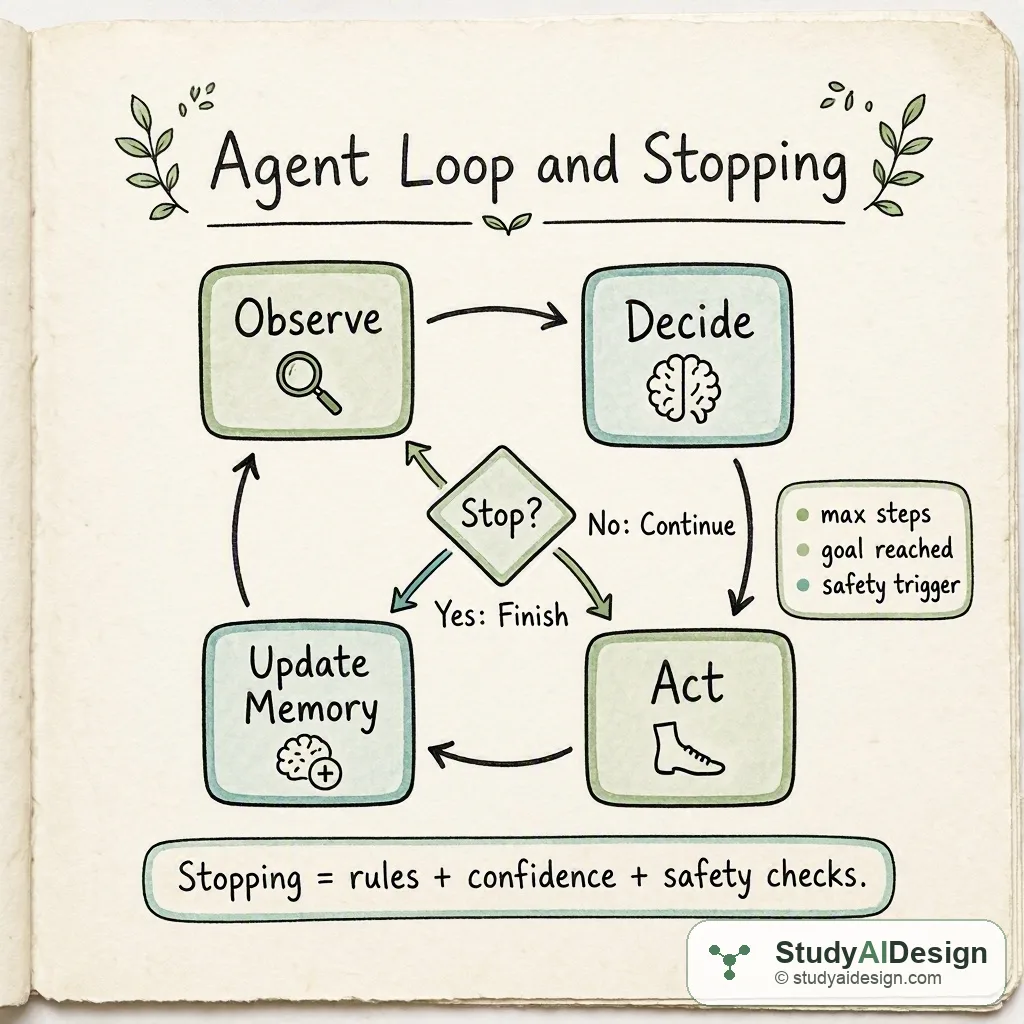
TL;DR
- An agent loop is the repeated cycle Observe -> Decide -> Act -> Update, with a stop check after Decide.
- Stopping can be a hard rule like max steps , a goal condition like reaching a target state, or a probabilistic/confidence threshold on completion.
- Good designs combine strict limits, goal checks, and safety or external-stop signals to avoid infinite or premature stopping. Key tradeoffs: responsiveness versus safety, completeness versus cost, and deterministic rules versus probabilistic confidence.
In this question, we will learn what an agent loop is and how it decides when to stop. We will treat the agent loop as the core control flow for many autonomous systems, and then examine practical stopping rules you might propose in an interview.
We will cover the following:
- The intuition
- How it actually works
- Common stopping criteria and a worked example
- Design patterns and diagnostic checks
- Tradeoffs, failure modes, and interview follow-ups
Direct answer: An agent loop is the repeating Observe-Decide-Act-Update cycle that drives an agent. It decides to stop using explicit termination checks such as reaching a goal, hitting a step or time limit, satisfying a confidence or utility threshold, or receiving an external stop signal. The best designs combine multiple criteria and safety checks so the agent neither loops forever nor stops too early.
The intuition (an analogy that makes it click)
Think of the agent loop like a student working on a homework problem. The student reads the problem statement, chooses a plan, writes a solution step, then checks progress and notes what they learned. At each pause they ask: am I done? If the answer is yes they hand in the paper. If not they continue.
That small question, am I done, is the stop check. In software it is explicit logic that inspects state, counters, or confidence and then branches to end or continue.
How it actually works (the real mechanics, with a concrete worked example)
The canonical loop looks like this:
- Observe: read sensory inputs or the environment state .
- Decide: choose action using policy given history .
- Act: execute and receive new observation and reward.
- Update: store results, update memory, increment step counter .
- Check stop conditions; if triggered exit, otherwise repeat.
Stopping is a predicate evaluated on the current history and counters. Typical predicates include:
- Hard step cap: .
- Goal reached: .
- Utility threshold: cumulative reward .
- Confidence threshold: .
- Safety or abort signal from a monitor.
A simple grid navigation example. The agent must reach cell G from start. We use a step cap and the goal condition.
| Condition | Action |
|---|---|
| Stop and return success | |
| Stop and return timeout | |
| Emergency flag true | Stop and return aborted |
Concrete flow for a run: the agent moves, increments, and at each loop we check if equals . If not and we continue. If reaches we stop even if the goal is not reached.
We can write the simple stop predicate as a display formula:
This combines logical checks with short-circuit semantics: success stops the loop before a timeout, and emergency stops override everything.
Common stopping criteria and comparison
We often mix several criteria to balance safety, cost, and correctness. Here is a compact comparison.
| Type | When to use | Pros | Cons |
|---|---|---|---|
| Hard cap | Prevents infinite runs | Simple, predictable | May stop before correct result |
| Goal condition | When a clear success state exists | Correctness-driven | Needs reliable detection |
| Utility threshold | When reward is meaningful | Flexible cost control | Hard to set threshold |
| Confidence threshold $P(\text | h)\ge\tau$ | For generative/completion agents | Stops when model is confident |
| External abort | Human or monitor stops agent | Safety and control | Requires external system integration |
When designing, ask whether stopping should be deterministic or probabilistic, and whether stopping early has acceptable cost.
Design patterns and practical tips
- Combine rules: use goal checks plus a safety cap. That avoids endless retries and prevents premature termination in noisy settings.
- Use conservative confidence thresholds when the cost of being wrong is high. If false positives are costly, raise . If time is expensive, lower .
- Instrument the loop with counters and logs. Expose , cumulative reward , and recent observations so you can reason about why the loop stopped.
- Provide explicit stop reasons in the agent's return value: success, timeout, aborted, or error. That makes debugging and testing far easier.
Tradeoffs and failure modes
Stopping criteria introduce tradeoffs.
- Safety versus completeness: a low or high confidence threshold can keep the system safe but may prevent reaching a correct result.
- Determinism versus adaptability: hard caps are easy to test; probabilistic stopping can reduce cost but is harder to verify.
Questions the interviewer might ask:
Some follow-up questions you might get:
How do you choose ? Pick based on empirical latency and cost budgets. Use profiling runs to estimate typical steps and add margin for variance.
How do you handle noisy goal detectors? Combine a detector with temporal smoothing or require the goal to be observed consistently for consecutive steps before stopping.
What if the agent is resource-bounded and must trade off thinking versus acting? Use adaptive planning budgets: tie per-step compute to remaining budget and reduce decision depth as the budget shrinks.
How do you design for safety-critical systems? Always include an external monitor and hard abort rules, and run formal tests on corner cases for the stop logic.
How do you verify probabilistic stopping rules? Calibrate the confidence model on held-out data and simulate scenarios to measure false positive and false negative stop rates.
Some things to note:
- Always return an explicit stop reason to help debugging.
- Instrument the loop so you can reproduce runs that stop unexpectedly.
What the interviewer is really testing
They want to see that you understand control flow and failure modes in autonomous systems and that you can design robust termination logic. They also check for practical thinking about tradeoffs such as safety, cost, and reliability, and for ability to pick appropriate stop criteria and diagnostics. Show concrete examples and test strategies to demonstrate readiness to implement and debug an agent loop.
Further reading in the curriculum
Go deeper on the fundamentals behind this question.
- Agent Fundamentals From single LLM calls to autonomous agents: planning, tool use, memory, and the control loop.
- Reliability and Safety How to build AI pipelines that fail gracefully and refuse to produce harm, from input guardrails to circuit breakers to ensemble verification.
- AI Design Patterns A catalog of recurring architectural patterns for LLM systems, with tradeoffs, failure modes, and guidance on when to combine or avoid each.
Related questions
How would you rate the quality of this article?
Prepare for your AI engineering interview
This is one of many detailed questions and explainers on StudyAIDesign. Browse the full set, work through the curriculum, and walk into your interview ready.