Explain self-consistency prompting and how it improves reasoning.
Self-consistency prompting explains how sampling multiple chain-of-thought answers and aggregating them improves reasoning and robustness. Learn what self-consistency is, why multiple sampled rationales help, and when to use it in prompts.
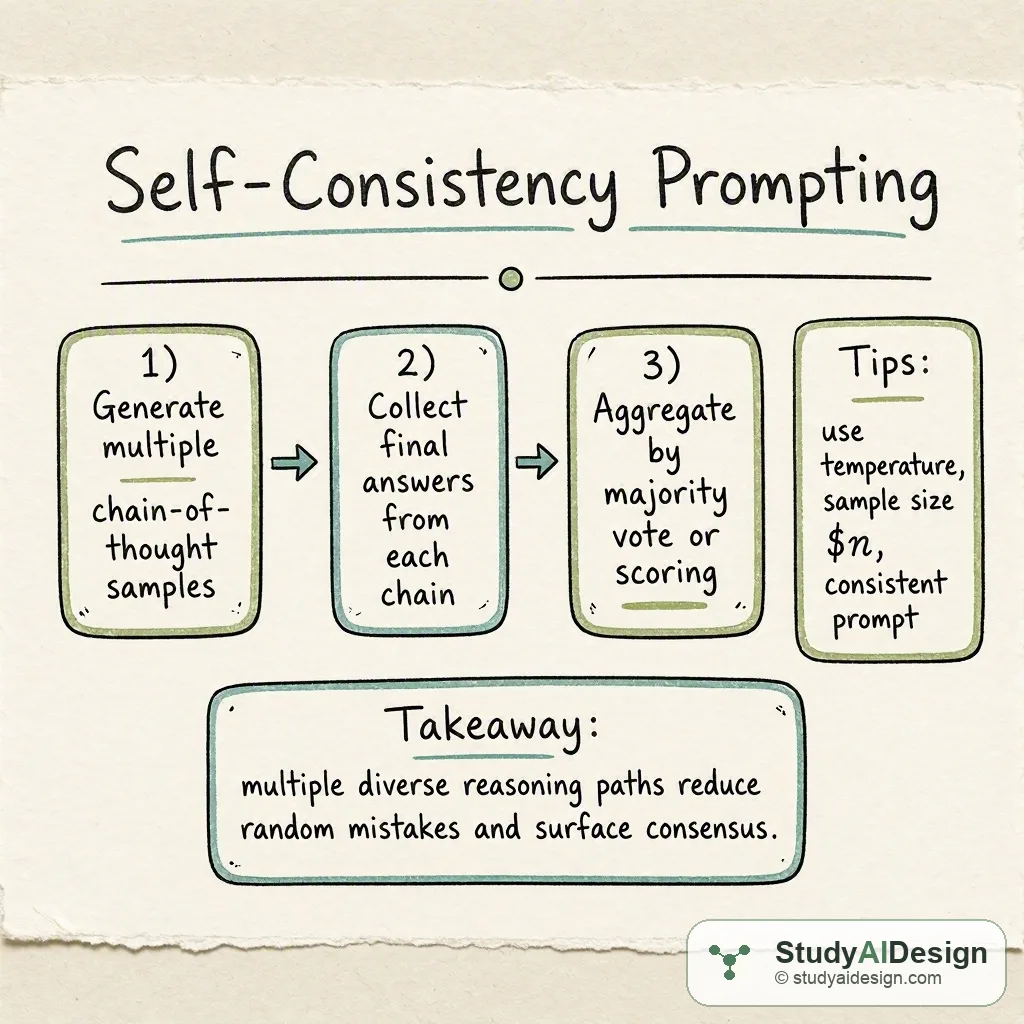
TL;DR
- Self-consistency prompting means sampling multiple chain-of-thought rationales and then aggregating their final answers.
- Instead of trusting one chain-of-thought, we draw samples with stochastic decoding and take a majority or scored consensus.
- This converts uncertain single-run reasoning into a small ensemble that often raises final-answer accuracy. Key tradeoffs: more calls and compute for reduced random error and better robustness.
In this question, we will learn what self-consistency prompting is, why it often raises reasoning accuracy, and how to use it in interviews or practical systems.
We will cover the following:
- The intuition
- How it actually works
- Practical settings and tips
- When to use it
- Tradeoffs and failure modes
- Questions the interviewer might ask
- What the interviewer is really testing
Direct answer: Self-consistency prompting means generating multiple chain-of-thought samples for the same prompt, then aggregating the final answers (for example by majority vote). This reduces the chance that a single mistaken chain determines the output, and it often improves accuracy because stochastic sampling explores alternative valid reasoning paths. It costs more computation and does not fix systematic biases in the model.
The intuition (an analogy that makes it click)
Think of reasoning as walking a maze. A single chain-of-thought is one walk that might hit a dead end. Self-consistency is like sending several walkers from the same start who take different turns. If most walkers reach the same exit, that exit is more likely correct. Random missteps tend to cancel when you aggregate.
This works best when errors are partly random rather than identically repeated across samples.
How it actually works (the real mechanics, with one concrete worked example)
Mechanically, we ask the model to produce chain-of-thought style rationales and final answers while sampling stochastically. We repeat that times with the same prompt and model temperature setting, then collect the final answers and aggregate.
A common aggregation is majority vote. If each sample has probability of yielding the correct final answer independently, the probability that the majority of samples is correct is
This formula shows that if , increasing raises the majority probability toward 1. If , more samples make majority worse.
Worked example: compare a single sample versus majority for several per-sample accuracies.
| per-sample | Single-sample accuracy | 5-sample majority accuracy |
|---|---|---|
We computed the 5-sample numbers with the binomial majority sum. You can see modest per-sample reliability gains become large after aggregation when is above chance.
In practice, the samples are not perfectly independent, but stochastic decoding with temperature or top-k sampling introduces useful diversity in reasoning paths.
Practical settings and tips
- Temperature and decoding: Use a moderate temperature like to encourage diverse chains without extreme hallucination. Higher temperature increases diversity but also risk of nonsense.
- Sample count : Common choices are to depending on budget. Diminishing returns set in; measure gains on a small validation set.
- Prompt framing: Ask for chain-of-thought or step-by-step rationale, then require a clear final answer token that you can extract for voting.
- Aggregation methods: Majority vote is simple. You can also score each final answer by log-probability or rerank with a verification prompt to weigh samples.
When to use it
Use self-consistency when single-shot chain-of-thought is noisy but not catastrophically biased. It shines on multi-step arithmetic, logical puzzles, and problems where independent chains can explore distinct solution paths.
Do not expect improvement when the model consistently follows the same wrong logic every sample. In those cases, alternative defenses like better prompts, few-shot exemplars, or external verification are necessary.
Tradeoffs and failure modes
Self-consistency reduces random mistakes but has clear costs.
- Compute cost: you multiply API calls by .
- Correlated errors: if samples share the same incorrect inference, aggregation does not help.
- Calibration: majority may prefer a wrong consensus if error modes are common.
Questions the interviewer might ask
Some follow-up questions you might get:
Why does sampling the chain-of-thought help more than sampling final answers only? Sampling chain-of-thought exposes diverse reasoning trajectories that can lead to different final answers, whereas sampling only final answers often collapses to similar outputs with less underlying diversity.
How many samples should you draw? Start with for a quick check and increase to or if gains continue on validation. Watch for diminishing returns and cost limits.
What aggregation strategies other than majority voting work? You can score final answers by their conditional log-probability, rerank using a verifier prompt, or cluster answers and pick the most frequent cluster representative.
When will self-consistency fail? It fails when errors are systematic or when sampling increases garbage output. Also, correlated sampling due to strong prompt patterns reduces the benefit.
Can we make samples more independent? Yes: vary few-shot exemplars, use diverse temperatures, or randomize irrelevant prompt order to break correlations.
Does self-consistency increase hallucinations? It can if higher temperature or sampling encourages invented facts. Pair sampling with verification or grounding for knowledge-critical tasks.
Some things to note:
- Validate aggregation gains on a small dataset before scaling.
- Combine with verifier models or calculators for high-stakes tasks.
What the interviewer is really testing
They want to see that you understand stochastic sampling as an ensemble method for reasoning and can reason about independent versus correlated errors. They also expect you to know practical knobs like temperature, sample size , and aggregation strategies, and to recognize when self-consistency will not help due to systematic bias. Demonstrating measured tradeoff thinking and validation plans is the key outcome.
Further reading in the curriculum
Go deeper on the fundamentals behind this question.
- Prompting and Context Engineering How to structure prompts and fill the context window so models produce reliable, grounded, and cost-efficient outputs.
Related questions
How would you rate the quality of this article?
Prepare for your AI engineering interview
This is one of many detailed questions and explainers on StudyAIDesign. Browse the full set, work through the curriculum, and walk into your interview ready.