What is prompt engineering, and why is it critical for AI applications?
Prompt engineering explains prompt engineering and why it matters for AI applications, focusing on how wording, context, and examples shape model outputs. Learn the practical tradeoffs between clarity, cost, and robustness when designing prompts for large language models.
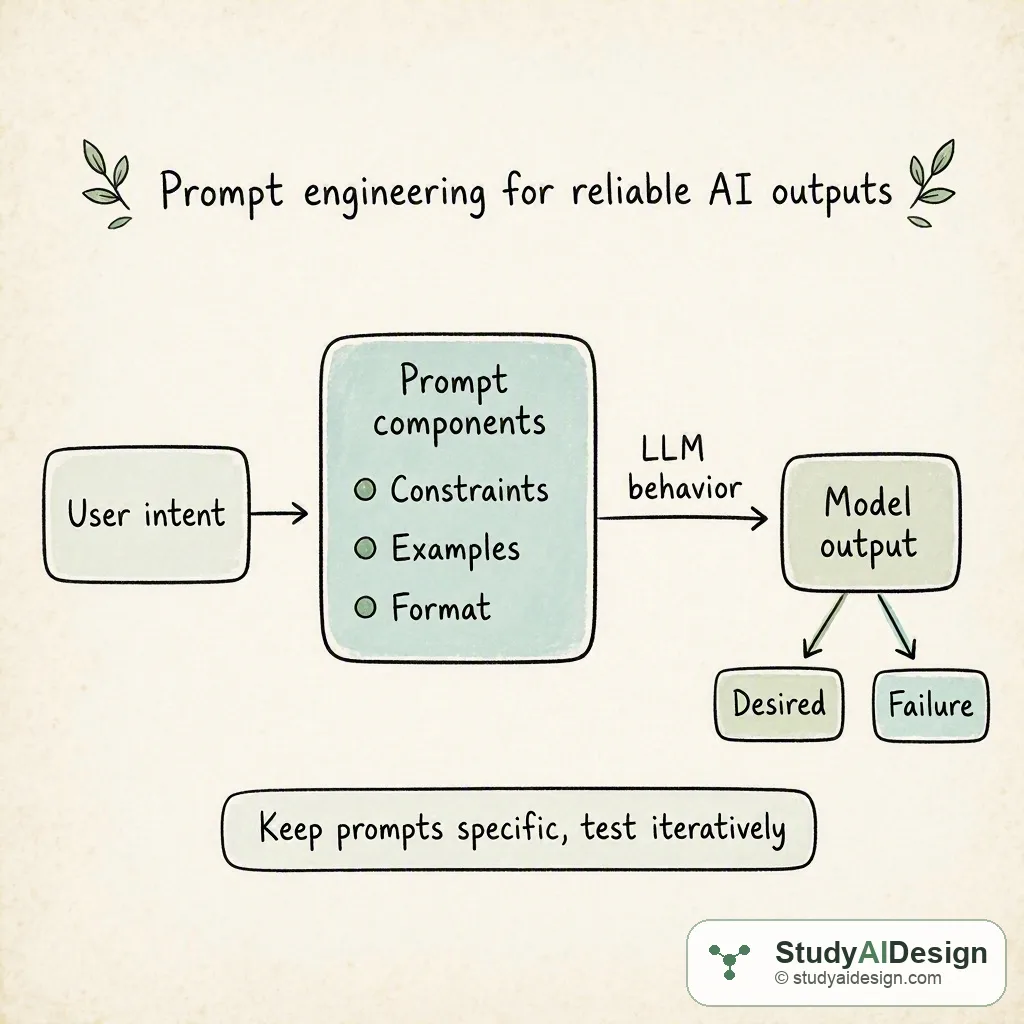
TL;DR
- Prompt engineering is how you craft the input given to a model so the model produces the behavior you want.
- Small changes to wording, example selection, or constraints often change accuracy, cost, and safety.
- Good prompts improve reliability, lower repeated edits, and simplify postprocessing. Key tradeoffs: specificity versus flexibility, prompt length versus inference cost, short-term fixes versus robust instruction design.
In this question, we will learn what prompt engineering is and why it is critical for AI applications, and we will practice clear ways to think about and test prompts.
We will cover the following:
- The intuition
- How it actually works
- Practical strategies and a comparison of styles
- Tradeoffs and failure modes
- Questions the interviewer might ask
- What the interviewer is really testing
Prompt engineering is the practice of designing and iterating the exact input you give to a model so the model returns the intended output in a reliable, efficient, and safe way. You will explain why small wording choices, structure, and examples matter, show a concrete prompt tweak, and describe when to prefer short instructions or richer context.
The intuition (an analogy that makes it click)
Think of the model as an experienced assistant who cannot ask clarifying questions. The prompt is the memo you hand to that assistant. If the memo is vague the assistant guesses and may be wrong. If the memo includes clear constraints, an example of the intended format, and the exact task, the assistant is much more likely to produce usable work. We want to minimize guessing and make success obvious to the assistant.
How it actually works (the real mechanics, with one concrete worked example)
A language model produces a probability distribution over possible continuations given prompt . The shape of depends strongly on the tokens and examples in . For generation control there are two common levers: the prompt content and the sampling temperature. Temperature rescales logits before a softmax:
Lower concentrates probability mass on high logit choices and tends to produce deterministic, safer outputs. Higher increases diversity but also the chance of errors. Prompt content shifts the logits themselves by giving the model context and desired structure.
Worked example. Task: extract the publication year from a passage and output as a single four-digit number.
- Vague prompt: "When was this published?"
- Structured prompt: "Extract the publication year from the passage. Output only a four-digit year, or NONE if missing. Passage:
<text>"
Compare results on ten examples and measure exact-match accuracy and parsing cost. Prompt length affects token cost. Rough complexity of cost per request is in the number of tokens processed, where is the sum of prompt plus response tokens.
| Prompt style | Typical accuracy | Token cost |
|---|---|---|
| Vague question | 40% | low |
| Instruction with format | 85% | medium |
| Few-shot example + instruction | 95% | higher |
This table shows that adding examples improves correctness but increases tokens and cost.
Practical strategies and comparisons
Here are concise strategies and when to reach for them.
- Zero-shot instruction: give a clear instruction when the task is straightforward.
- Few-shot prompting: add 2 to 5 examples when examples disambiguate subtle format or style choices.
- Chain-of-thought prompting: include intermediate reasoning examples when the model must perform multi-step logic and the model is allowed to reveal reasoning.
- Constraint-first prompts: put must-follow constraints and output schema at the top to guard against hallucination.
Comparison table:
| Strategy | When to use | Pros | Cons |
|---|---|---|---|
| Zero-shot | Well-known tasks | Low cost, simple | Less robust to ambiguity |
| Few-shot | Ambiguous or format-sensitive tasks | Higher accuracy | Higher token cost |
| Chain-of-thought | Complex reasoning tasks | Improves multi-step correctness | Verbose outputs, may expose internal errors |
| Constraint-first | Safety or strict schemas | Reduces hallucination | Can be brittle if constraints conflict |
Tradeoffs and failure modes
Prompt engineering reduces errors but can introduce brittle behavior. If you hardcode too many constraints without testing, the model may ignore them or follow them inconsistently across inputs. Relying only on clever prompt hacks can hide underlying model limitations.
Watch for prompt injection and unintended context inheritance. If the prompt includes user-provided content, the model can be steered by malicious or malformed input. Always validate critical outputs and isolate sensitive instructions from untrusted content.
Common failure modes:
- Hallucination when the prompt asks for facts beyond the model knowledge.
- Format drift where the model slowly deviates from a requested schema.
- Prompt brittleness: small wording changes cause large behavior shifts.
Questions the interviewer might ask
Some follow-up questions you might get:
How do you decide between few-shot and zero-shot? Choose few-shot when examples clearly disambiguate the desired output format or style and the added token cost is acceptable. Use zero-shot for simple, well-constrained tasks.
What metrics do you use to evaluate prompts? Use exact-match, F1, or custom validators for structure plus human review samples for subjective quality. Also track token cost and latency.
How do you guard against prompt injection? Separate untrusted user text from instruction layers, use sanitization and strict output schemas, and run validators that reject or flag suspicious outputs.
When should you use chain-of-thought prompting? Use it when intermediate steps improve final correctness and when exposing reasoning is acceptable. For safety-critical cases prefer structured verification instead of relying solely on chain-of-thought.
How do you reduce inference cost while keeping quality? Shorten or compress examples, move static context to system-level instructions, and prefer concise constraint-first prompts. Consider model choice and batching.
Some things to note:
- Always measure on a held-out set that matches production inputs.
- Combine prompt engineering with postprocessing validators for strict schemas.
What the interviewer is really testing
They want to see that you understand prompts are not magic; they are a specification tool that changes the model distribution . They test whether you can reason about tradeoffs: accuracy, cost, and safety, and whether you can propose measurable experiments to iterate on prompts. Show that you will validate prompts systematically and guard against common failure modes.
Related questions
How would you rate the quality of this article?
Prepare for your AI engineering interview
This is one of many detailed questions and explainers on StudyAIDesign. Browse the full set, work through the curriculum, and walk into your interview ready.