How do you implement caching strategies for LLM applications?
Caching strategies for LLM applications speed up responses and reduce API cost by storing embeddings, partial outputs, or full answers. This question asks how to choose cache tiers, design keys and invalidation, and measure tradeoffs between latency, cost, and freshness.
TL;DR
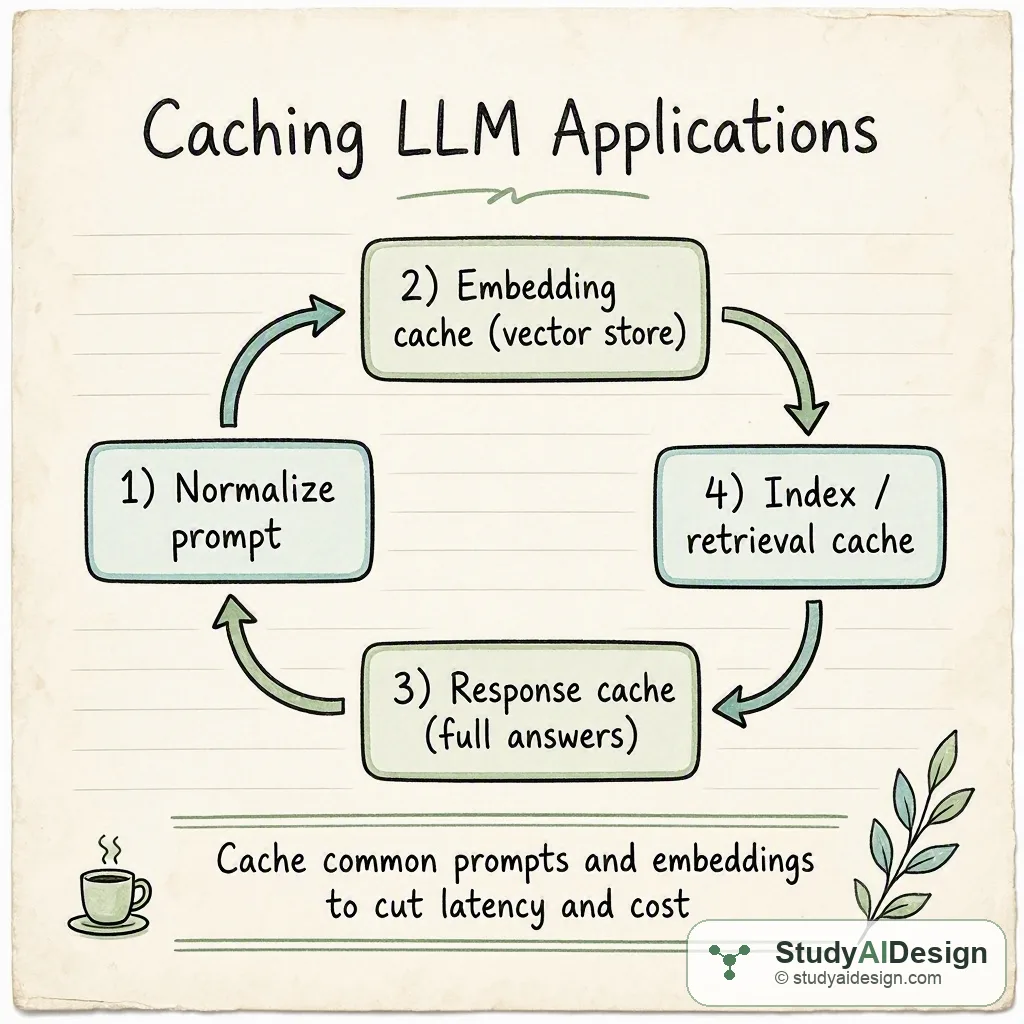
- Cache at multiple levels: prompt/response cache for exact or near-exact matches, embedding/vector cache for retrieval speed, and partial or token-level caches for long generations.
- Normalize prompts and use cache keys that include versioning and context signatures to avoid stale or unsafe hits.
- Measure hit rate, effective latency, and cost per request to decide cache size and eviction policy. Key tradeoffs: freshness versus latency and cost savings.
In this question, we will learn how to implement caching strategies for LLM applications so you can improve latency and control API spend while keeping results correct. We will walk through cache tiers, key design, eviction and invalidation, and a worked example that shows the math behind effective latency and cost.
We will cover the following:
- The intuition
- How it actually works
- Cache types comparison
- Practical design checklist
- Tradeoffs and failure modes
- Questions the interviewer might ask
- What the interviewer is really testing
Direct answer: use a multi-tier cache: normalize the prompt to create a stable cache key, store exact-response and embedding-level entries, add versioning and TTLs for freshness, and choose eviction policies by cost sensitivity and access patterns. Monitor hit rate, latency, and model cost to iterate.
The intuition (an analogy that makes it click)
Think of an LLM system like a kitchen that assembles dishes on demand. A response cache is like keeping a pre-made plate for common orders. An embedding cache is like storing prepared ingredients that speed up putting together new but similar dishes. Token-level caching is like pre-rolling dough for a specific long recipe section.
You store whole plates when orders repeat exactly. You store ingredients when orders are similar and can be composed faster. You add version tags and discard items past use-by dates to avoid serving stale food.
How it actually works (the real mechanics, with one concrete worked example)
Main steps when a request arrives:
- Normalize the input: trim whitespace, canonicalize synonyms if appropriate, hash context and system prompts.
- Check the exact-response cache using the normalized key. If hit, return cached answer.
- If miss, check embedding or retrieval-level caches to avoid costly index queries or repeated embedding computations.
- If still miss, query the model, then write back to the appropriate caches.
Key formulas to reason about impact. Let be the cache hit rate, the latency for a cache hit, and the latency when the model is called. Effective latency is
Similarly, for cost with per-call model cost and cheap cache cost :
Worked example. Suppose an embedding cache has , , and . Then
That is a large latency saving compared to always calling the model. If model cost per miss is \0.0270%$ in expectation.
Cache key design example. A compact key might be the SHA256 of the tuple (normalized prompt, system prompt version, retrieval corpus version, user role). This makes it easy to invalidate when you update the system prompt or corpus.
Cache types comparison
| Cache tier | What is stored | Typical latency | When to use |
|---|---|---|---|
| Exact-response cache | Full model outputs for normalized prompts | 1-10 ms | Repeated identical queries, bots, FAQs |
| Embedding / vector cache | Embeddings or nearest-neighbor lists | 5-50 ms | Retrieval augmented generation, semantic search |
| Retrieval/index cache | Top-k doc ids or cached snippets | 1-20 ms | Expensive retriever or dense index queries |
| Partial/token cache | Prefix or commonly generated token sequences | 1-10 ms | Long structured generations with reusable prefixes |
Choose which tier to prioritize by looking at where latency and cost are concentrated in your pipeline.
Practical design checklist
- Normalize and canonicalize prompts before hashing. Include system prompt version in the key.
- Separate caches by privacy class. Never cache PII or private user data in shared caches.
- Use TTL and explicit invalidation on model or data changes. Add a generation id to responses for traceability.
- Pick eviction policy by access pattern: LRU for recency, LFU for consistent hotspots, cost-aware when misses are expensive.
- Instrument: track hit rate, miss latency, cold-start patterns, and cost savings per day.
Tradeoffs and failure modes
Caching increases speed and reduces cost but introduces staleness, potential privacy leaks, and correctness risks. You must balance freshness against expense.
Common failure modes:
- Overly aggressive normalization merges distinct intents and returns wrong answers.
- Missing versioning causes widespread stale responses after system prompt changes.
- Cache cold start during load spikes causes sudden high bill and latency.
Questions the interviewer might ask
Some follow-up questions you might get:
How do you design a cache key for a prompt? Include the normalized user prompt, system prompt version, retrieval corpus version, and any user privacy flag. Hash the tuple to a fixed-length key.
When would you not cache a response? When the response depends on private user data, real-time state, or external facts that change frequently unless you can enforce a very short TTL.
How do you handle semantic similarity instead of exact matches? Use an embedding cache plus nearest-neighbor lookup to find semantically similar prompts and then either return a cached response or use the cached embedding to speed up retrieval.
What eviction policy would you choose for a high-throughput assistant? Start with LRU for simplicity and monitor. If a small set of prompts dominates, LFU can reduce misses. For expensive misses prefer cost-aware eviction.
How do you measure cache effectiveness? Track hit rate, cold-start frequency, effective latency , and cost reduction in dollars per 1,000 requests.
How do you handle cache invalidation on model updates? Bump a model or system-prompt version identifier that is part of the key, or perform-rolling invalidation by tag so you can retire entries gradually.
Some things to note:
- Monitor both latency and correctness; a high hit rate is not useful if cached responses are wrong.
- Keep private and public caches separate and encrypt sensitive entries.
What the interviewer is really testing
They want to see that you can weigh latency, cost, and correctness and turn that into concrete design choices. They are checking for understanding of key design elements: normalization, versioning, TTLs, eviction policy, and instrumentation. Demonstrating a clear example with formulas and a monitoring plan shows practical competence.
Related questions
How would you rate the quality of this article?
Prepare for your AI engineering interview
This is one of many detailed questions and explainers on StudyAIDesign. Browse the full set, work through the curriculum, and walk into your interview ready.