What is evaluation-driven development for AI applications?
Evaluation-driven development for AI applications focuses on iterating models and features based on measurable evaluation metrics and deployment feedback. It asks how you choose metrics, run experiments, and close the loop from evaluation to shipped behavior for reliable AI products.
TL;DR
- Evaluation-driven development for AI applications means designing, running, and using quantitative evaluations to guide model and product decisions.
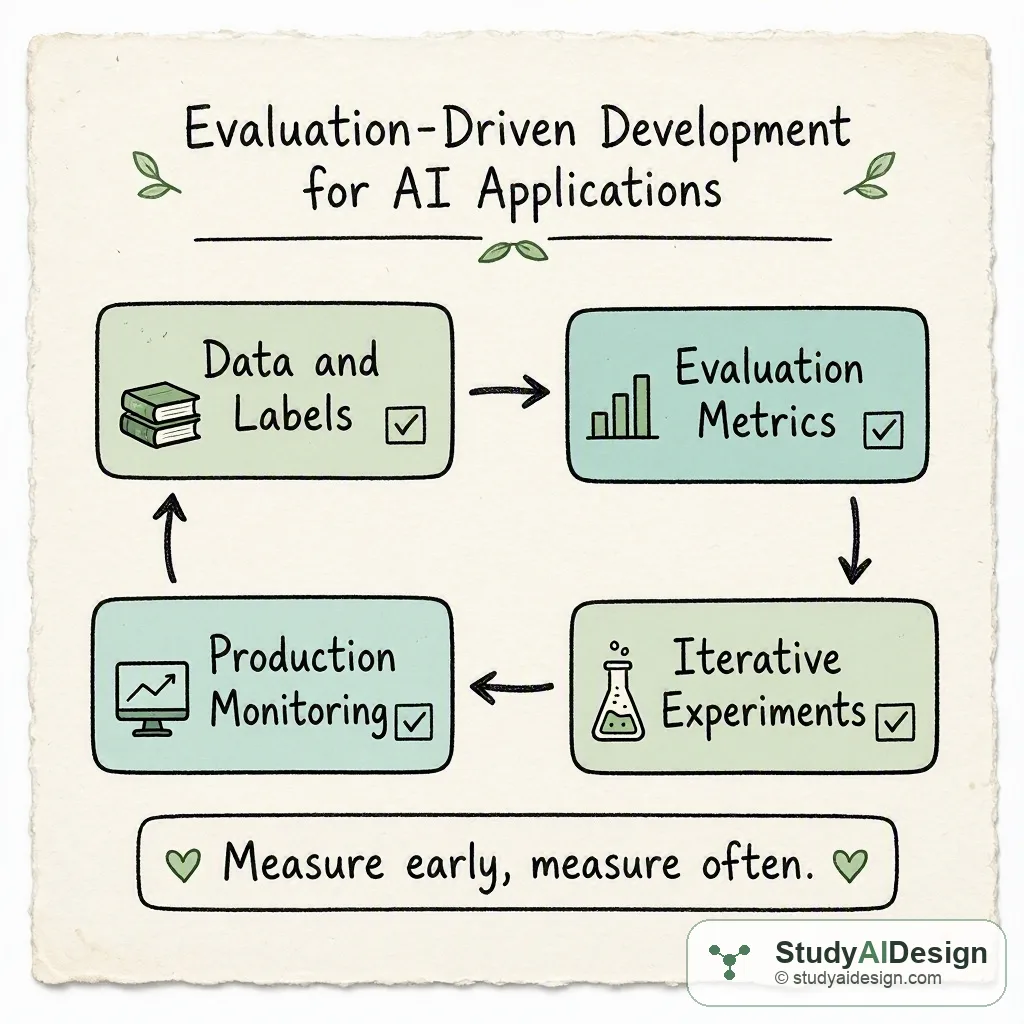
- It includes choosing task-appropriate metrics, building reproducible experiments, and connecting production monitoring back into training and labeling.
- Good practice ties metric thresholds to product outcomes, prioritizes failure modes, and automates feedback loops from real users. Key tradeoffs: precision of evaluation versus speed of iteration, and short-term metric gains versus long-term product safety.
In this question, we will learn what evaluation-driven development is, why it matters for real AI products, and how to run it in practice so that model improvements produce better user outcomes.
We will cover the following:
- The intuition
- How it actually works
- When to measure and which metrics
- Tradeoffs and failure modes
- Questions the interviewer might ask
- What the interviewer is really testing
Direct answer: Evaluation-driven development is the practice of making model and product decisions based on systematic, repeatable evaluation pipelines that include offline metrics, controlled experiments, and production monitoring; it forces you to specify what success means, measure it, and close the loop so measurement drives development. It combines metric design, experiment discipline, and operational monitoring so you do not optimize proxies that do not match product goals.
The intuition (an analogy that makes it click)
Think of building a bridge. You could tweak materials and geometry, but without load tests and sensors you would not know whether a change improves safety or just saves cost. Evaluation-driven development replaces guesswork with measurements at three stages: bench tests, controlled tests, and in-service sensors. That way each change has evidence, not opinion.
How it actually works (the real mechanics, with one concrete worked example)
The core mechanics are:
- Define task-level success and select metrics.
- Create reproducible evaluation pipelines with fixed datasets and seeds.
- Run experiments and record metrics and artifacts.
- Deploy in gradual stages and monitor production signals.
- Feed production data and failure cases back into labeling and training.
Worked example: an email spam classifier. We care about user annoyance and missed important mails. We choose metrics: precision at threshold, recall for spam, and a user impact metric like false-positive rate per 10k inboxes.
We compare two candidate models on a held-out test set. Numbers are illustrative.
| Model | Precision | Recall | False positives per 10k |
|---|---|---|---|
| Baseline | 0.92 | 0.70 | 25 |
| New model | 0.89 | 0.78 | 40 |
Inline math: precision is and recall is . We may combine them with score. Display formula for :
Here the new model raises recall but reduces precision and increases false positives per 10k. If product priority is avoiding false positives we reject the new model. If catching more spam matters more and we can fix UI, we might accept it after A/B testing and monitoring.
A/B testing step: run a controlled experiment exposing 10% of traffic to the new model, measure user complaints, downstream metrics like message reopen rate, and the operational false-positive alerts. If production false positives spike beyond an agreed threshold we roll back.
When to measure and which metrics
Measure at three layers: offline, simulated online, and production.
- Offline metrics: accuracy, precision, recall, calibration, and task-specific costs. Use these to filter bad models early.
- Simulated online: replay logs or shadow mode to estimate latency and downstream effects without impacting users.
- Production monitoring: drift, user-facing error rates, latency, and business KPIs.
Choose metrics that map to product goals. For imbalanced tasks prefer precision, recall, and calibration. For ranking tasks use normalized discounted cumulative gain or precision at . For cost-sensitive tasks express metrics in monetary or safety units when possible.
Comparison table of metric choices for common tasks:
| Task | Useful metrics | When to prioritize |
|---|---|---|
| Binary classification | Precision, recall, calibration | When cost of FP or FN dominates |
| Ranking / search | P@k, NDCG | When top results matter to users |
| Regression | MAE, RMSE, calibration | When absolute error maps to cost |
Connecting evaluation to the engineering loop
Make evaluations reproducible with artifact tracking and benchmarks. Automate training runs, evaluation reports, and unit tests of metrics. Keep a benchmark dataset that contains known failure modes and fresh holdouts that you update deliberately.
Set clear acceptance criteria for model promotion. For example, require no increase in production false positives above X per million and improvement of at least Y in the primary metric. Automate gating so builds that fail do not go to production.
Tradeoffs and failure modes
Evaluation-driven development reduces guesswork but has tradeoffs. Investing in thorough evaluation slows iteration. Overfitting to benchmarks or metric gaming produces models that do well on paper but fail users. Narrow metrics can hide fairness and safety problems.
Practical mitigations: maintain diverse metrics, monitor orthogonal signals, and require human review for risky changes.
Questions the interviewer might ask
Some follow-up questions you might get:
How do you pick metrics when business KPIs are vague? Start by decomposing the KPI into observable behaviors. Choose proxy metrics that map to those behaviors and validate the mapping with experiments.
How do you prevent overfitting to your benchmark? Hold out a temporal test set and rotate in new data periodically. Use blind evaluation and separate benchmark tasks for internal tuning and final evaluation.
How do you handle metrics that conflict, for example precision versus recall? Make tradeoffs explicit and tie them to product cost. Use multi-objective criteria or thresholds, then run A/B tests to measure net product impact.
What production signals should be monitored? Monitor error rates, latency, model confidence distribution, label drift, and business KPIs influenced by the model. Alert on large deviations.
When do you use shadow mode or canary releases? Use shadow mode to see behavior without user impact, and canary releases when you need live signals with controlled exposure. Both reduce risk before full rollout.
Some things to note:
- Automate the evaluation pipeline to avoid manual mistakes.
- Keep benchmark datasets representative and updated.
What the interviewer is really testing
They want to see that you can translate product goals into measurable signals, design reproducible evaluations, and connect evaluation outcomes to engineering actions. They are also judging whether you understand common failure modes like metric gaming and data drift, and whether you can propose concrete controls such as gates, canaries, and monitoring to reduce risk.
Related questions
How would you rate the quality of this article?
Prepare for your AI engineering interview
This is one of many detailed questions and explainers on StudyAIDesign. Browse the full set, work through the curriculum, and walk into your interview ready.