How does Hybrid Search work?
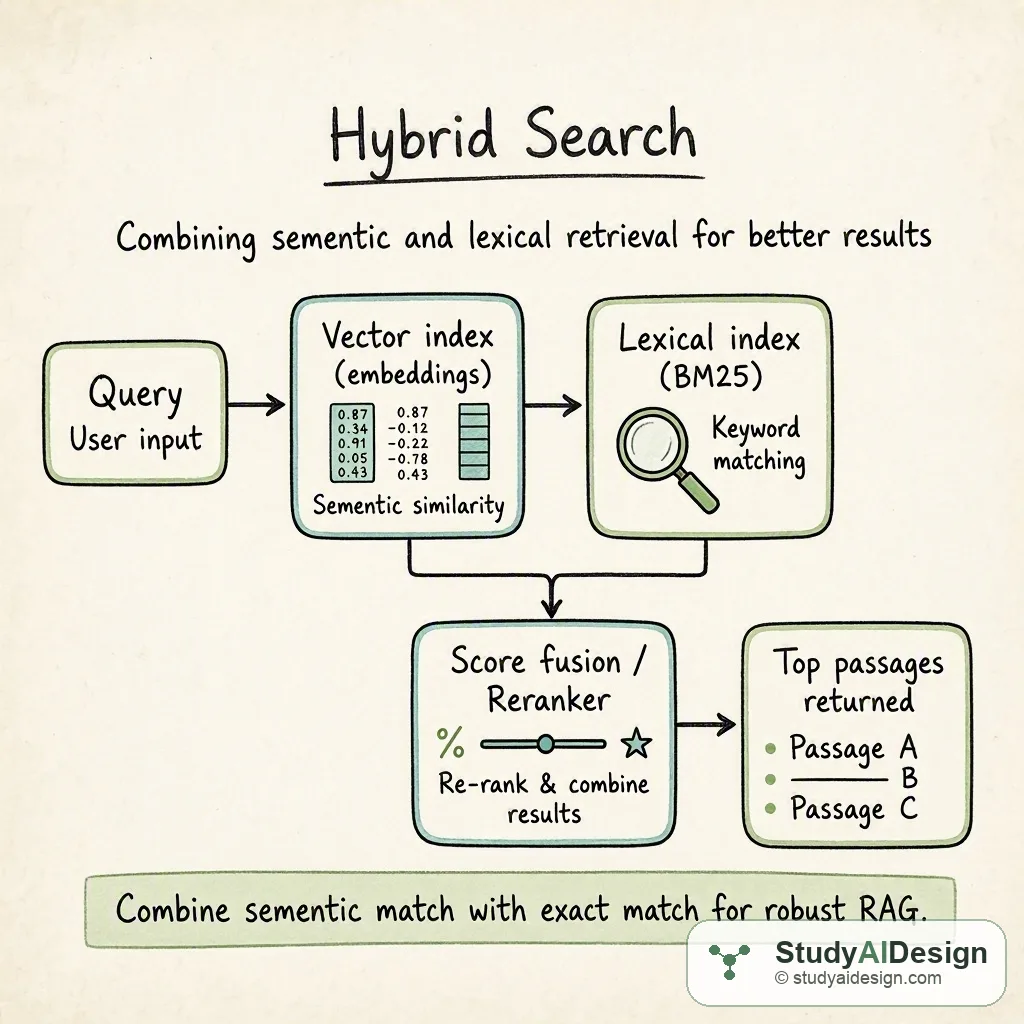
Hybrid Search explains how we combine vector-based semantic retrieval and lexical search for RAG. This page shows the core mechanics, a numeric worked example, and when to prefer each component for retrieval-augmented generation.
TL;DR
- Hybrid Search combines semantic vector retrieval and lexical exact-match retrieval into a single pipeline.
- We run both an embedding-based nearest neighbor search and a lexical search like BM25, then fuse or rerank results.
- Fusion can be a weighted sum, normalized scores, or a cross-encoder rerank step for highest accuracy. Key tradeoffs: balancing recall and precision, added latency and complexity vs more robust relevance.
In this question, we will learn how Hybrid Search works and why it is useful for retrieval-augmented generation systems. We will explain the components, show a numeric example of score fusion, and give practical rules of thumb for when to use each element.
We will cover the following:
- The intuition
- How it actually works
- When to use hybrid search and practical tips
- Tradeoffs and failure modes
- Questions the interviewer might ask
- What the interviewer is really testing
Direct answer: Hybrid Search runs both a semantic vector search and a lexical search over your corpus, then combines their signals either by score fusion or a reranker to produce a final ranked list. This yields better coverage for diverse queries because vectors capture meaning while lexical search preserves exact matches and important tokens.
The intuition (an analogy that makes it click)
Think of a librarian helping you find passages. The lexical search is the librarian scanning an index of exact words and page numbers, fast at finding precise mentions. The semantic search is a librarian who remembers the topics and themes of each book and can find passages that are about the same idea even without matching words exactly. Hybrid Search asks both librarians and then reconciles their suggestions so we do not miss either an exact phrase or a strong thematic match.
How it actually works (the real mechanics, with one concrete worked example)
A common pipeline has these steps:
- Encode the query to an embedding and perform a vector nearest-neighbor search to get candidates and their cosine similarities .
- Run a lexical search (for example BM25) to get candidates and BM25 scores .
- Merge the candidate sets and compute a fused score. Optionally rerank the merged top results with a cross-encoder for final ordering.
A simple fusion uses a weighted sum after score normalization. Let be the raw cosine similarity for document and the raw BM25 score. We normalize each list into by min-max on the merged candidates or by softmax. A straightforward linear fusion is:
where controls emphasis on semantic match.
Worked example. We query: "how to rotate an image 90 degrees". The system returns three candidate documents with raw scores as follows.
| doc | cosine similarity | BM25 |
|---|---|---|
| A | 0.82 | 4.0 |
| B | 0.55 | 6.5 |
| C | 0.90 | 1.2 |
Normalize each column by min-max across these three candidates. Cosine min 0.55 max 0.90. BM25 min 1.2 max 6.5. Compute values and let .
After normalization the fused scores might be:
| doc | fused | ||
|---|---|---|---|
| A | 0.64 | 0.43 | 0.60.64 + 0.40.43 = 0.56 |
| B | 0.07 | 1.00 | 0.60.07 + 0.41.00 = 0.43 |
| C | 1.00 | 0.00 | 0.61.00 + 0.40.00 = 0.60 |
Ranking by yields C then A then B. Document C is thematically closest, A balances both, and B had the strong exact-token match but weaker semantic score. If we then run a cross-encoder on the top 5 results, the reranker can correct fine-grained order to prefer passages that actually answer the query when semantics alone are noisy.
When to use hybrid search and practical tips
Use hybrid search when queries can be phrased both explicitly and implicitly. Examples: troubleshooting, API questions, or when users use synonyms. Pure lexical search misses paraphrases, pure vector search can miss exact code snippets or rare tokens.
Practical tips:
- Choose by validation on a held-out relevance set and by the metric you care about, like MRR or Recall@k.
- Normalize scores consistently. Min-max on the merged candidate set or z-score across the index are options, but keep the method stable.
- Consider retrieval depth tradeoffs: fetch and larger than final top-k and then rerank to recover high precision.
Tradeoffs and failure modes
Hybrid Search improves recall and robustness but adds complexity and cost. Running two retrieval systems increases CPU, memory, and operational surface. Score normalization can bias results if distributions differ across queries. Cross-encoder rerankers raise latency substantially.
Be careful with normalization and scale mismatch. If one score type systematically has smaller variance, naive fusion will give it too little influence. Always validate fusion on representative queries and watch for cases where vectors prefer topical but irrelevant passages, causing hallucination in RAG outputs.
Questions the interviewer might ask:
Some follow-up questions you might get:
How do you choose the fusion weight ? Use a validation set and pick to optimize your key metric. If you care more about recall for paraphrases, raise toward semantic; for exact match needs, lower it.
Why normalize scores before combining? Raw scores come from different scales and distributions. Without normalization a high-variance signal can dominate, so normalization makes weights meaningful.
When would you prefer reranking with a cross-encoder? When precision is critical and latency allows it. Use cross-encoders on a small merged candidate set to improve final ordering.
What are alternatives to linear fusion? You can use learned rankers that take raw features, logistic regression, gradient-boosted trees, or neural rankers that use both embedding distances and lexical features.
How does hybrid search affect latency and cost? Expect roughly additive costs for two retrievals plus merging. Rerankers add more compute per query. Measure and budget for memory and CPU accordingly.
Some things to note:
- Validate on realistic queries and measure per-query failure modes.
- Keep index and embedding model stable; model changes can shift score distributions.
What the interviewer is really testing
They want to see you can combine systems thoughtfully: you should know why vector and lexical signals are complementary, how to fuse them reliably, and how to evaluate the tradeoffs. They also want practical judgment on latency, cost, and validation strategies rather than only theory.
Further reading in the curriculum
Go deeper on the fundamentals behind this question.
- RAG Fundamentals Why retrieval-augmented generation works, and how to build a pipeline that actually grounds answers.
- Evaluating AI Systems How to measure, monitor, and improve LLM system quality from offline eval sets through production observability.
- AI Design Patterns A catalog of recurring architectural patterns for LLM systems, with tradeoffs, failure modes, and guidance on when to combine or avoid each.
Related questions
How would you rate the quality of this article?
Prepare for your AI engineering interview
This is one of many detailed questions and explainers on StudyAIDesign. Browse the full set, work through the curriculum, and walk into your interview ready.