Explain the Query(Q), Key(K), and Value(V) in attention.
Query, Key, and Value in attention explain how a transformer decides what to focus on by scoring queries against keys and using those scores to mix values. This question covers the math, a small numerical example, intuitive analogies, and common interviewer follow ups so you can answer clearly and concisely.
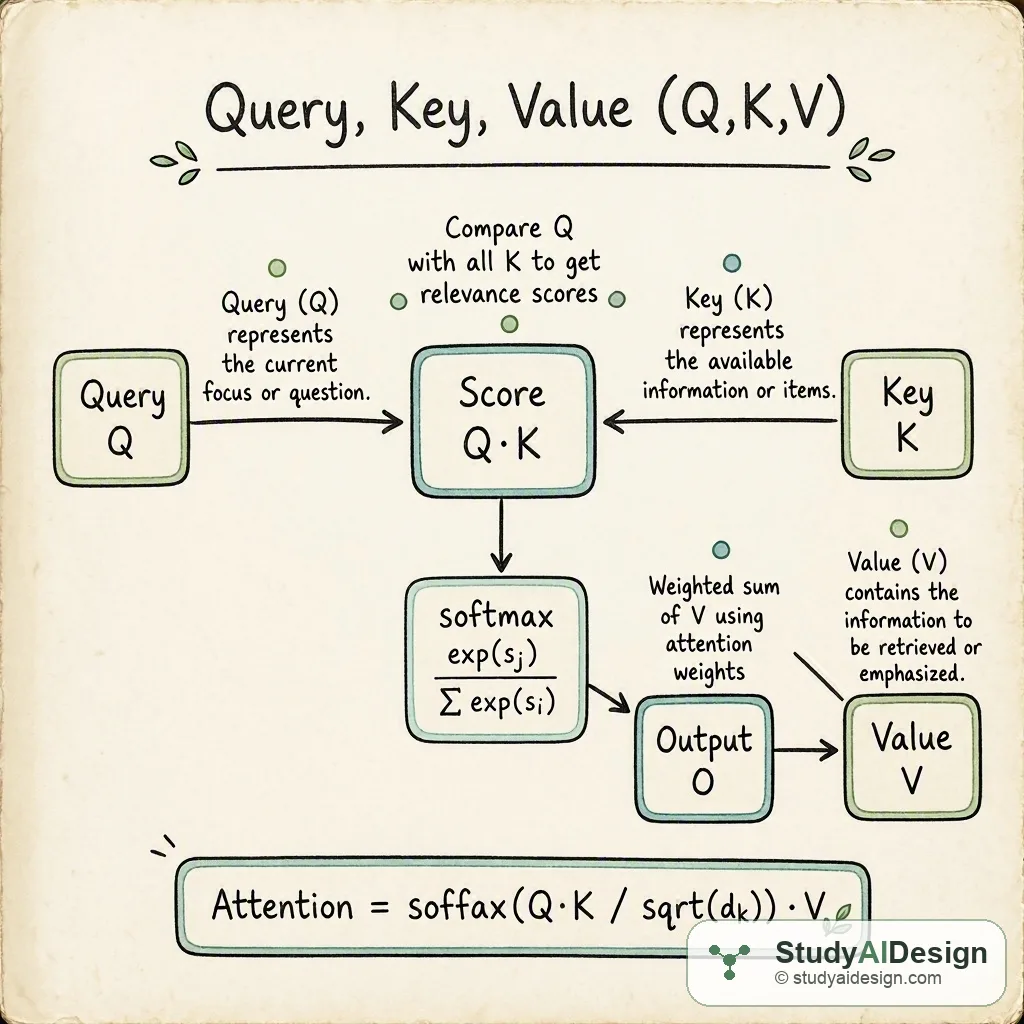
TL;DR
- Q, K, V are the three roles in attention: queries ask, keys are indexed facts, values are the payload we mix.
- The core computation is softmax of scaled dot products, then a weighted sum of values.
- Scaling by stabilizes gradients and prevents extremely peaked distributions. Key tradeoffs: speed versus expressiveness, and positional context versus global mixing.
In this question, we will learn what Query, Key, and Value mean in the attention mechanism and why they let a model decide which tokens to focus on. We will keep the math concrete and walk through a small numerical example so the operations feel tangible.
We will cover the following:
- The intuition
- How it actually works
- Variants and practical notes
- Tradeoffs and failure modes
- Questions the interviewer might ask
- What the interviewer is really testing
Direct answer: Query is the vector that asks what we need, Key is the vector that answers whether a memory entry is relevant, and Value is the vector that contains the information we will mix. The attention weights come from comparing Queries and Keys, usually by scaled dot product, and those weights are used to form a weighted sum of Values. This produces context-aware outputs that the model can stack and combine.
The intuition (an analogy that makes it click)
Think of a librarian helping you find sentences in a long book. Your question is the Query. Each page has an index card with a Key that summarizes the page, and the page itself is the Value. The librarian compares your question to every index card, ranks pages by relevance, and then brings you a short mix of the most relevant pages. Attention does the exact same steps with vectors and soft scores.
How it actually works (the real mechanics, with one concrete worked example)
The common formula we use is scaled dot-product attention:
Here is a matrix of queries, is keys, is values, and is the key dimension used for scaling.
Concrete worked example. Suppose a single query and three key-value pairs. Use 2-dimensional vectors for clarity.
- Query
- Keys
- Values
Compute dot products between and each key, then scale by , then softmax.
| key | dot product | scaled score | softmax weight |
|---|---|---|---|
| 1 | |||
| 0 | |||
| 1 |
Weights were computed by exponentiating the scaled scores and normalizing. Now multiply weights against the values and sum:
So attention produced a combined vector that favors content from and because their keys matched the query.
This example shows three points: the dot product measures alignment, the softmax turns scores into a distribution, and values are mixed according to that distribution.
Variants and practical notes
-
Scaled dot-product attention is standard because it is simple and fast on GPUs. The scale prevents scores from growing with dimension, which otherwise makes softmax extremely sharp.
-
Additive attention uses a small feed-forward net instead of dot product. It can be more flexible at low dimension but is slower and less parallelizable.
-
Multi-head attention runs several independent Q,K,V projections in parallel. Each head uses different learned projections so the model can capture different similarity notions.
| Variant | Pros | Cons |
|---|---|---|
| Scaled dot-product | Fast, GPU-friendly, simple | May conflate different similarity metrics if projections are not expressive enough |
| Additive | Can model non-dot-product similarity | Slower, harder to scale to many heads |
| Multi-head | Captures multiple relations | More parameters and compute |
Tradeoffs and failure modes
Attention is powerful but not free. Using many heads or large increases compute and memory. Softmax can concentrate too much on a few keys when scores are large, making outputs insensitive to other context.
Other failure modes include attending to repeated tokens that look similar by dot product but are contextually different, and scaling issues when using extremely large without proper initialization.
Questions the interviewer might ask
Some follow-up questions you might get:
Why divide by ? Dividing by keeps the dot-product magnitudes stable as dimension grows. Without it the softmax can produce extremely small gradients and very peaked distributions.
How do Q, K, V get produced in practice? They are linear projections of the input token embeddings. For each head we have learned matrices and compute , , .
What happens when you stack multiple attention layers? Each layer produces context-aware representations. Stacking lets the model build higher-level relations, because later layers can attend to combinations created by earlier layers.
When would additive attention be preferred? When dimension is small and the dot product is a poor similarity measure. It can work better for low-resource models but is slower at scale.
How does attention handle positions? Attention itself is permutation-invariant. Positional encodings or relative position biases supply order information so positions can influence dot products.
Some things to note:
- Attention weight matrices are often large and dominate memory for long sequences.
- Sparse or local attention patterns are common to scale to long contexts.
What the interviewer is really testing
They want to see you can connect the algebra to an intuition: queries score keys, softmax turns scores into weights, and values get mixed. They also check that you know why scaling matters and can explain practical variants like multi-head or additive attention. A concise numerical example and awareness of failure modes show you understand both theory and practice.
Further reading in the curriculum
Go deeper on the fundamentals behind this question.
- How LLMs Actually Work A ground-up tour of tokens, embeddings, attention, and why transformers scale.
Related questions
How would you rate the quality of this article?
Prepare for your AI engineering interview
This is one of many detailed questions and explainers on StudyAIDesign. Browse the full set, work through the curriculum, and walk into your interview ready.