What is an AI agent, and how does it differ from a simple LLM call?
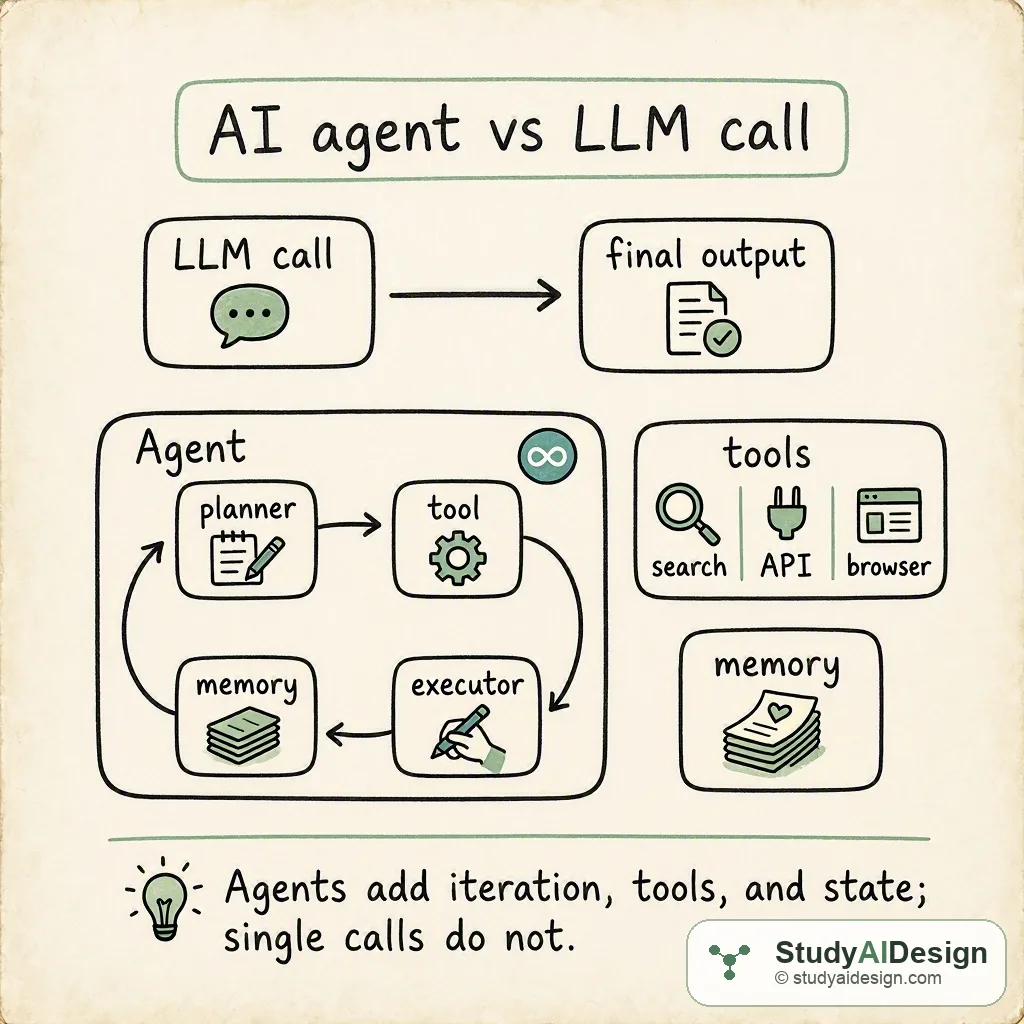
AI agent vs LLM call: an AI agent composes an LLM, tools, memory, and a control loop to complete multi step tasks, while a simple LLM call is a single prompt-response interaction. This page explains the structural differences, typical architectures, and when you should pick an agent over a one-off LLM call.
TL;DR
- An AI agent is a control loop that uses an LLM plus tools, memory, and decision logic to solve multi step goals.
- A simple LLM call is a one off prompt and response with no persistent loop or direct tool access.
- Agents add planning, tool invocation, and state, which raises capability and complexity.
- Use an LLM call for short stateless tasks and an agent when you need multi step coordination or external actions. Key tradeoffs: capability and automation versus latency, cost, and safety.
In this question, we will learn what an AI agent is, how it differs from a simple LLM call, and when to choose one in an interview or design discussion.
We will cover the following:
- The intuition
- How it actually works
- Design patterns and a concrete worked example
- Tradeoffs and failure modes
- Questions the interviewer might ask
- What the interviewer is really testing
Direct answer: An AI agent is a system that composes an LLM with external tools, memory, and a control loop so it can plan, act, and update state across multiple steps, while a simple LLM call is a single prompt-response interaction with no active orchestration. Agents enable automation and tool use at the cost of added complexity, latency, and safety concerns, whereas single calls are cheaper, faster, and simpler for stateless queries.
The intuition (an analogy that makes it click)
Think of a simple LLM call as asking a single question to an expert and getting one answer. You hand over the problem and receive a response. There is no follow up, no intermediate work, and no external actions.
An agent is like a small team: one person plans, another fetches data or calls an API, another records notes, and they iterate until the goal is finished. The team passes information back and forth. That iterative collaboration allows handling tasks that require checking facts, calling services, and maintaining progress across steps.
How it actually works (the real mechanics)
An agent is built from a few components: a planner or policy that decides next actions, tool adapters that run external calls or code, a memory or scratchpad that records intermediate state, and an executor that implements the planner decisions. The core LLM can appear in the planner, the executor, or both.
A minimal schematic of calls is useful. If the agent performs planning steps and triggers tool invocations, the total number of LLM interactions is roughly:
where the initial 1 is an optional single-shot prompt or system instruction. That contrasts with a simple LLM call where .
Worked concrete example: "Book a flight and schedule a calendar invite".
- Task decomposition: find flight options, select best flight, call booking API, confirm details, create calendar event.
- A single LLM call might generate a plan and a mock curl command, but it cannot reliably call the booking API or handle live errors.
- An agent would iterate: plan step 1, call a search tool, parse results, decide, call booking API, handle API errors, then call calendar API.
Compare the two on practical axes:
| Aspect | Simple LLM call | AI agent |
|---|---|---|
| Statefulness | No | Yes, via memory or database |
| Tool access | Indirect, requires external orchestration | Direct, tool adapters called by agent |
| Multi step tasks | Hard and brittle | Natural, iterative |
| Latency and cost | Low | Higher due to extra calls |
| Safety surface | Smaller | Larger, needs guardrails |
Design patterns and variants
Common agent patterns you should name in an interview: ReAct style where the LLM produces actions and observations interleaved, planner-executor where one model generates a high level plan and another executes steps, and tool-augmented completion where the LLM calls specialized APIs through adapters.
When you design an agent consider these pieces:
- Prompting and instruction design for planner clarity.
- Tool interfaces with strict contracts to reduce hallucination.
- A memory layer to store facts needed across steps.
- Monitoring and circuit breakers to avoid runaway behavior.
A small comparison of interaction counts helps interviewers see cost tradeoffs. Suppose the task requires 3 external tool calls and 2 planning iterations. Then:
| Approach | LLM calls | Tool calls |
|---|---|---|
| Single-shot LLM | 1 | 0 (external orchestrator required) |
| Agent | 3 |
So the agent will have more LLM and tool traffic but can actually complete the end to end task.
Tradeoffs and failure modes
Agents are powerful for automation, but they introduce new risks. They are more expensive and slower. They can hallucinate when interpreting tool outputs. They can enter loops or trigger unintended actions if safeguards are weak.
Common failure modes to mention: hallucinated tool outputs, state mismatch between memory and services, race conditions when multiple agent instances share resources, and cost blowups from repeated planning.
Questions the interviewer might ask
Some follow-up questions you might get:
How would you prevent an agent from calling the wrong API? Use strict tool schemas, require explicit confirmation steps for destructive actions, and implement a policy layer that checks intent against allowed operations.
When is a simple LLM call preferable? For short, stateless tasks such as summarization, translation, or single answer Q and A where external action is not required and latency and cost matter.
How do you handle long term memory in an agent? Store canonical facts in a database and surface only relevant snippets to the model. Use retrieval to keep prompts compact and prefer verification steps for critical facts.
How do you debug an agent that loops? Log the planner outputs and tool results, add step counters, and apply a maximum iteration cutoff with a fallback error path.
How do you measure agent success? Define end to end success metrics like task completion rate, time to completion, number of interventions needed, and error rates from tools.
Some things to note:
- Design conservative tool contracts and type checks to limit hallucination.
- Measure cost per successful task, not just per API call.
- Add human in the loop for high risk actions.
What the interviewer is really testing
They want to know you understand the architectural gap between a single LLM call and a full agent: how iteration, tool access, and state change capability and risk. They also test whether you can reason about cost, latency, safety, and when each approach is appropriate. Explain tradeoffs clearly and mention concrete mitigations for common failure modes.
Related questions
How would you rate the quality of this article?
Prepare for your AI engineering interview
This is one of many detailed questions and explainers on StudyAIDesign. Browse the full set, work through the curriculum, and walk into your interview ready.