How do you implement content filtering for AI outputs?
Content filtering for AI outputs: implement a reliable pipeline that detects and blocks harmful or disallowed content before it reaches users. Learn practical architectures, metrics, threshold math, and operational steps to balance safety, utility, and latency for llmops production systems.
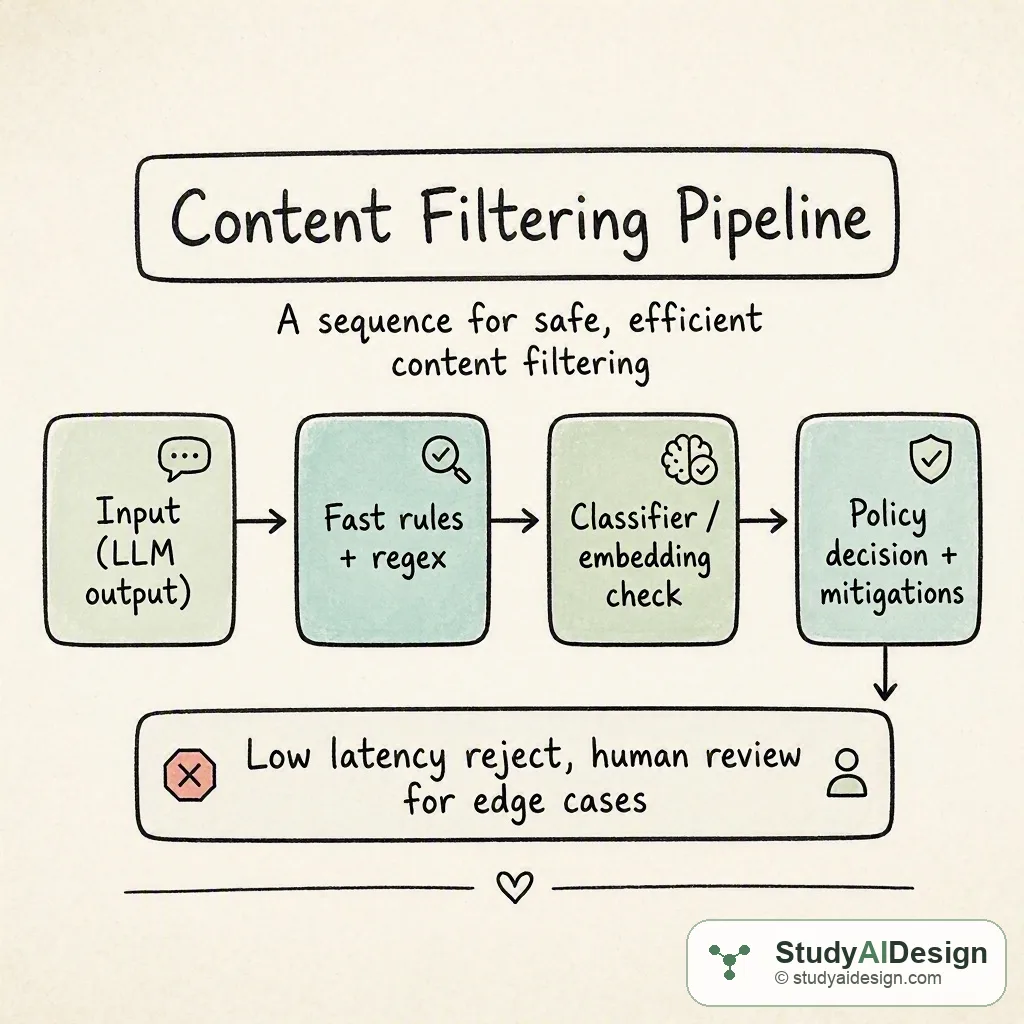
TL;DR
- Content filtering for AI outputs is a layered pipeline: fast syntactic rules, statistical classifiers, semantic checks, and policy decisioning.
- Measure what matters: precision, recall, latency, and operational cost, and pick thresholds using cost-aware math.
- Use human review and feedback loops for edge cases, logging for audit, and monitoring for drift and adversarial inputs. Key tradeoffs: stricter filters reduce harm but increase false positives and user friction; looser filters increase utility but raise safety risk.
In this question, we will learn how to implement content filtering for AI outputs so you can stop disallowed or harmful responses while preserving useful behavior. We will walk through the intuition, a concrete pipeline design, metrics and threshold math, and operational practices you will need in production.
We will cover the following:
- The intuition
- How it actually works
- Design and components
- Evaluation and thresholds
- Tradeoffs and failure modes
- Questions the interviewer might ask
- What the interviewer is really testing
Direct answer: implement a layered, monitored filtering pipeline that combines fast deterministic checks, a calibrated classifier or scoring LLM, semantic similarity checks, policy logic, and human review. Use metrics such as precision and recall with a cost-based threshold, instrument for drift and adversarial inputs, and provide remediation paths and appeals.
The intuition (an analogy that makes it click)
Think of content filtering like airport security. We first stop obvious problems with a metal detector and rules. Then suspicious items get an X-ray or secondary inspection. The strictest checks are slow and costly, so we only run them on flagged items. Humans handle the final edge cases. The same layered approach keeps throughput high while catching the important threats.
How it actually works (the real mechanics, with one concrete worked example)
A typical pipeline has stages: quick syntactic filters, supervised classifier or specialized safety model, semantic similarity checks for policy-specified items, decision logic with thresholds, and human-in-the-loop review. We will use a worked example: a chat assistant where some outputs may be disallowed (violent instruction) and you have a classifier that outputs , the probability the text is disallowed.
Start with a simple rule set to catch direct matches and explicit phrases. Pass remaining outputs to a classifier that gives . Choose a decision threshold based on relative costs of errors. If blocking is positive, derive the cost-optimal threshold by comparing expected costs. Let be the cost of false positive (blocking allowed content) and the cost of false negative (allowing disallowed content). Choose to block when where
Example numbers: suppose (user friction) and (harm). Then . That low threshold shows we favor safety in this example.
Compare detection techniques:
| Technique | Typical latency | Precision | Recall | Best use case |
|---|---|---|---|---|
| Regex / rule | <10 ms | high on explicit phrases | low on paraphrase | Block explicit tokens |
| Supervised classifier | 10-200 ms | medium-high | medium | Fast probabilistic decisions |
| LLM safety scoring | 100-500 ms | high contextual | high semantic | Hard cases and nuance |
| Embedding similarity | 50-200 ms | high for paraphrase | medium | Policy phrases and examples |
In a deployed example we might route outputs as: rules -> classifier -> embeddings check -> human review for scores in and automatic block for .
Key operational formulas you should know: and . Monitor both over time and watch for concept drift.
Design and components
Make each stage a separate service with clear contracts. Typical components:
- Fast rule engine: deterministic block/allow passthrough, low latency.
- Safety classifier: calibrated probability scores and confidence.
- Semantic matcher: nearest neighbor on examples for policy enforcement.
- Decision service: applies thresholds, risk scores, and mitigations such as redaction, soft refusals, or escalation.
- Human review queue: for edge scores, appeals, and high-severity incidents.
- Logging and telemetry: store inputs, model scores, decision reasons, and user outcomes for auditing.
Design consequences: keep the rule engine transparent for auditors, and keep model outputs and metadata for post-hoc analysis. Use a correlation id so you can reconstruct each decision from logs.
Evaluation and thresholds
Pick metrics that map to business and safety goals. A basic monitoring table might look like this:
| Metric | Target | Action on drift |
|---|---|---|
| Precision | > 0.90 for blocked items | Adjust threshold or retrain |
| Recall | > 0.85 for harmful class | Expand training data |
| Median latency | < 200 ms | Optimize model or cache |
When setting thresholds, use the cost-aware formula above to match business risk. Calibrate the classifier with temperature scaling or isotonic regression so reflects true probability before applying .
Tradeoffs and failure modes
Filtering always trades recall versus precision. Overblocking frustrates users and loses product value. Underblocking causes safety incidents and potential legal risk. Latency constraints push you toward simpler checks early and expensive checks later. Adversaries will try to evade filters with obfuscation or context shifts, so you must monitor and update.
Questions the interviewer might ask
Some follow-up questions you might get:
How do you measure success for a content filter? Measure precision and recall on a representative test set and track user-facing metrics such as appeals, false positive rate in production, and incident counts. Tie metrics to business and legal requirements.
How do you handle ambiguous or borderline cases? Route them to a human review queue, use soft refusals that ask for clarification, or apply partial redaction. Log decisions and rationale for later training.
What do you do about multilingual content? Use language-specific rules and models, or multilingual models that are calibrated per language. Ensure labeled data covers the languages you expect.
How do you defend against adversarial evasion? Use adversarial training, paraphrase augmentation, embedding-based semantic checks, and monitor for new patterns in logs. Rate-limit suspicious behavior and escalate in suspicious sessions.
How do you balance latency and safety? Run fast checks first and reserve heavy checks for flagged items. Use caching for repeated benign outputs and precompute embeddings for common prompts.
How do you audit and explain decisions? Persist the input, model scores, matched rules, and final action. Provide human-readable rationale for reviewers and appeals. Keep an immutable audit trail for compliance.
Some things to note:
- Calibrate model probabilities before thresholding.
- Instrument everything for drift and adversarial patterns.
- Maintain a human-in-the-loop path for edge cases and appeals.
What the interviewer is really testing
They want to know you can design a practical, layered safety system that balances tradeoffs: speed, accuracy, user experience, and liability. They are also probing your ability to translate abstract policy into measurable metrics and operational processes, including monitoring and incident response. Show you can reason about costs of errors, calibration, and continuous maintenance.
Related questions
How would you rate the quality of this article?
Prepare for your AI engineering interview
This is one of many detailed questions and explainers on StudyAIDesign. Browse the full set, work through the curriculum, and walk into your interview ready.