What is chain-of-thought (CoT) prompting, and when should you use it?
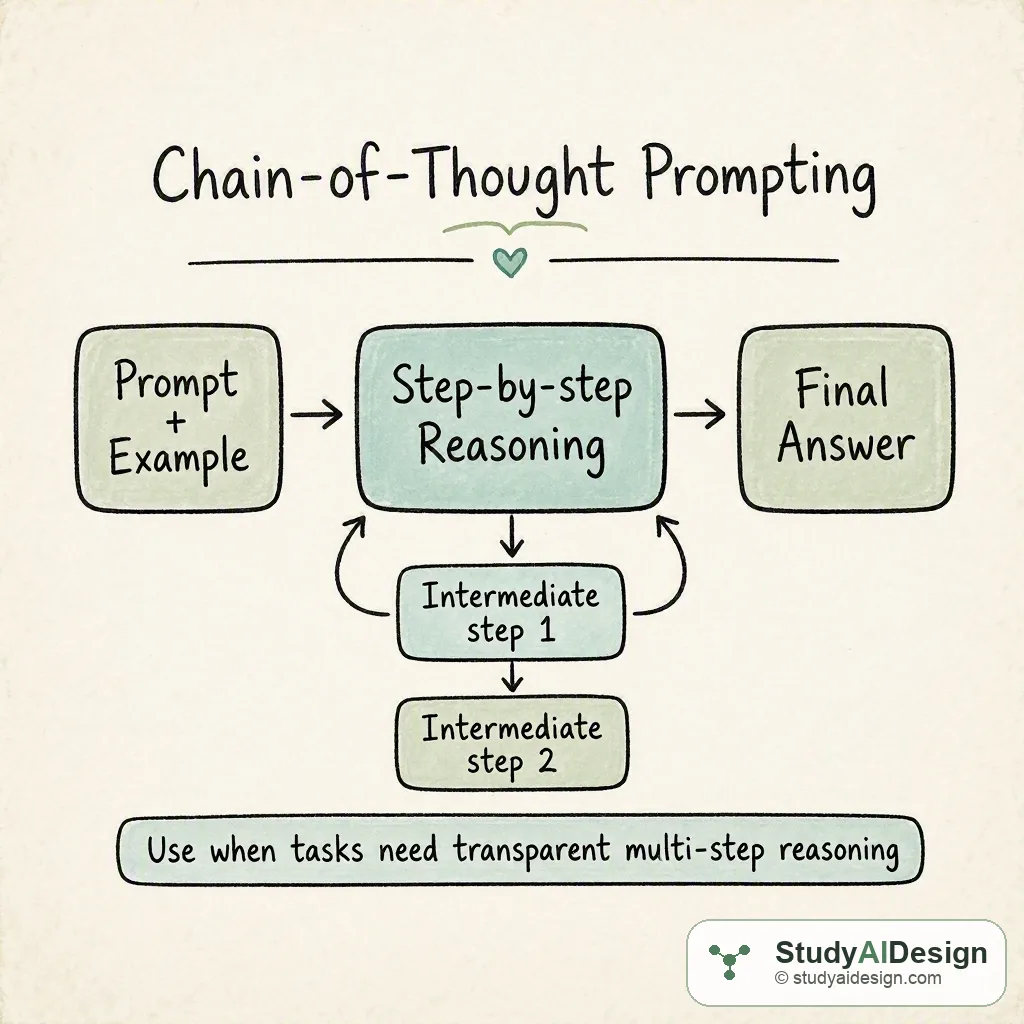
Chain-of-thought (CoT) prompting explains step-by-step reasoning to elicit multi-step answers from large language models. Use CoT when the task needs intermediate steps, arithmetic or logical reasoning, or when you want interpretable chains of reasoning to debug model errors.
TL;DR
- Chain-of-thought (CoT) prompting asks the model to produce intermediate steps, not just a final answer.
- Use CoT when a problem requires multi-step arithmetic, logical deduction, or interpretable reasoning traces.
- CoT often improves correctness but can increase verbosity and sensitivity to prompt phrasing. Key tradeoffs: better multi-step accuracy versus longer, less robust outputs.
In this question, we will learn what chain-of-thought prompting is, when it helps, and how to craft and evaluate CoT prompts so you know when to use it in interviews or production.
We will cover the following:
- The intuition
- How it actually works
- When to use CoT and practical patterns
- Tradeoffs and failure modes
- Questions the interviewer might ask
Chain-of-thought prompting is a prompting pattern that requests the model to show its intermediate steps so you get a stepwise reasoning trace and often higher accuracy on multi-step tasks. Use it for arithmetic, multi-hop logic, and tasks where you want interpretable steps, but avoid it for short factual lookups or when concise outputs are required.
The intuition (an analogy that makes it click)
Think of CoT like asking a student to show their work on a math test. The final score matters, but the written steps let you see where mistakes occur. When the student writes intermediate lines, you can catch algebra errors or misapplied rules. Similarly, when a model lists its steps, you get both a better chance of a correct result and a way to audit errors.
How it actually works (the real mechanics, with one concrete worked example)
At a high level, many language models perform better on multi-step problems when prompted to produce intermediate reasoning. The prompt nudges the model to generate a chain of tokens that imitate human step-by-step reasoning.
Example problem we will solve with CoT style: "Three friends split 10 less than B. How much does each person get?"
We ask the model to show work. The algebraic solution goes like this. Let be the amount B gets. Then A is and C is . The sum constraint is:
Solve the equation:
Then A is and C is .
Writing those intermediate steps in the model prompt increases the chance the model follows the same algebraic path rather than guessing a final triplet. When we compare prompting styles, the practical differences are visible.
| Prompt style | Typical strength | Typical weakness |
|---|---|---|
| Zero-shot (short question) | Short, direct answers | Often wrong on multi-step problems |
| Few-shot without steps | Learns format | May still miss intermediate logic |
| Chain-of-thought few-shot | Better multi-step accuracy | Longer answers, sensitive to phrasing |
When to use CoT and practical patterns
When to use CoT:
- Multi-step arithmetic and algebra problems where intermediate values guide the solution.
- Multi-hop reasoning like following a sequence of events or causal chains.
- Tasks where you need a human-readable trace to debug model behavior.
When not to use CoT:
- Simple factual lookups that need a short reply.
- Privacy-sensitive outputs where intermediate speculations could expose data.
- Low-latency systems where extra token generation is unacceptable.
Practical prompting patterns:
- Few-shot CoT: provide 2 to 4 worked examples that include full chains of reasoning plus final answers.
- Instruction style: "Explain your reasoning step by step, then give the final answer." Keep examples consistent in format.
- Selective CoT: ask for steps only when the model signals uncertainty or when the problem type matches a flag in your system.
Tradeoffs and failure modes
CoT improves correctness on many benchmarks, but it also introduces new risks and costs. CoT is more sensitive to the exact wording of examples and the order you present them. Models can produce plausible but incorrect chains, known as reasoning hallucinations, where the steps look coherent but the arithmetic or logic is wrong.
Performance costs to consider:
- Token costs increase because the model must generate intermediate text.
- Latency increases, which matters in interactive systems.
- Sometimes CoT reduces accuracy if examples are poor or inconsistent.
Additional practical tips
Verification-and-refinement: Ask the model to check its own final answer. For numeric problems, you can append a verification step: "Check your final answer by substituting back into the original constraints." That prompts a short self-audit and often catches simple arithmetic slips.
Prompt hygiene: Use consistent few-shot examples that match the problem structure. If examples mix different reasoning patterns, the model may generalize incorrectly.
Questions the interviewer might ask
Some follow-up questions you might get:
How does few-shot CoT differ from standard few-shot prompting? Few-shot CoT includes worked examples with explicit intermediate steps. Standard few-shot often shows only final answers or brief explanations, so it provides less guidance on step structure.
Can CoT help with non-numeric problems like legal reasoning? Yes. CoT helps when reasoning must chain multiple premises or cite intermediate findings. However, the model may still hallucinate precedents, so you need verification.
Does CoT make models more truthful? Not automatically. CoT improves structured correctness but can produce confident-looking wrong steps. Always verify outcomes for high-stakes use.
How many examples should you include in few-shot CoT? Usually 2 to 4 clear, representative examples work well. More examples help only if they are consistent and fit within your token budget.
Is there an automated way to evaluate CoT outputs? You can run verification checks that re-evaluate intermediate steps or use a separate model to grade the chain. Automated tests should focus on invariants and constraints.
Some things to note:
- CoT improves performance on many benchmarks but requires careful example design.
- Always include verification for critical numbers or logical constraints.
What the interviewer is really testing
The interviewer wants to see whether you understand when to trade off interpretability and accuracy for cost and latency. They are also checking that you know practical prompt patterns like few-shot CoT, verification steps, and the limitations such as hallucinated reasoning and sensitivity to prompt wording. Show that you can design prompts that improve correctness while planning for validation and efficiency.
Further reading in the curriculum
Go deeper on the fundamentals behind this question.
- Prompting and Context Engineering How to structure prompts and fill the context window so models produce reliable, grounded, and cost-efficient outputs.
Related questions
How would you rate the quality of this article?
Prepare for your AI engineering interview
This is one of many detailed questions and explainers on StudyAIDesign. Browse the full set, work through the curriculum, and walk into your interview ready.