Inside ChatGPT: What Happens After You Hit Enter?
Inside ChatGPT: What Happens After You Hit Enter? This question walks through the inference pipeline inside ChatGPT after you submit a message, covering tokenization, transformer inference, decoding, and post-processing. You will explain the stages, costs, and common tradeoffs so you can answer clearly in an interview.
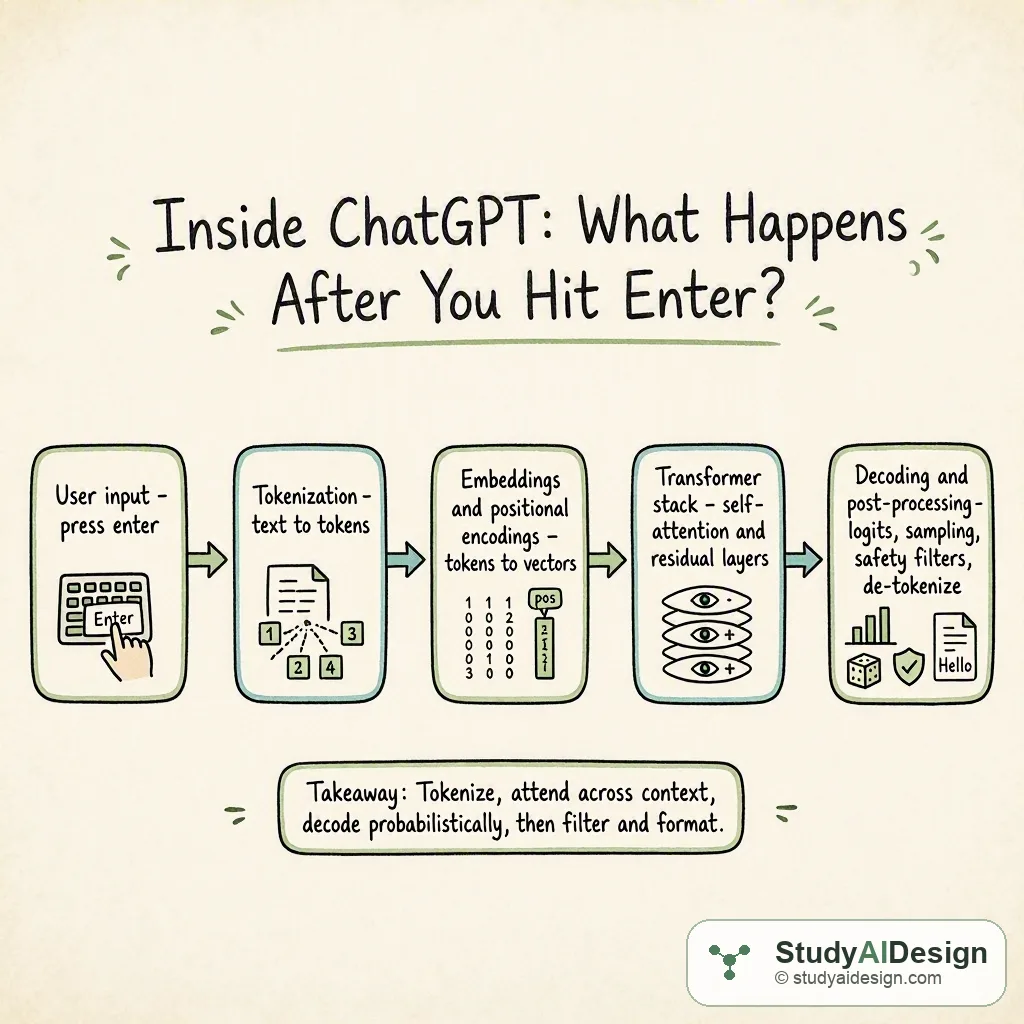
TL;DR
- When you hit Enter, text is turned into discrete tokens, then into vectors, and fed through the transformer to compute next-token probabilities.
- The model produces logits which are converted to probabilities with softmax and then sampled or selected by a decoding strategy like greedy, beam, top-k, or nucleus.
- The raw token output is detokenized and passed through safety and formatting steps before you see the final text. Key tradeoffs: latency versus quality, determinism versus diversity, and context length versus compute cost.
In this question, we will learn the end-to-end steps that run after you press Enter and how each stage affects latency, correctness, and safety.
We will cover the following:
- The intuition
- How it actually works
- Decoding strategies and comparison
- Tradeoffs and failure modes
- Questions the interviewer might ask
- What the interviewer is really testing
Direct answer: After you hit Enter the client tokenizes your text and sends tokens to the model, the transformer stack computes logits for the next tokens using attention across the context, a decoding rule converts logits into discrete tokens, and post-processing applies safety filters and formatting before the final text is returned. This pipeline balances compute, memory, and probability choices like temperature or top-p to trade off speed, determinism, and creativity.
The intuition (an analogy that makes it click)
Imagine a conversation as a relay race. The runner hands a baton that encodes the conversation so far to the next runner. Tokenization is the handoff. The transformer layers are runners that look at the baton and the race history to decide the best next step. Decoding is the decision to sprint or take a measured step. Post-processing is the referee checking rules and polishing the result.
This keeps the sequence coherent because each layer attends to prior context and refines predictions.
How it actually works (the real mechanics, with one concrete worked example)
Step overview: tokenization, embedding, transformer inference, logits, softmax, decoding, detokenization, filtering.
Concrete example: you type "Hello, how are you?"
Tokens and ids example:
| Token | Token id |
|---|---|
| Hello | 15496 |
| , | 11 |
| how | 703 |
| are | 389 |
| you | 345 |
| ? | 30 |
The model converts each token id to an embedding vector of dimension . For a context of length the model works with a tensor of shape . Positional encodings are added so the model knows order.
The core compute is a stack of transformer layers. Each layer computes self-attention then a feed-forward network. Self-attention computes attention scores between all pairs of positions, which costs time or memory with respect to the context length . The attention weights are used to mix value vectors and produce contextualized representations.
The model produces logits vector over the vocabulary for the next token. We turn logits into probabilities with softmax:
Then a decoding strategy selects the next token, the token is appended to the context, and inference continues until a stop condition.
Latency and cost table (approximate contributions):
| Stage | Example relative cost |
|---|---|
| Tokenization + prep | 5% |
| Transformer inference | 75% |
| Decoding overhead | 10% |
| Post-processing and filters | 10% |
A small worked numeric step: with temperature and logits for three candidates , probabilities become:
Compute these to see which token is likely and how temperature spreads probability mass.
Decoding strategies
We choose how to map probabilities to discrete tokens. Common options and tradeoffs:
| Method | Determinism | Typical use |
|---|---|---|
| Greedy | high | fast, repetitive responses |
| Beam search | medium | structured tasks, can increase coherence but may be stale |
| Top-k sampling | low | controls tail by k, increases variety |
| Nucleus (top-p) | low | focuses on cumulative mass, adaptive diversity |
Temperature is a scalar applied to logits before softmax. Higher temperature makes the distribution flatter and increases diversity. Lower temperature concentrates mass on the highest logit.
When we run autoregressive generation we often cache key and value tensors from previous steps so we do not recompute everything for prior tokens. Caching reduces compute per token from to per new token for the attention with respect to earlier tokens, but total memory grows with .
Tradeoffs and failure modes
- Latency versus context: larger gives better context but costs memory and higher latency.
- Determinism versus creativity: greedy or low temperature gives repeatable answers but may be bland. High temperature or sampling can hallucinate.
- Safety filtering versus fidelity: aggressive filters may remove correct but sensitive content or change tone.
Questions the interviewer might ask
Some follow-up questions you might get:
How does the context window limit affect generation? Context length bounds how many tokens the model can attend to. Older tokens fall out of context and the model may lose earlier details unless you summarize or use retrieval to reintroduce them.
Why is attention and can it be improved? Self-attention computes pairwise scores between positions, so naive cost is . Sparse or linearized attention approximations reduce cost but trade off expressiveness and sometimes quality.
What is the role of logits versus probabilities? Logits are raw scores that the model outputs. Softmax converts logits into probabilities. Temperature and top-p operate on logits or probabilities to shape sampling behavior.
How do caching and batching affect throughput? Caching previous key/value tensors speeds incremental generation. Batching multiple requests increases GPU utilization but adds scheduling complexity and potential latency for real-time apps.
How do safety filters integrate into the pipeline? Filters run after detokenization or on token streams. They detect policy violations and can block, redact, or request reformulation. Filters add latency and can create false positives.
Some things to note:
- Retrieval augmentation and tool use can reduce hallucinations by supplying grounded context.
- Quantization or mixed precision reduces memory and latency but can slightly affect output fidelity.
What the interviewer is really testing
They want to know you can explain the full inference pipeline clearly and link design choices to practical tradeoffs. They also want to hear how you would mitigate common problems like hallucination, latency, and context limits by using caching, decoding knobs, retrieval, or safety controls. Show you understand both the math and operational implications.
Related questions
How would you rate the quality of this article?
Prepare for your AI engineering interview
This is one of many detailed questions and explainers on StudyAIDesign. Browse the full set, work through the curriculum, and walk into your interview ready.