How do you prepare a dataset for fine-tuning an LLM?
Prepare a dataset for fine-tuning an LLM: practical steps to clean, format, and split training data for instruction, classification, or generation tasks. Learn how to choose file formats, remove leakage and duplicates, compute token budgets, and set validation checks so fine-tuning is effective and safe.
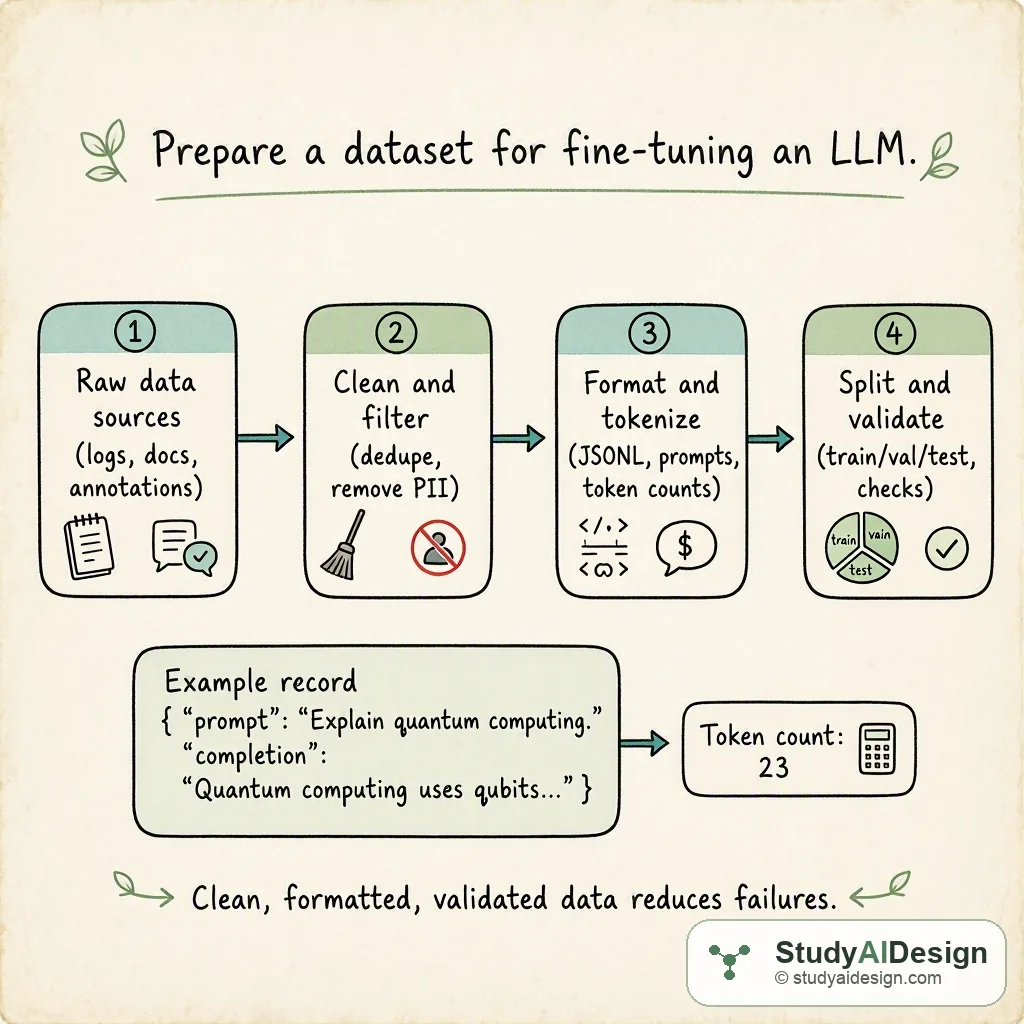
TL;DR
- Start by cleaning and deduplicating source text, removing private information and obvious errors.
- Convert examples into a consistent format such as JSONL with explicit prompt and response fields and compute token counts to fit your budget.
- Split into train and validation sets, and run quality checks: label consistency, prompt-response alignment, and example-level token limits. Key tradeoffs: more cleaning and filtering reduces noise but risks removing useful edge cases; larger datasets give coverage but increase cost and risk of distribution mismatch.
In this question, we will learn how to prepare a dataset for fine-tuning an LLM so you can produce reliable, efficient, and safe model updates. We will keep practical steps you can run in a script and checks you can run before you start training.
We will cover the following:
- The intuition and why each step matters
- How it actually works with a concrete worked example
- Practical checklist and file formats
- When to augment or filter data
- Tradeoffs and failure modes
Direct answer: Prepare a clean, deduplicated, and consistently formatted dataset (often JSONL) with explicit prompt and response fields, compute token counts to fit your training budget, split into train and validation sets, and run automated checks for leakage, label consistency, and toxic or private content. We also recommend keeping a small held-out test set and tracking provenance metadata for reproducibility.
The intuition (an analogy that makes it click)
Think of fine-tuning as teaching a student by example. If the examples are messy or inconsistent, the student learns contradictions. Clean, aligned examples are like clear worked solutions that the student can imitate. Validation examples are quiz questions that verify the student actually learned the pattern rather than memorized a handful of answers.
How it actually works (the real mechanics, with one concrete worked example appropriate to the question; use a markdown table if you compare options or show numbers, and inline LaTeX for any math)
At a high level you will: collect sources, clean and normalize text, deduplicate, label or pair prompt/response, compute token counts, format as a file the training pipeline accepts, and split into train/validation/test.
A useful quantity to compute early is the total token budget. If you have examples and average tokens per example , total tokens is
Worked example: you have examples and average tokens per example, so tokens. If your fine-tuning budget allows tokens, you are within budget.
Common output formats and quick pros and cons:
| Format | When to use | Notes |
|---|---|---|
| JSONL (prompt/response) | Instruction tuning, chat responses | Easy to stream example-by-example, includes metadata fields |
| TSV / CSV | Simple tabular pairs | Compact, but needs escaping and careful handling of newlines |
| Specialized SFT format | Tooling-specific | May include role tokens and system prompts required by the trainer |
Tokenization and chunking rules matter. For long documents, chunk at sentence or paragraph boundaries and include overlap if context is needed. Keep per-example token counts under your model context window minus system prompt tokens. Track per-example token length as a field so you can filter or balance by size.
Batch and step planning: if you use batch size and dataset size , steps per epoch are
Tune number of epochs so you do not overfit small datasets. For small , use stronger regularization and fewer epochs.
Practical checklist and file formats
Follow this checklist before you start fine-tuning:
- Source collection: record provenance and original IDs.
- Cleaning: normalize whitespace, fix encoding, remove obvious HTML or markup.
- Sensitive data removal: remove or mask personal identifiers and secrets.
- Deduplication: remove exact duplicates and near-duplicates by hashing or shingling.
- Label alignment: ensure prompts match responses and the intended instruction style.
- Token counts: compute and cap tokens per example to the model's context window.
- Splits: create train, validation, and optional test splits (common split: 90/9/1 if you have many examples).
- Format: export as JSONL with fields like
{"id":..., "prompt":..., "response":..., "tokens":..., "source":...}. - Sanity checks: run a small training pass or a scoring pass on the validation set to catch formatting bugs.
File format example (conceptual):
| field | purpose |
|---|---|
| id | unique example id |
| prompt | text given to the model |
| response | desired model output |
| tokens | token count after chosen tokenizer |
| source | provenance note |
When to augment or filter data
Augment when you have very few examples in a class or to balance label distributions. Use controlled augmentation such as paraphrasing with a high-quality model and then filter by semantic similarity or human review.
Filter aggressively when examples are low-quality, contradictory, or contain toxic content. For safety-critical applications, prefer higher precision in filtering even at the cost of recall. Track filtered examples so you can inspect what was removed.
Tradeoffs and failure modes
- Over-cleaning can remove rare but valid edge cases and introduce bias.
- Under-cleaning leaves label noise that degrades model quality and can lead to hallucinations.
- Removing duplicates helps generalization but may reduce coverage of common correct answers.
Questions the interviewer might ask
Some follow-up questions you might get:
How do you detect duplicates at scale? Use hashing for exact duplicates and locality sensitive hashing or n-gram shingling with a similarity threshold for near-duplicates. Compute fingerprints after normalization.
How do you choose the train/validation split? If you have a large dataset, a small validation fraction like to is enough. For small datasets, use cross-validation or multiple validation folds to estimate variance.
How do you handle label imbalance? Use oversampling, controlled augmentation, or loss weighting. Monitor for overfitting to oversampled classes.
What token limit should I apply per example? Cap per-example tokens to the model context minus system prompt. For a token context, you may cap at to leave room for system tokens.
How do you check for private data in training sources? Combine regex heuristics for phone numbers and emails, named entity detection, and human review for high-risk sources. Maintain provenance for removal.
Some things to note:
- Store a compact manifest with metadata for reproducibility.
- Run a smoke test fine-tune on a tiny subset to validate the pipeline.
What the interviewer is really testing
They want to know you can produce reproducible, safe, and cost-effective training data. Expect to show you understand token budgets, formats the trainer accepts, and basic data quality checks. They also want to hear how you prevent leakage and how you balance cleaning against preserving useful variability.
Further reading in the curriculum
Go deeper on the fundamentals behind this question.
- Fine-Tuning and Adaptation How to adapt pretrained language models to specific tasks using full fine-tuning, LoRA, instruction tuning, and preference alignment, and when each approach is the right tool.
Related questions
How would you rate the quality of this article?
Prepare for your AI engineering interview
This is one of many detailed questions and explainers on StudyAIDesign. Browse the full set, work through the curriculum, and walk into your interview ready.