What is the difference between single-agent and multi-agent systems?
Single-agent and multi-agent systems: explain how a single decision maker differs from multiple interacting agents, and why coordination, communication, and scaling matter. Learn the tradeoffs between centralized simplicity and decentralized robustness so you can design the right architecture.
TL;DR
- Single-agent and multi-agent systems differ in the number of decision makers and whether agents must coordinate or compete.
- Single-agent problems are simpler to model and debug, while multi-agent problems add communication, coordination, and possible strategic behavior.
- Interaction scaling and non-stationarity are the main engineering challenges when moving to multi-agent. Key tradeoffs: simplicity and centralized control versus scalability, parallelism, and coordination overhead.
In this question, we will learn the core differences between single-agent and multi-agent systems, why those differences matter for design, and how to reason about complexity, communication, and failure modes.
We will cover the following:
- The intuition
- How it actually works
- Coordination patterns
- When to use each
- Tradeoffs and failure modes
- Questions the interviewer might ask
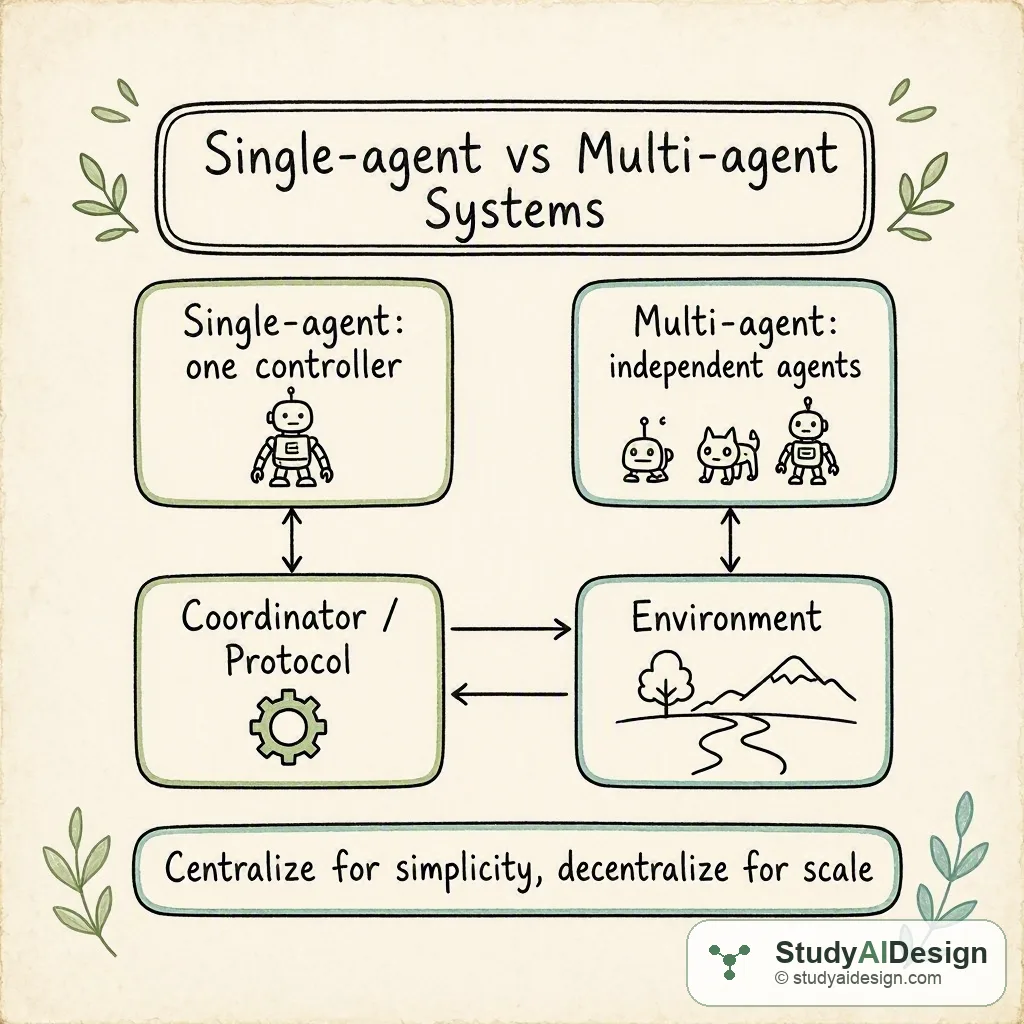
A single-agent system has a single decision maker optimizing actions in an environment, while a multi-agent system has two or more agents whose actions affect each other; multi-agent designs require attention to interaction, communication, and often strategic behavior. The single-agent case is easier to analyze and debug; the multi-agent case brings parallelism and robustness at the expense of coordination complexity.
The intuition (an analogy that makes it click)
Think of a single-agent system like a solo pianist playing from sheet music: one player controls tempo and dynamics. A multi-agent system is like a chamber ensemble where each musician follows a part, listens, and adapts. Poor timing or a missed cue by one musician affects the whole group, just as poor coordination by one agent can ripple through a distributed system.
How it actually works (the real mechanics, with one concrete worked example)
Mechanically, differences show up in state and action spaces, objective design, communication, and scaling.
Worked example: a traffic intersection. Two approaches:
- Single-agent: one central planner controls all vehicle trajectories through the intersection.
- Multi-agent: each vehicle is an independent agent that plans locally and communicates with nearby vehicles or a coordinator.
Compare key metrics:
| Metric | Single-agent (one controller) | Multi-agent (each vehicle an agent) |
|---|---|---|
| Decision units | 1 | |
| Coordination complexity | centralized optimization | decentralized negotiation and protocols |
| Communication needs | internal state sharing | explicit messages or implicit signaling |
| Scalability | limited by centralized compute | parallel but protocol-dependent |
Pairwise interactions often drive complexity. If interactions are checked pairwise, naive cost grows as
for agents. Systems typically reduce this with locality, spatial partitioning, or communication neighborhoods to approach or behavior in practice.
In the intersection example, a centralized planner can optimize traffic globally but its computational cost and single point of failure increase with . A multi-agent design distributes computation and isolates failures, but requires robust protocols to avoid deadlocks, oscillations, or unsafe behavior.
Coordination patterns
We often use recurring coordination patterns and they each have tradeoffs:
- Centralized training, decentralized execution: use global information to train stable policies, then run with local observations to meet deployment constraints.
- Leader-follower: a leader proposes plans and followers adapt; low communication at runtime but fragile if the leader fails.
- Market or auction-based allocation: agents bid for resources and a coordinator resolves conflicts; good for resource allocation but requires truthful bidding or verification.
- Implicit coordination: agents coordinate via environmental signals or predictable behavior, reducing explicit messaging but increasing design subtlety.
Each pattern balances latency, robustness, and implementation complexity.
When to choose each
Choose single-agent when the entire state can be aggregated cheaply and the problem size fits a central solver or when you need guaranteed global optimality. Choose multi-agent when the system is physically distributed, when parallel decisions are necessary for latency or scale, or when modularity and fault isolation are priorities.
Practical checklist:
- If agents are physically separate and local sensing dominates, multi-agent is natural.
- If you can centralize sensing and compute with acceptable latency, single-agent simplifies design.
Tradeoffs and failure modes
Single-agent pros: simpler reasoning, easier global optimization, straightforward debugging. Single-agent cons: single point of failure, compute bottleneck, poor fit for distributed hardware.
Multi-agent pros: parallelism, modularity, fault tolerance, potential for emergent solutions. Multi-agent cons: communication overhead, non-stationarity during learning, credit assignment challenges, and possible adversarial or selfish behavior.
Questions the interviewer might ask
Some follow-up questions you might get: How does non-stationarity affect multi-agent learning? Non-stationarity means each agent's learning target shifts as others change policies, breaking i.i.d. or stationary environment assumptions. Use approaches like centralized critics, opponent modeling, or slower learning schedules. What is centralized training with decentralized execution? It is a training setup that uses global state or coordinated critics to stabilize learning while ensuring agents act on local observations at runtime. How would you reduce communication overhead? Apply locality constraints, event-triggered communication, message compression, or rely on implicit coordination through shared signals. How do you assign credit in cooperative multi-agent tasks? Techniques include difference rewards, shaped global rewards with credit-assignment heuristics, or value decomposition that factors joint value into per-agent components. When is a market-based allocation appropriate? Markets suit resource allocation problems with clear utility signals and when agents can express preferences; they require careful mechanism design to avoid manipulation.
Some things to note:
- Non-stationarity and credit assignment are core technical hurdles in many multi-agent problems.
- Hybrid designs mixing centralized and decentralized elements are common in practice to balance tractability and scalability.
What the interviewer is really testing
They want to see that you understand the architectural and algorithmic consequences of adding agents: how state and action spaces grow, how interactions affect complexity, and what design patterns mitigate those issues. They are also checking for practical mitigation strategies like centralized training, locality, and protocol design rather than only formal definitions.
Further reading in the curriculum
Go deeper on the fundamentals behind this question.
- Agent Fundamentals From single LLM calls to autonomous agents: planning, tool use, memory, and the control loop.
- AI Design Patterns A catalog of recurring architectural patterns for LLM systems, with tradeoffs, failure modes, and guidance on when to combine or avoid each.
Related questions
How would you rate the quality of this article?
Prepare for your AI engineering interview
This is one of many detailed questions and explainers on StudyAIDesign. Browse the full set, work through the curriculum, and walk into your interview ready.