How do LLM guardrails work?
How do LLM guardrails work? This page explains how LLM guardrails operate at design time and runtime, covering classifiers, prompts, tooling, and orchestration. You will get a concise technical picture of patterns, a worked example with simple math, and the common tradeoffs.
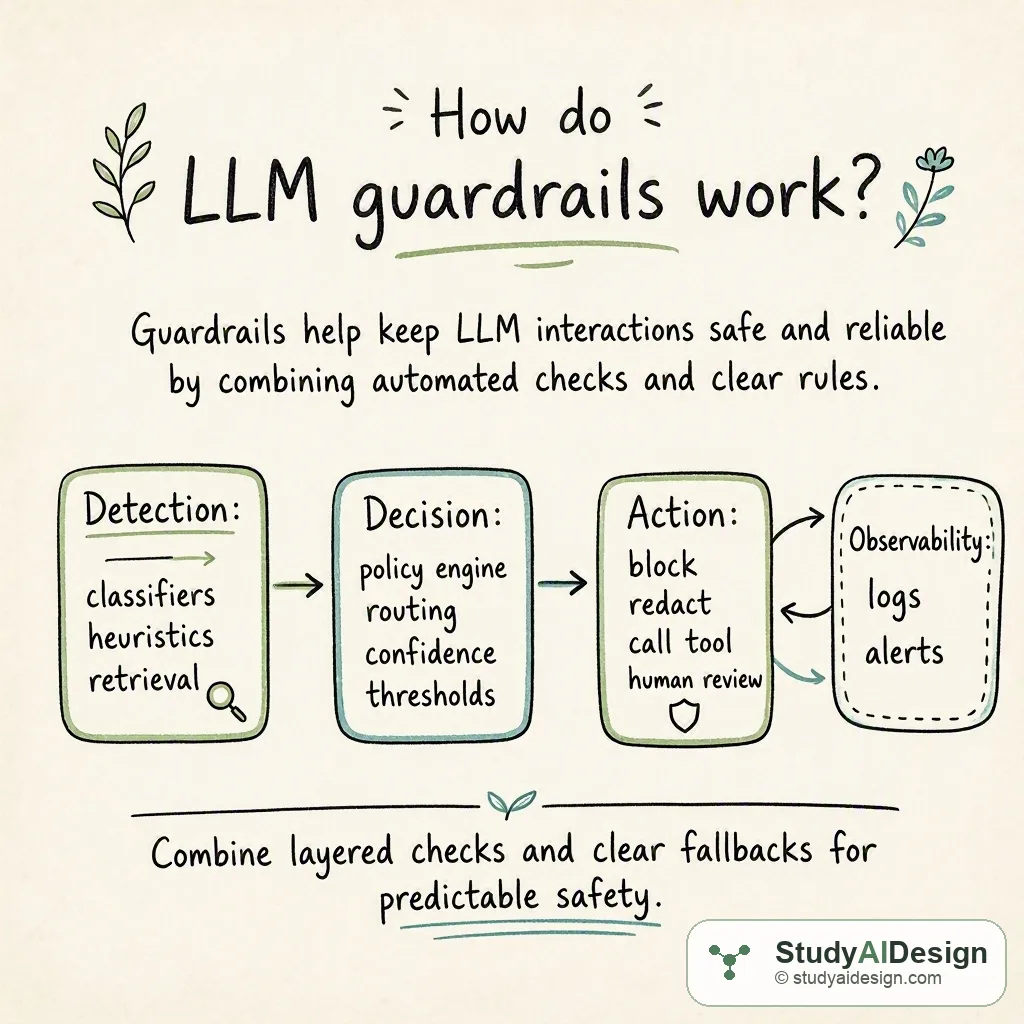
TL;DR
- LLM guardrails are layered controls combining prompts, model tuning, external classifiers, and runtime policy engines to prevent harmful outputs.
- Effective guardrails mix prevention, detection, and remediation with observability and clear fallbacks so behavior is predictable.
- You tune thresholds and composition to trade off latency, coverage, and false blocking. Key tradeoffs: latency versus coverage, precision versus recall, and maintenance cost versus strictness.
In this question, we will learn how LLM guardrails work and what components you combine to make models safer and more predictable. We will keep the explanation practical so you can design a simple runtime pipeline and explain tradeoffs to an interviewer.
We will cover the following:
- The intuition
- How it actually works
- Patterns and deployment considerations
- Tradeoffs and failure modes
- Questions the interviewer might ask
- What the interviewer is really testing
Direct answer: Guardrails work by stacking preventive and detective controls around an LLM and then applying rule-based or learned decisions to take safe actions. You start with system prompts and model tuning to reduce risky outputs, add classifiers and filters to detect violations, and use a policy engine to decide whether to block, transform, or escalate. Observability and clear fallbacks make the behavior auditable and robust.
The intuition (an analogy that makes it click)
Think of an LLM as a car on a busy road. Guardrails are the combination of a speed governor, lane sensors, and a human in the loop. The governor (system prompt and model tuning) reduces how fast risky content can appear. Sensors (classifiers and heuristics) spot problems early. The human or policy engine is the safety operator who decides to apply the handbrake, steer to a different lane, or let the car continue with a warning.
How it actually works (the real mechanics, with a worked example)
At a high level we split work into prevention, detection, decision, and action.
- Prevention: system prompt, instruction tuning, RLHF or model edits to reduce probability of certain outputs.
- Detection: lightweight classifiers, heuristics, regex, or external models that label outputs or inputs for policy violations.
- Decision: a policy layer that applies thresholds, business rules, and composition logic to determine the action.
- Action: block, redact, re-prompt, call a safe tool, or route to human review.
Worked example: imagine we want to block toxic replies. We use a detector with true positive rate and false positive rate . If the base rate of toxic prompts is then the probability a flagged example is actually toxic, the precision, is:
Plugging numbers gives:
That means most flagged cases are false positives at that base rate. We therefore design the decision step to require either higher detector confidence or a secondary check before blocking outright.
Latency example: if the base model costs and the classifier costs , the simple serial pipeline latency is
If we run detection in parallel on the user input before calling the model, we can reduce worst-case latency at the cost of extra classifier calls. These are engineering knobs you can explain in an interview.
Compare common guardrail approaches:
| Approach | Latency | Coverage | Maintenance | Typical false-positive tendency |
|---|---|---|---|---|
| System prompt / instructions | Low | Medium | Low | Low |
| Model fine-tuning / RLHF | Medium | High | High | Medium |
| Post-generation classifier | Medium | High | Medium | High |
| Tool-based execution (call safe tool) | High | Very high | Medium | Low |
| Human-in-the-loop | Very high | Very high | High | Low |
Patterns and deployment
Two practical patterns interviewers like: defensive-first and progressive filters.
- Defensive-first: apply prevention and input-time checks so the model rarely sees hazardous prompts. This reduces downstream checks but can raise false negatives if the model still produces bad outputs.
- Progressive filters: let the model respond, then run detectors on the output and apply remediation. This is safer for recall but can cost latency and create false-positive blocking.
A simple production pipeline is:
- Input pre-check (regex, profanity list).
- System prompt and constrained decoding.
- Post-generation classifier and policy engine.
- If flagged, try safe transformation or send to human review.
Monitoring is essential: track metrics like flagged rate, blocked rate, false-positive estimate, and mean time to human review. Use these to tune thresholds and the policy engine.
Tradeoffs and failure modes
Guardrails are not perfect. Common failure modes include adversarial prompts that bypass prevention, detectors that produce many false positives for rare harms, and complex composition bugs when policies conflict. You must balance user experience against safety.
Mitigations include multi-stage checks, allowlists for sensitive contexts, and periodic auditing of flagged examples.
Questions the interviewer might ask
Some follow-up questions you might get:
How do you choose thresholds for a detector? Pick thresholds with clear business metrics. Use precision-recall curves and set thresholds by acceptable false-positive rates or expected harm cost. Simulate with historical traffic to measure impact.
When would you prefer prevention over detection? Prefer prevention when strict guarantees matter and user flows tolerate constrained responses, for example legal or safety-critical outputs. Detection is better when recall is paramount and you can remediate gracefully.
How do you handle adversarial attempts to bypass filters? Use ensemble detectors, input normalization, and behavior tests. Log adversarial examples and retrain detectors, and add targeted rules where necessary.
What metrics would you report? Report flagged rate, confirmed-harm rate from sampling, precision estimate, latency impact, and human escalation load. Show trends over time.
How do you ensure guardrails do not encode harmful bias? Audit labeled data and detector behavior across demographic slices. Prefer transparent rules and human review for borderline cases.
When should human review be used? Use human review for high-impact or low-confidence decisions. Automate clear-cut cases and route ambiguous or high-risk cases to reviewers.
Some things to note:
- Low base rates make high precision hard without conservative thresholds.
- Mixed strategies often work best: prevention plus post-checks and escalation.
- Invest in observability early to tune and justify thresholds.
What the interviewer is really testing
They want to see you reason about layered safety, quantifiable tradeoffs, and concrete engineering choices. They expect familiarity with detectors, policy orchestration, latency and UX impacts, and monitoring strategies. Show you can pick approaches based on risk profile and iterate with metrics and human oversight.
Related questions
How would you rate the quality of this article?
Prepare for your AI engineering interview
This is one of many detailed questions and explainers on StudyAIDesign. Browse the full set, work through the curriculum, and walk into your interview ready.