What is re-ranking, and how does it improve RAG retrieval quality?
Re-ranking and RAG retrieval quality: explain what re-ranking is, why it is used in retrieval-augmented generation, and how combining cheap retrievers with expensive re-rankers improves final answers. Practical examples, a scoring formula, and tradeoffs are included to help you answer interview questions clearly.
TL;DR
- Re-ranking rescores an initial set of retrieved passages using a stronger relevance model to improve final context for RAG.
- You typically use a cheap retriever to fetch candidates then a cross-encoder or learned ranker to reorder or filter them.
- Re-ranking raises precision at the top results, which often yields better answers from the generator. Key tradeoffs: more compute and latency for higher precision at top ranks.
In this question, we will learn what re-ranking means in retrieval-augmented generation and why it improves retrieval quality for downstream answer generation. We will keep it concrete so you can explain the idea and show a small worked example.
We will cover the following:
- The intuition
- How it actually works
- When to apply re-ranking and practical choices
- Tradeoffs and failure modes
- Questions the interviewer might ask
- What the interviewer is really testing
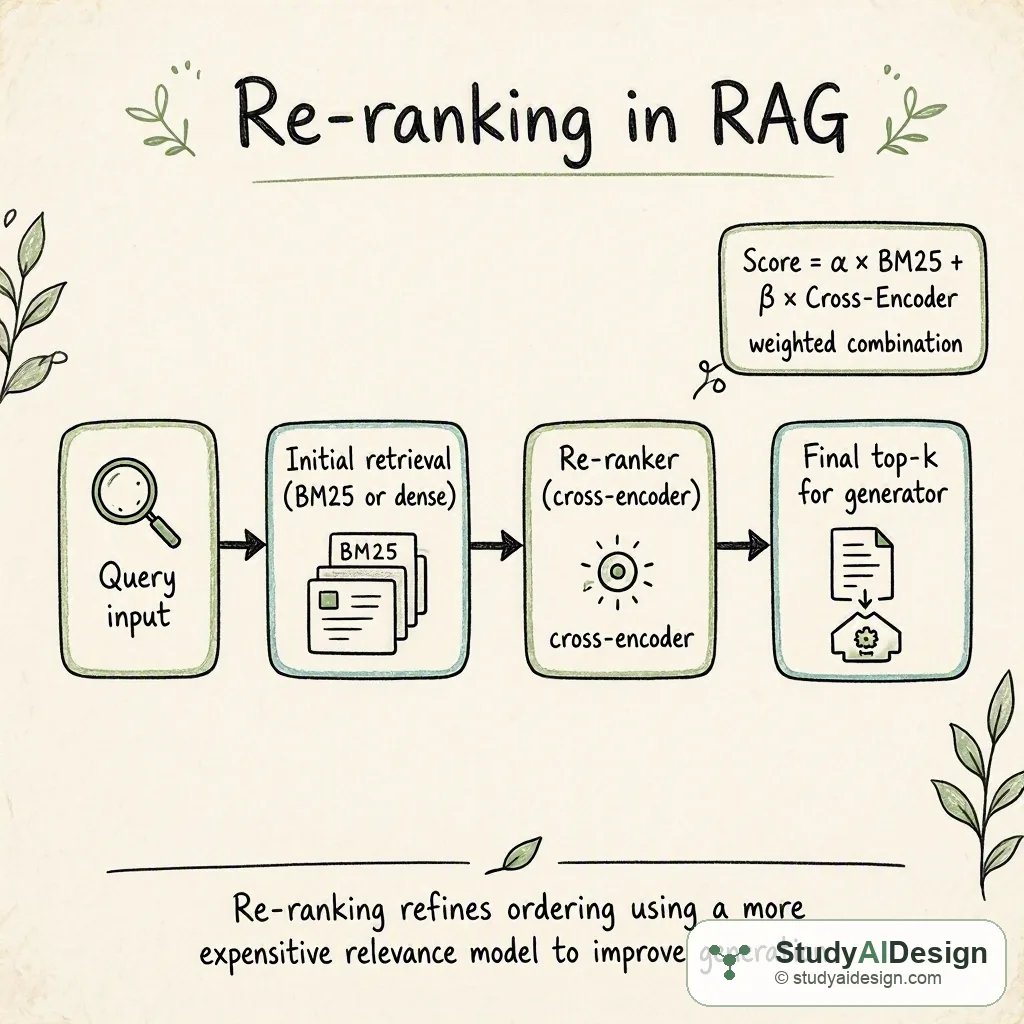
Direct answer: Re-ranking is the step that takes a cheap initial retrieval of candidate passages and rescoring them with a stronger relevance model, often a cross-encoder, to improve ordering and top-k precision for the generator. This improves RAG quality by reducing irrelevant or partially relevant context passed to the generator, which reduces hallucinations and increases factual accuracy. Re-ranking costs more compute and latency, so teams balance precision gains against system constraints.
The intuition (an analogy that makes it click)
Think of retrieval as a grocery shopper using a quick list and a flashlight in a poorly lit store. The shopper grabs a handful of items that might match the list. Re-ranking is like a second person who inspects those items closely, checking labels and expiration dates before placing the final items on the checkout belt. The second check is slower but avoids a bad purchase.
In RAG the generator is sensitive to the top few passages. Small improvements in the top ranks usually have outsized impact on the final answer quality.
How it actually works (the real mechanics, with one concrete worked example)
A common pipeline has two stages:
- A first-stage retriever (sparse like BM25 or dense like a dual-encoder) returns candidates with scores .
- A re-ranker (often a cross-encoder) computes richer relevance scores for those items and produces a final ordering or a combined score.
A simple linear combination of scores looks like this:
Here and are weighting parameters you tune on validation data. The re-ranker can also replace and sort purely by .
Worked example: the retriever returns four passages. We show initial scores, re-ranker scores, and final ranks after combination.
| passage | retriever score | re-ranker score | combined | final rank |
|---|---|---|---|---|
| A | 1.0 | 0.3 | 0.65 | 2 |
| B | 0.9 | 0.9 | 0.90 | 1 |
| C | 0.7 | 0.5 | 0.60 | 3 |
| D | 0.6 | 0.2 | 0.40 | 4 |
If we set and , then and B moves to the top because the cross-encoder identifies strong relevance.
The re-ranker typically uses cross-attention between the full query and a passage, which captures fine-grained interactions the dual-encoder misses.
When to apply re-ranking and practical choices
Use re-ranking when the top-k precision matters more than throughput. Typical scenarios:
- You have a limited context window for the generator and must feed only the best passages.
- Answers require fine-grained lexical or semantic reasoning that the first-stage retriever misses.
- You can afford extra latency or use asynchronous pipelines that re-rank in the background.
Practical choices:
- First stage: choose large enough so the true positives are likely included, commonly to depending on corpus size.
- Re-ranker model: cross-encoder BERT or a lightweight transformer distilled ranking model. Cross-encoders are slower but more accurate.
- Combination: either replace ordering with alone or tune weights on a dev set.
Implementation patterns and optimizations
You can reduce cost and latency with hybrid patterns:
- Cascade re-ranking: apply a medium-cost reranker to shrink candidates from to , then a heavy cross-encoder for top where .
- Distillation: train a smaller re-ranker to mimic the cross-encoder scores so you get similar ordering with less compute.
- Caching and offline reranking: rerank popular queries offline and cache the top results.
Each pattern trades compute, freshness, and accuracy differently.
Tradeoffs and failure modes
Re-ranking improves precision at the top ranks but brings costs and new failure modes. Compute and latency increase, especially with cross-attention models. If the initial retriever misses the correct passage, re-ranking cannot recover it. Over-reliance on a faulty ranking signal can also push semantically relevant but lexically different passages down.
Common failure modes:
- Retriever recall too low so re-ranker never sees the correct answer.
- Re-ranker overfits training signals and favors passages with spurious cues.
- Latency budgets are exceeded for interactive systems.
Questions the interviewer might ask:
Some follow-up questions you might get:
Why not only use a cross-encoder for retrieval? You can, but cross-encoders are expensive at scale. Dual-encoder or sparse retrievers let you index and search quickly; cross-encoders are best used on a small candidate set.
How do you choose and the re-ranker model? Choose by measuring recall at on held-out queries. Pick a re-ranker based on the latency budget and accuracy needs, and tune weights on dev data.
How do you evaluate re-ranking improvements? Use precision-at-top metrics like P@1 or P@5, mean reciprocal rank MRR, and downstream QA or generation quality measures such as exact match or human judgments.
Can you combine multiple re-rankers? Yes. Cascading small to large models or ensemble scoring can improve robustness but adds complexity and cost.
How does re-ranking affect hallucinations in generation? By improving the relevance and precision of the context, re-ranking reduces the chance the generator will rely on unrelated or misleading passages, lowering hallucination risk.
Some things to note:
- Always confirm the first-stage retriever achieves reasonable recall before investing in heavy re-ranking.
- Test re-ranking impact on the final generated answers, not only ranking metrics.
What the interviewer is really testing
They want to confirm you understand retrieval pipelines end-to-end: recall vs precision, the role of candidate pools, and the cost-accuracy tradeoffs of cross-encoders. They also want practical judgment on when to add re-ranking, how to tune the combination, and how to measure downstream gains. Show that you think about latency, scalability, and failure modes as well as accuracy.
Further reading in the curriculum
Go deeper on the fundamentals behind this question.
- RAG Fundamentals Why retrieval-augmented generation works, and how to build a pipeline that actually grounds answers.
- Evaluating AI Systems How to measure, monitor, and improve LLM system quality from offline eval sets through production observability.
- AI Design Patterns A catalog of recurring architectural patterns for LLM systems, with tradeoffs, failure modes, and guidance on when to combine or avoid each.
Related questions
How would you rate the quality of this article?
Prepare for your AI engineering interview
This is one of many detailed questions and explainers on StudyAIDesign. Browse the full set, work through the curriculum, and walk into your interview ready.