retrieval
Part of the AI system design curriculum
RAG Fundamentals
Why retrieval-augmented generation works, and how to build a pipeline that actually grounds answers.
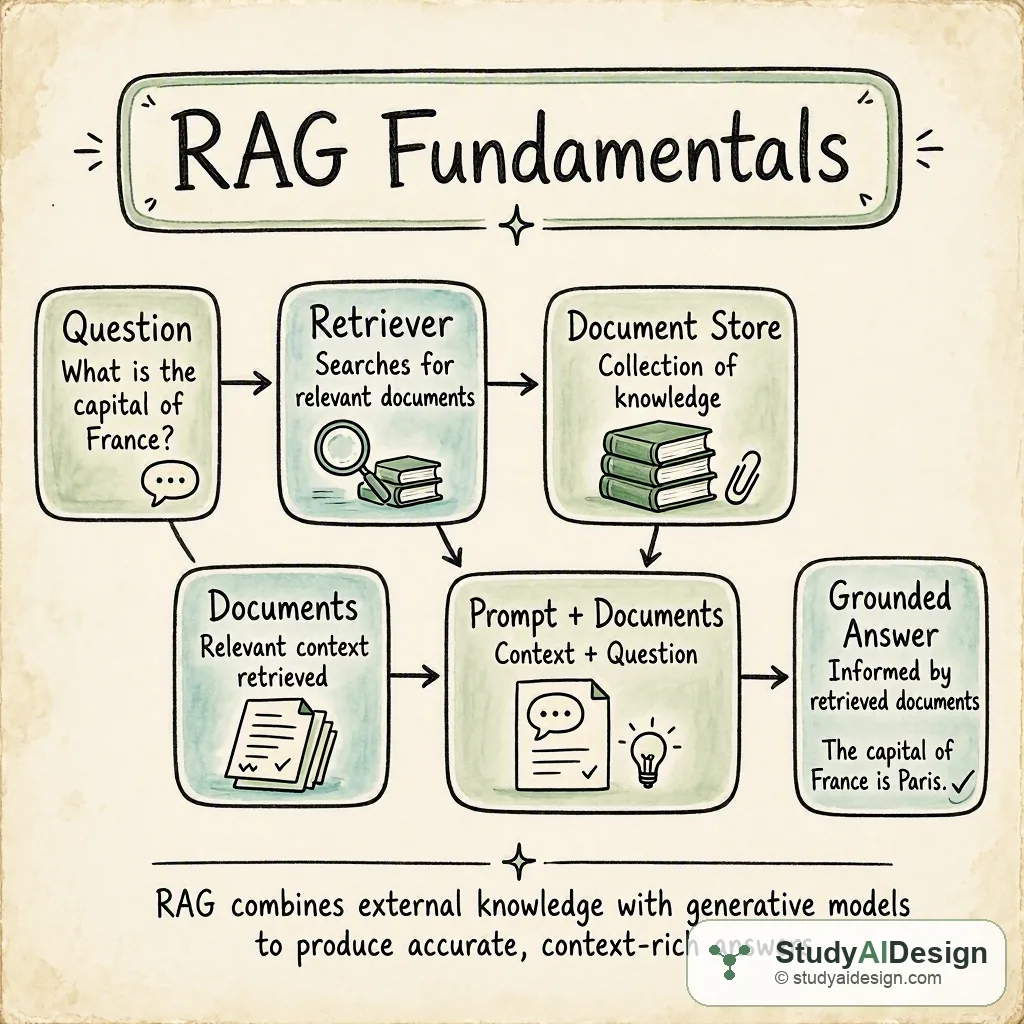
A language model trained six months ago has never read your internal wiki, your Q3 product specs, or yesterday's incident report. When you ask it about these things, it either refuses or confabulates, generating fluent text that sounds right but is grounded in nothing. Retrieval-Augmented Generation (RAG) fixes this by giving the model a search capability: find the relevant documents at query time, inject them into the prompt, and let the model reason over verified content instead of recalled patterns. The architecture is conceptually simple, but making it work reliably in production is a surprisingly deep engineering problem.
TL;DR
- RAG replaces static, weight encoded memory with dynamic retrieval. Documents live outside the model and can be updated easily by re-indexing.
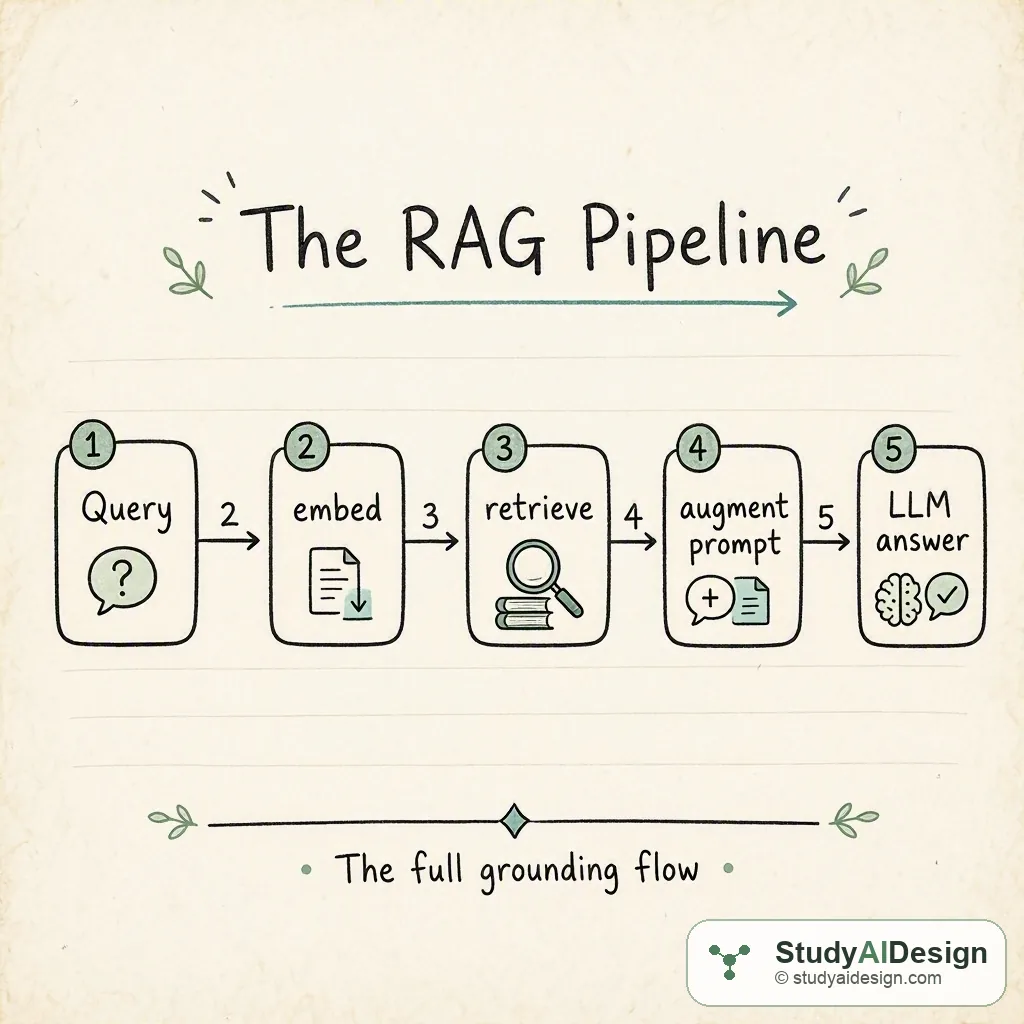
- The standard pipeline is index (embed chunks offline), retrieve (vector similarity search at query time), and generate (prepend retrieved chunks to the query).
- Hybrid retrieval combines dense embedding search with sparse keyword search (like BM25) to catch both semantic meaning and exact terminology, outperforming either method alone.
- Most RAG failures are retrieval failures, not generation failures. If your retrieval recall is low, fix chunking and retrieval strategies before trying a different model.
- Chunk size requires balance: small chunks yield precise embeddings but lose context, while large chunks retain context but dilute the embedding signal.
The Grounding Problem
Why LLMs Confabulate
Hallucination is the wrong mental model. A language model does not have opinions or beliefs; it predicts probable continuations. When the training data contains no signal about a specific fact, the model still produces a continuation that fits the surrounding context. The result is confident, plausible text that happens to be wrong.
Think of a brilliant research librarian who has read millions of books but not your company's internal documentation. Ask her about public history, and she's excellent. Ask her about last week's board meeting, and she'll fill the gap with a plausible reconstruction, not because she intends to deceive, but because that's what fluent speakers do when pressed for specifics they don't have.
The problem compounds in domain-specific applications. A legal assistant that confidently cites a statute that does not exist, or a customer support tool that invents a product feature, causes real downstream harm that a plain "I don't know" would not. The deeper issue is that there is no natural signal inside the model to distinguish between remembered fact and inferred plausibility; both produce identical-looking output text.
Fine-tuning does not solve knowledge freshness. When you fine-tune a model on a set of facts, you are encoding those patterns into the weights. That can work for stable, high-frequency information, but it is brittle: one update to a document requires another fine-tuning run, coverage of edge cases depends on how well your training examples represent them, and the model may still confabulate on queries it has not seen enough of during training. RAG replaces weight-encoded memory with retrieval. The document lives outside the model, is easily updated by a re-index operation, and is directly visible in the prompt where the model can read it literally rather than recall it probabilistically.
The Core RAG Pipeline
The canonical three-stage pipeline:
- Indexing (offline): Split source documents into chunks, embed each chunk into a vector, persist in a vector store
- Retrieval (online, per query): Embed the user's query, find the top-K most similar chunks by vector similarity
- Generation: Prepend retrieved chunks to the query and pass the full context to the LLM
from sentence_transformers import SentenceTransformer
import numpy as np
embedder = SentenceTransformer("all-MiniLM-L6-v2")
# --- Indexing phase (done once) ---
documents = [
"The Paris Agreement targets limiting warming to 1.5°C above pre-industrial levels.",
"Photovoltaic panels convert photons into direct current via the photoelectric effect.",
"Our Q3 revenue was $4.2M, up 18% year-over-year.",
]
doc_embeddings = embedder.encode(documents, normalize_embeddings=True)
# --- Retrieval phase (per query) ---
def retrieve(query: str, top_k: int = 2) -> list[str]:
q_vec = embedder.encode([query], normalize_embeddings=True)
# Cosine similarity is just dot product for unit vectors
scores = doc_embeddings @ q_vec.T
ranked = np.argsort(scores[:, 0])[::-1][:top_k]
return [documents[i] for i in ranked]
# --- Generation phase ---
context_chunks = retrieve("What was our Q3 financial performance?")
prompt = "Context:\n" + "\n".join(context_chunks) + "\n\nQuestion: What was our Q3 financial performance?"
# Pass `prompt` to your LLMThis works for demos. For production, every stage has significant failure modes.
Chunking Strategy and Recall
How you split documents directly determines whether the right information surfaces at retrieval time. Chunk too small and you lose sentence context: the embedding of a 50-token fragment rarely captures the full meaning of a paragraph, and cosine similarity scores become noisy because the model is comparing two slivers of meaning rather than two coherent units. Chunk too large and the embedding averages over too much content: a 1000-token chunk that covers both pricing policy and shipping policy scores mediocrely against a question about either topic alone, because the embedding is a centroid of many concepts rather than a precise signal for any single one.
A practical starting point is 256 to 512 tokens with a 40 to 80 token overlap between adjacent chunks. The overlap prevents a useful sentence from being stranded at a boundary by copying the tail of each chunk into the head of the next. For documents with natural structural units (numbered contract clauses, API endpoint descriptions, FAQ entries), align chunk boundaries to those units rather than fixed token counts. Structural boundaries are almost always better split points than arbitrary token positions.
Two patterns extend the baseline further. Parent-document retrieval indexes small sentence-level chunks (around 128 tokens) to produce sharp, precise embeddings, but stores a pointer from each sentence chunk to its full parent section (512 to 1024 tokens). When a sentence chunk matches at retrieval time, the retriever returns the parent section rather than the small chunk. The small chunk acts as a precise address; the large chunk carries the context the model actually needs to generate a complete answer. Sentence-window expansion is a lighter version of the same idea: index individual sentences, but at retrieval time expand each matched sentence to include the two or three sentences on either side before passing to the LLM. Both patterns improve Recall@K because the index is sharp, and improve generation quality because the context window is fuller.
A useful diagnostic to run on your system: if Recall@10 is above 80% but answer quality is still poor, chunking is probably not the bottleneck and the failure is downstream in generation. If Recall@10 is below 60%, check chunk boundaries and chunk size before blaming the embedding model or retrieval algorithm.
The Three Retrieval Gaps
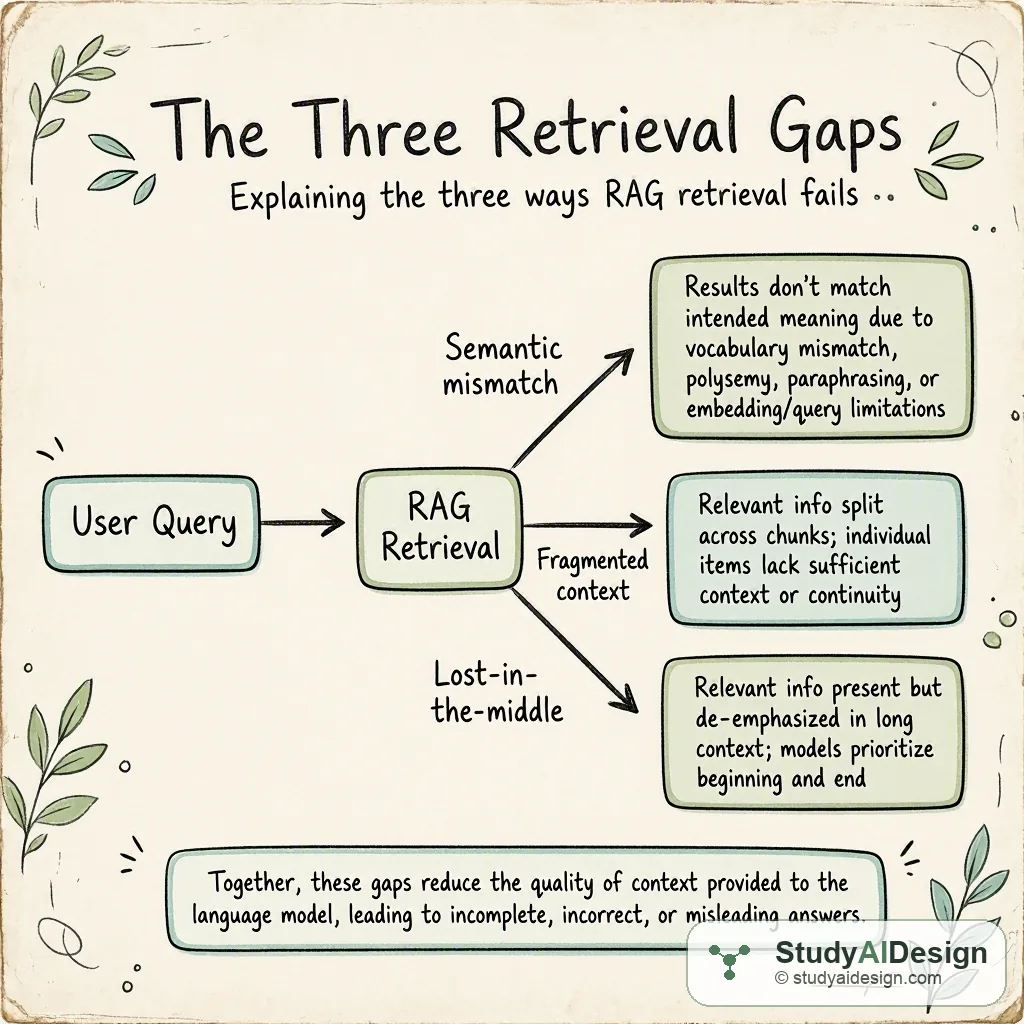
Most RAG failures are retrieval failures, not generation failures. The LLM is perfectly capable of reading a relevant passage and extracting the answer. The problem is that the relevant passage never made it into the context window. There are three distinct ways this happens.
Gap 1: Semantic Mismatch
A user asks "which vehicle accelerates fastest?" Your database stores a document titled "Porsche 911 Turbo S 0-60 benchmark results." Pure keyword search finds nothing because no words overlap. Embedding search usually helps (semantic similarity captures paraphrase), but embedding models trained on general text sometimes miss domain-specific vocabulary.
The fix is hybrid retrieval: run both dense (embedding) search and sparse (BM25) keyword search, then merge the ranked results with Reciprocal Rank Fusion (RRF). Each result gets a score of 1 / (k + rank) in each list, and the scores are summed. Sparse search catches exact terminology; dense search catches conceptual equivalence. Their combination beats either alone.
BM25 is a term-frequency and inverse-document-frequency scoring function that has been the backbone of full-text search engines for decades. It handles exact matches, phrase proximity, and rare tokens without any learned representation, which makes it robust to domain shift: a BM25 index over legal documents does not need to be trained on legal text, it just counts and weights tokens. Dense retrieval adds semantic generalization but can fail on a specific model number, a contract identifier, or a rare technical term that the embedding model has not seen in sufficient context during training. Neither dominates across all query types; hybrid retrieval extracts the strengths of both.
The RRF formula in full: given ranked lists from multiple retrieval systems, assign each document a score of 1 / (k + rank_in_list) for each list it appears in, then sum those scores across all lists. The constant k is typically 60. It prevents a single top-ranked result from dominating when there is uncertainty at the top of a list, and it requires no score normalization: BM25 scores and cosine similarities live in completely different numeric ranges, but ranks are always comparable integers. The combined merged list is then passed to the reranker.
On the BEIR benchmark (a collection of 18 heterogeneous retrieval tasks spanning biomedical literature, legal filings, and financial documents), hybrid retrieval consistently outperforms dense-only retrieval by 2 to 8 NDCG points, with the largest gaps on out-of-domain queries where the embedding model was not specifically trained on that domain's vocabulary.
Gap 2: Fragmented Context
The retriever fetches a chunk that contains a partial answer, but the complete answer spans two adjacent chunks that were split during indexing. The model sees "the interest rate was increased by..." and the completion "...50 basis points" lives in the next chunk, which scored just below the retrieval cutoff.
The fix involves smarter chunking strategies:
- Overlapping windows: chunks share N tokens with their neighbors
- Parent-document retrieval: index small chunks for precision, but return the full parent section when a small chunk matches
- Sentence-window expansion: expand a matched sentence to include its surrounding paragraph at generation time
The effect of overlap is measurable. On a corpus of legal briefs split into 256-token chunks with no overlap, Recall@10 for questions whose answers span a paragraph boundary was around 34%. Adding a 64-token overlap raised it to roughly 71%, because a sentence straddling a chunk boundary now appears in both adjacent chunks, and at least one of those chunks is retrieved.
For parent-document retrieval, a concrete setup: index 128-token sentence-level chunks so that embedding signals are sharp, but store a pointer from each sentence chunk to its 512-token parent section. When the retriever finds the top-K sentence chunks, swap each one for its parent before building the context window. This is a single indirection in the retrieval layer but frequently doubles the completeness of the context passed to the LLM, because the model receives the full paragraph from which the matched sentence came rather than an isolated fragment.
Gap 3: Lost in the Middle
Even when all relevant content arrives in the context window, LLMs disproportionately use information near the start and end of long prompts, effectively ignoring content buried in the middle. If you retrieve 20 chunks and the key fact is chunk 11, the model may not use it.
The fix is a cross-encoder reranker. After initial retrieval, the reranker scores each candidate chunk against the query using a model that attends jointly to both (not just their individual embeddings). This is slower than embedding lookup but far more accurate at separating relevant from marginally relevant content. Keep only the top 3-5 chunks and move the most relevant ones to the prompt boundaries.
Understanding why cross-encoders are more accurate clarifies when the extra latency is worth it. A bi-encoder (the standard embedding approach) produces one vector for the query and one vector for each document, computed independently, with no interaction between them. Relevance is the dot product of two fixed-length vectors, which collapses all meaning into a single geometric comparison. A cross-encoder instead concatenates the query and the candidate document into a single input sequence, runs the full transformer attention stack over all tokens together, and produces a scalar relevance score. Every query token can attend to every document token. This joint attention catches fine-grained term-level matches, negation, and conditional relationships that a dot product between independent vectors cannot represent.
The cost is one forward pass per candidate. For a corpus of a million documents, running a cross-encoder over every candidate is not feasible at query time. The practical pattern is a two-stage pipeline: a fast bi-encoder retrieves the top 50 candidates (roughly 5 to 10 ms using HNSW approximate nearest-neighbor search), and the cross-encoder rescores those 50 in 100 to 200 ms on a single GPU. Total end-to-end retrieval latency is under 300 ms, which is acceptable for most interactive applications. If latency is tighter, reduce the candidate pool to 20 or 30 and use a smaller reranker model such as cross-encoder/ms-marco-MiniLM-L-6-v2 instead of a full BERT-large variant.
RAG vs. Long Context Windows
Frontier models now offer context windows of 1M-2M tokens. The obvious question is whether RAG still makes sense when you can simply paste in everything.
The answer is nuanced and depends on your situation:
| Dimension | Long-context loading | RAG |
|---|---|---|
| Corpus under 50K tokens | Yes, simpler, no infra | Overkill |
| Corpus over 1M tokens | Impossible | Yes, required |
| Real-time / hourly updates | Expensive re-load | Yes, just update index |
| Cost-per-query sensitivity | High (input tokens are priced) | Yes, retrieve ~2K tokens |
| Source attribution required | Difficult to trace | Yes, chunk-level citations |
The practical heuristic: for a static corpus under 50K tokens, in-context loading with prompt caching is simpler and requires no vector infrastructure. For anything that grows, updates frequently, or must stay cost-efficient at scale, RAG is the right choice.
One consideration often overlooked is latency under document churn. If 10% of your documents update daily, long-context loading means re-loading the full corpus on every query that might touch updated content. RAG means re-indexing only the changed documents. Most vector databases support upsert by document ID, so re-indexing a changed document is a targeted operation, not a full rebuild. The incremental update cost favors RAG heavily for dynamic corpora.
A second practical consideration is source attribution. When an LLM reads 200K tokens and makes a claim, pinpointing which passage supports that claim is a post-hoc analysis problem. RAG pipelines surface chunk-level metadata automatically: each retrieved chunk carries its document ID, section heading, and creation timestamp. Attribution is a byproduct of the architecture, not an added audit step.
The RAG Quality Ladder
Think of RAG maturity in tiers:
| Tier | Name | What it adds | When to use |
|---|---|---|---|
| 1 | Naive RAG | Embed → cosine search → top-K → generate | Prototypes only |
| 2 | Advanced RAG | Hybrid retrieval (BM25 + dense), cross-encoder reranker, context compression | Minimum viable production baseline |
| 3 | Agentic RAG | Model controls retrieval, issues follow-up queries, routes between indexes | Highly varied query patterns |
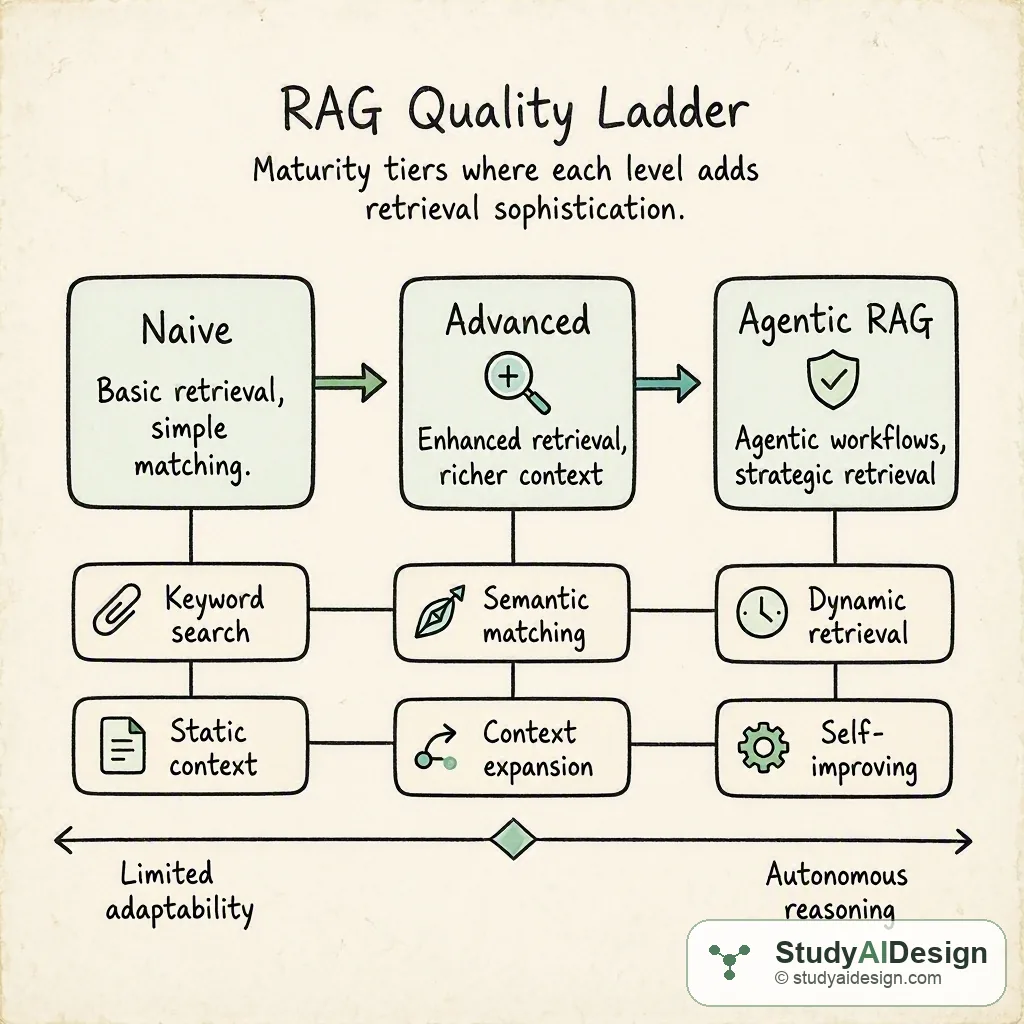
Between tiers there are concrete implementation decisions worth understanding. Moving from Tier 1 to Tier 2 is almost always justified. The components are well-supported: BM25 indexing is available in Elasticsearch, OpenSearch, or the rank-bm25 Python package; cross-encoder reranking is a single method call in the sentence-transformers library. Adding a reranker on a 50-candidate pool costs 100 to 200 ms per query, which is acceptable in most interactive applications. The improvement in answer quality is typically significant enough that the latency cost is not a real debate in practice.
Moving to Tier 3 (agentic) is only justified when queries vary so widely in structure that no single retrieval strategy covers them adequately: some queries need a precise single-document lookup, others require aggregating evidence across dozens of documents, and some require iterative refinement where each retrieval round depends on what the previous round found. Agentic RAG typically involves the model issuing a retrieval tool call, inspecting the results, deciding whether to issue a follow-up query with refined terms, and repeating until it has enough information. This loop introduces latency proportional to the number of rounds (each round adds a full retrieval and LLM inference step) and makes the pipeline significantly harder to evaluate systematically, because the retrieval path differs for every query. Exhaust the deterministic Tier 2 options before introducing agentic loops.
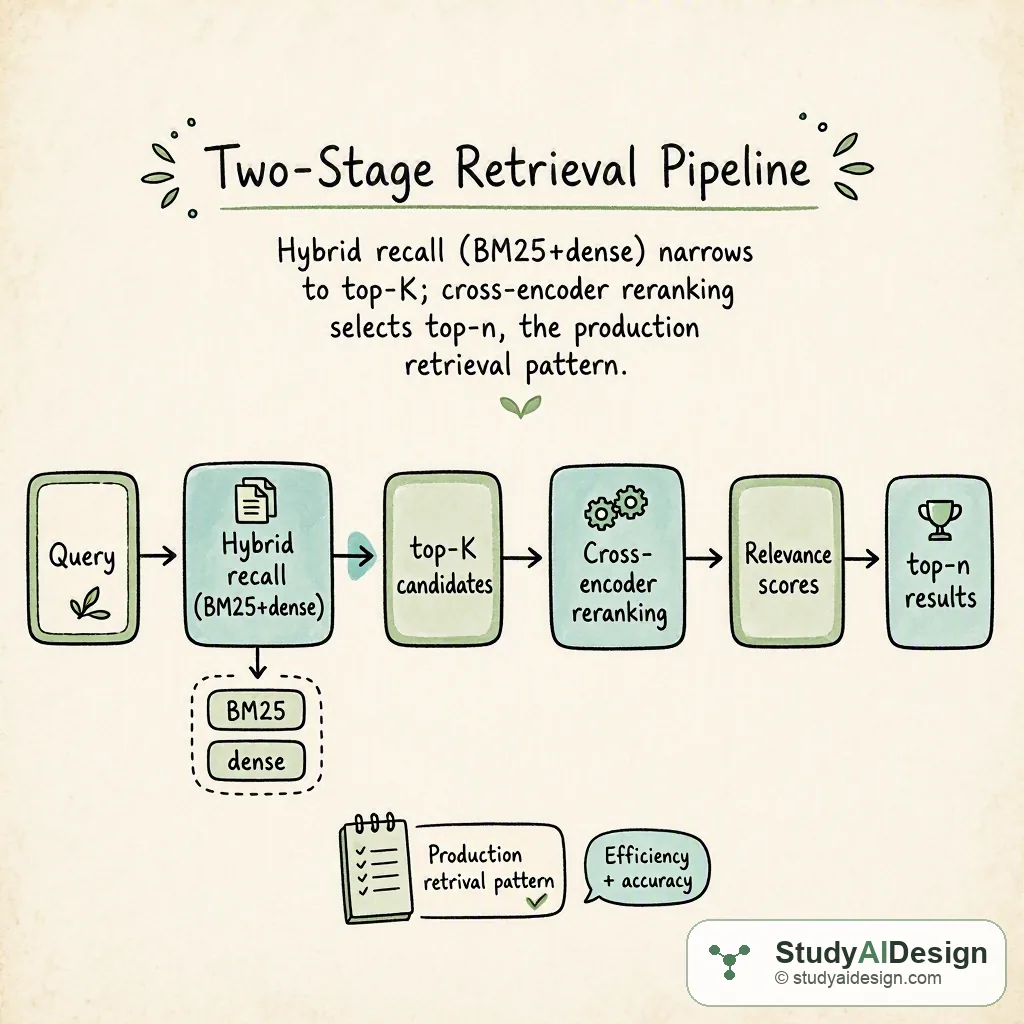
Worked Example: A Two-Stage Retrieval Pipeline
Consider a legal document search system. Queries come in two shapes: precise ("what is the indemnification clause in contract 4471?") and fuzzy ("what contracts have unusual liability exposure?").
A production pipeline for this system would:
- Index each contract clause as an overlapping chunk (200 tokens, 40-token overlap), stored in a vector database alongside a BM25 inverted index
- At query time, run both searches in parallel and merge with RRF
- Rerank the top-20 merged candidates with a legal-domain cross-encoder, keeping the top-5
- Generate a structured answer, citing clause IDs from the retrieved chunks
The clause ID citation is the payoff: because every retrieved chunk carries its source metadata, the generated answer can point back to the exact document section, making the system auditable in a way a pure LLM never could be.
With Concrete Numbers
A production evaluation on a held-out set of 200 labeled queries showed the following progression after each pipeline change:
| Pipeline variant | Recall@10 | Faithfulness | Avg context tokens sent to LLM |
|---|---|---|---|
| Naive RAG (dense only, top 10) | 61% | 74% | 2800 |
| Hybrid BM25 + dense, RRF, top 10 | 79% | 81% | 2800 |
| Hybrid + cross-encoder reranker, top 5 | 86% | 91% | 1400 |
The retrieval path for each query: BM25 returns its top 25 candidates; dense retrieval returns its own top 25. RRF merges the two lists into a pool of up to 50 unique documents (many candidates appear in both lists, so the actual pool is typically 30 to 40 unique entries). The cross-encoder scores every document in that pool against the query in a single batched forward pass, and the top 5 are passed to the LLM with their contract IDs included as metadata in the prompt.
Faithfulness here is measured by an LLM-as-judge approach: for each sentence in the generated answer, a judge model checks whether a retrieved clause directly supports that sentence. A faithfulness score of 91% means 9% of generated sentences contain claims not traceable to any retrieved chunk. Most of these occur when the model bridges two clauses with an implied inference that is not stated in either. The fix is a prompt instruction to state only what is explicitly supported by the provided clauses, not to derive or infer across them.
The drop in context tokens from 2800 to 1400 (from top 10 to top 5 after reranking) reduced per-query cost by roughly 15% and measurably improved response coherence, because the model was processing five tightly relevant clauses rather than five relevant clauses plus five marginally related ones that added noise.
Interview angle
Related Topics
How would you rate the quality of this article?
Keep going
Practice what you just read against real interview questions, or carry on through the curriculum.