What are the key components of the Transformer architecture?
Transformer architecture key components: attention, multi-head attention, positional encoding, feed-forward layers, residual connections, and layer normalization. This question asks you to name and explain each component and how they fit together in encoder and decoder stacks for large language models.
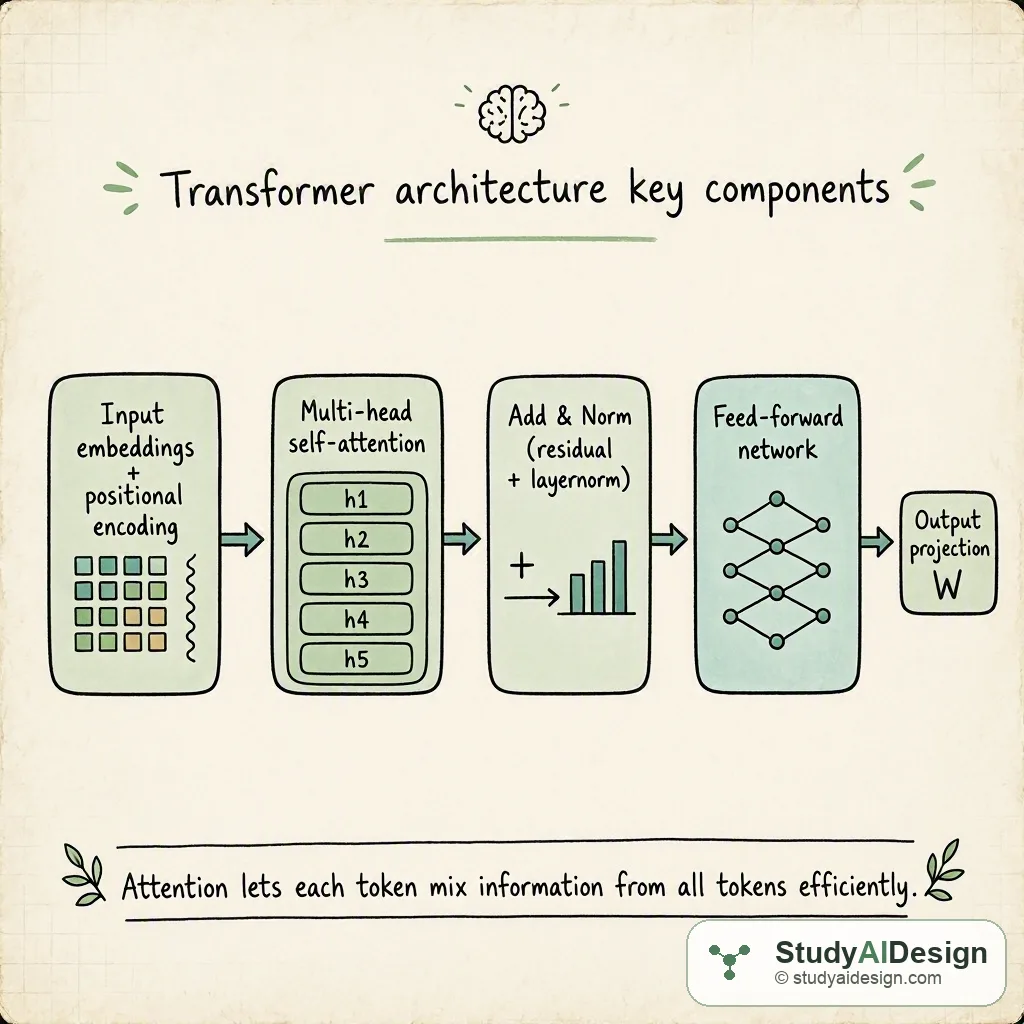
TL;DR
- Transformer architecture key components are: input embeddings with positional encoding, multi-head self-attention, residual connections with layer normalization, position-wise feed-forward networks, and output projection.
- Attention computes weights from queries and keys and applies them to values, often using scaled dot-product inside a softmax.
- Encoders stack self-attention and feed-forward layers; decoders add masked self-attention and encoder-decoder attention for generation. Key tradeoffs: latency and memory scale roughly with sequence length squared for vanilla attention, while parallelism and representation power are strong.
In this question, we will learn the key components of the Transformer architecture and why each piece matters for modern LLMs and sequence models. We will explain what each component does, show a small worked example of dimensions and attention, and summarize common variants and failure modes.
We will cover the following:
- The intuition
- How it actually works
- Encoder versus decoder roles
- Scaling, efficiency, and common variants
- Tradeoffs and failure modes
- Questions the interviewer might ask
- What the interviewer is really testing
Direct answer: The key Transformer components are input embeddings with positional encoding, multi-head scaled dot-product attention, residual connections with layer normalization, position-wise feed-forward networks, and an output projection; encoders and decoders arrange these blocks differently for encoding and autoregressive decoding. These components let the model mix information across positions, stabilize training, and produce contextualized token representations.
The intuition (an analogy that makes it click)
Think of a classroom discussion. Each student (token) has a short note (embedding). Positional encoding tells each student their seat. During attention, a student scans the room to decide which other students to listen to for this particular question. Multi-head attention is like having several overhearers focusing on different topics simultaneously. The feed-forward network is each student thinking alone about what they heard and rewriting their note. Residual connections are the habit of keeping your original note while adding the new thought, and layer normalization keeps everyone's note scale similar so the classroom stays orderly.
How it actually works (the real mechanics, with one concrete worked example)
At a high level each token is mapped to an embedding vector of size . For self-attention we compute query , key , and value matrices by learned linear projections. Scaled dot-product attention for one head is:
Multi-head attention runs several of these in parallel, concatenates the results, and applies a final linear projection.
Worked example: suppose a tiny sequence of 4 tokens, , and a model dimension , with heads. Then each head uses .
| Item | Symbol | Shape |
|---|---|---|
| Input token embeddings | ||
| Queries for head 1 | ||
| Keys for head 1 | ||
| Values for head 1 | ||
| Attention weights (head 1) | ||
| Head outputs concatenated | concat(heads) |
Step through one forward pass, at high level:
- Compute = , split into heads.
- For each head compute to get .
- Concatenate heads to and apply output projection.
- Add residual projected-attention, apply layer normalization, then feed through a position-wise feed-forward network, add another residual and normalization.
The position-wise feed-forward layer typically has two linear layers with a nonlinearity, often , acting independently on each position: .
Encoder versus decoder roles
Encoders stack blocks of self-attention then feed-forward, producing contextual representations for all positions at once. Decoders use three attention mechanisms per block: masked self-attention (to prevent attending to future tokens), encoder-decoder attention (to read encoder outputs), and a feed-forward. For generation the mask enforces autoregressivity.
Because the decoder attends to encoder outputs via queries derived from the decoder states and keys/values from the encoder states, the decoder can condition generation on the encoder representation while still preserving causal constraints.
Scaling, efficiency, and common variants
Vanilla self-attention costs time and memory because of the matrix. That becomes expensive for long sequences. Common strategies to reduce cost include:
- Sparse or local attention that restricts pairwise interactions.
- Linearized attention that approximates softmax with kernels to achieve behavior.
- Memory layers or hierarchical attention that compress long contexts.
When designing or tuning models we trade off context length, model width (), and depth (number of layers). Wider models increase per-step compute and memory, while deeper models increase latency but can be more parameter efficient in some regimes.
Tradeoffs and failure modes
Attention gives powerful global context but has clear costs and limits. Practical failure modes include quadratic memory blowup, attention patterns that focus on irrelevant tokens, and sensitivity to positional encodings for very long contexts. Training can suffer from instability if residual scaling or layernorm placement is off.
Questions the interviewer might ask
Some follow-up questions you might get:
How does scaled dot-product attention differ from unscaled dot-product? Scaling by prevents the dot products from growing large in magnitude when is large, which keeps the softmax gradients in a stable range.
Why use multiple heads instead of one bigger head? Multiple heads let the model attend to different subspaces or relations simultaneously. They can represent diverse patterns that a single head may struggle to capture.
Where do residuals and layer normalization go and why? Residual connections add the block input to its output to preserve gradients, while layer normalization stabilizes activations. Typical placement is add then norm, though pre-norm variants put layernorm before the sublayer for training stability in very deep models.
What shapes determine memory cost in attention? Sequence length and number of heads matter most; the attention score matrix is and dominates memory for large .
How are positional encodings implemented? Classic Transformers use sinusoidal encodings added to embeddings. Learned positional embeddings are also common and sometimes perform better with sufficient data.
Some things to note:
- Residuals and normalization choices affect training depth and stability.
- Attention gives global receptive field at the cost of quadratic complexity.
- Encoder-decoder attention only exists in the decoder and links the two stacks.
What the interviewer is really testing
They want to see you can name each component and explain the data flow and purpose: how queries, keys, values produce attention, why multi-head and residual connections matter, and how encoders and decoders differ. They also want awareness of practical tradeoffs like quadratic cost and normalization placement, so show both conceptual understanding and engineering awareness.
Related questions
How would you rate the quality of this article?
Prepare for your AI engineering interview
This is one of many detailed questions and explainers on StudyAIDesign. Browse the full set, work through the curriculum, and walk into your interview ready.