What are foundation models, and how have they changed AI engineering?
Foundation models are large pretrained models such as large language models that serve as a reusable base for many tasks. This question asks what foundation models are and how they changed AI engineering, covering adaptation methods, deployment patterns, and the operational tradeoffs you will explain in an interview.
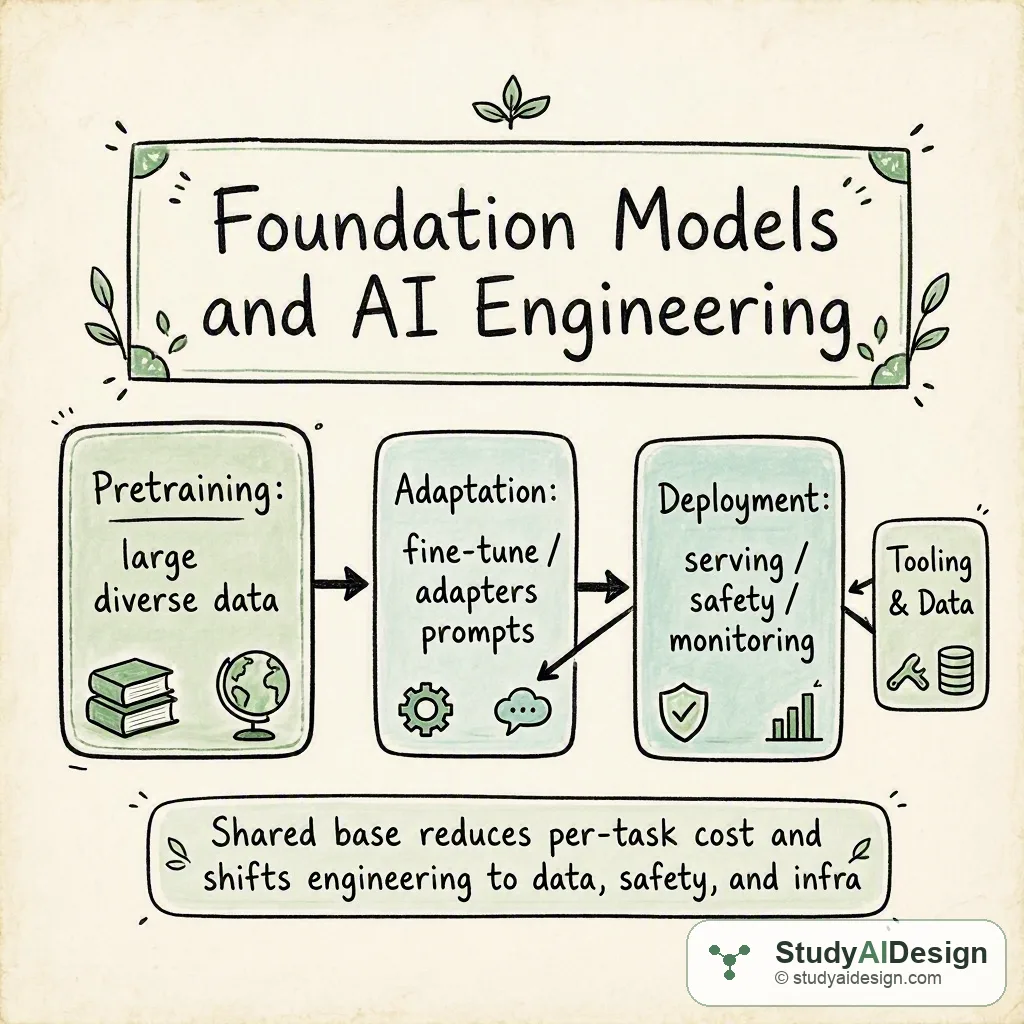
TL;DR
- Foundation models are large pretrained neural networks such as large language models, trained on broad data and reused for many downstream tasks.
- They move effort from training many task-specific models to adapting one base model through fine-tuning, adapters, or prompts.
- Engineering now emphasizes data pipelines, adaptation tooling, safety checks, and large-scale serving patterns.
In this question, we will learn what foundation models are, why they matter, and how they changed AI engineering practices. We will keep examples focused on language models and practical engineering implications so you can answer system and hiring interview questions confidently.
We will cover the following:
- The intuition
- How it actually works
- Engineering changes and patterns
- When to use foundation models and alternatives
- Tradeoffs and failure modes
- Questions the interviewer might ask
- What the interviewer is really testing
Direct answer: Foundation models are large pretrained models, often trained on broad heterogeneous data, that serve as a common base for many downstream tasks. They changed AI engineering by shifting effort to pretraining, adaptation strategies, data and safety pipelines, and infrastructure for large-scale serving and monitoring.
The intuition (an analogy that makes it click)
Think of a foundation model like a utility power plant. We build a big centralized source of capability once, then many applications plug in and pay for only the marginal adaptation cost. You do not build a small generator for every building. Instead you design adapters, transformers, and distribution networks that connect the plant to specific needs. That moves work from training many small models to designing how to safely, cheaply, and reliably use one big model.
How it actually works (the real mechanics, with one concrete worked example)
At core, a foundation model is trained with self-supervised objectives on massive and diverse data. After pretraining, we adapt it. Common adaptation methods include full fine-tuning, adapter modules, prompt tuning, and retrieval augmentation. Each method updates a different fraction of parameters and has different compute and data needs.
A simple mathematical view uses parameter count and fraction updated . Full fine-tune updates , adapters or prompt tuning update a small . This affects training compute and storage for per-task copies.
Worked example. Suppose you have a pretrained model with parameters and a task with labeled examples. Compare three adaptation strategies.
| Strategy | Fraction updated | Trainable params | Typical epochs | Notes |
|---|---|---|---|---|
| Full fine-tune | 3 | Best task fit, highest storage per task | ||
| Adapter modules | 3 | Small updates, easier to store many tasks | ||
| Prompt tuning | 10 | Very few params, needs careful prompt design |
With small, adapters and prompt tuning are often more sample efficient and cheaper to store per task. Full fine-tune can overfit and requires more GPU memory and runtime.
Retrieval augmentation changes the pattern. Instead of changing , we add an indexed database and a retrieval step that supplies context at inference time. That moves engineering effort to data pipelines, index freshness, and latency optimization.
Engineering changes and patterns
Two big engineering shifts are observable.
- Build once, adapt often. Teams invest in a single robust pretraining pipeline or adopt a vendor model. Work centers on tools to adapt and evaluate the base.
- Platform thinking. You need model versioning, adapter registries, prompt libraries, safety filters, and monitoring. Serving deals with larger memory, batching, and latency controls.
Operationally, this produces new roles and tools: dataset curators, prompt engineers, safety validators, and adapter registries. CI pipelines now include red-team tests, data drift checks, and rollout canary stages for model changes.
When to use foundation models and alternatives
Foundation models excel when you need broad language or multimodal capability, fast iteration on new tasks, or to reduce the cost of building many task-specific models. If you have tiny compute budgets, strict latency constraints, or a very small domain with privacy that prevents cloud hosting, a smaller specialized model or edge model may be preferable.
A quick decision table:
| Case | Prefer foundation model when | Prefer specialized-smaller model when |
|---|---|---|
| Broad capability | Need generalization across tasks | Task is narrow and labeled data plentiful |
| Cost per task | Many tasks share base model | Single high-throughput service with strict latency |
| Privacy | Can apply private retrievers or on-prem hosting | Data cannot leave device or strict legal limits |
Tradeoffs and failure modes
Foundation models bring scale benefits and also new risks. You gain transfer power and faster product development. You also inherit biases from pretraining data, a larger attack surface, and new operational complexity. Monitoring and robust evaluation become mandatory.
Questions the interviewer might ask
Some follow-up questions you might get:
How does parameter count relate to capability?
Capability often improves with parameter count and data size, roughly following scaling laws such as where is loss and is a positive exponent. This is empirical and varies by task.
What is the difference between fine-tuning and prompt tuning?
Fine-tuning updates many or all parameters. Prompt tuning keeps the model fixed and optimizes a small prompt vector or tokens. Prompt tuning saves storage but may need more engineering to reach the same performance.
How do you control hallucinations in LLMs?
Use grounding with retrieval, add tool-based verification, calibrate confidence scores, and apply post-processing rules. Maintain human review for high-risk outputs.
How do you handle model updates in production?
Use canary rollouts and shadow tests, keep adapters and prompts versioned, and run regression checks against historical test suites. Plan fast rollback and incident triage.
What are cost drivers in deploying foundation models?
Model size , inference latency targets, throughput, and the need to store per-task adapters or full copies. Also include data pipeline and monitoring costs.
Some things to note:
- Pretraining data quality often matters more than raw parameter count.
- Adaptation strategy strongly affects storage, compute, and sample efficiency.
What the interviewer is really testing
They want to see you can connect model concepts to system design, costs, and safety. The interviewer expects clear reasoning about adaptation methods, operational patterns, and tradeoffs so you can propose realistic deployment strategies. Show that you can choose methods based on data size, latency, and privacy constraints rather than only model size.
Related questions
How would you rate the quality of this article?
Prepare for your AI engineering interview
This is one of many detailed questions and explainers on StudyAIDesign. Browse the full set, work through the curriculum, and walk into your interview ready.