What is LLM-as-a-judge evaluation, and what are its limitations?
LLM-as-a-judge evaluation uses a language model to score, rank, or critique outputs from models or people. This page explains how LLM-as-a-judge evaluation works, common protocols, and its main limitations such as bias, calibration, and reproducibility.
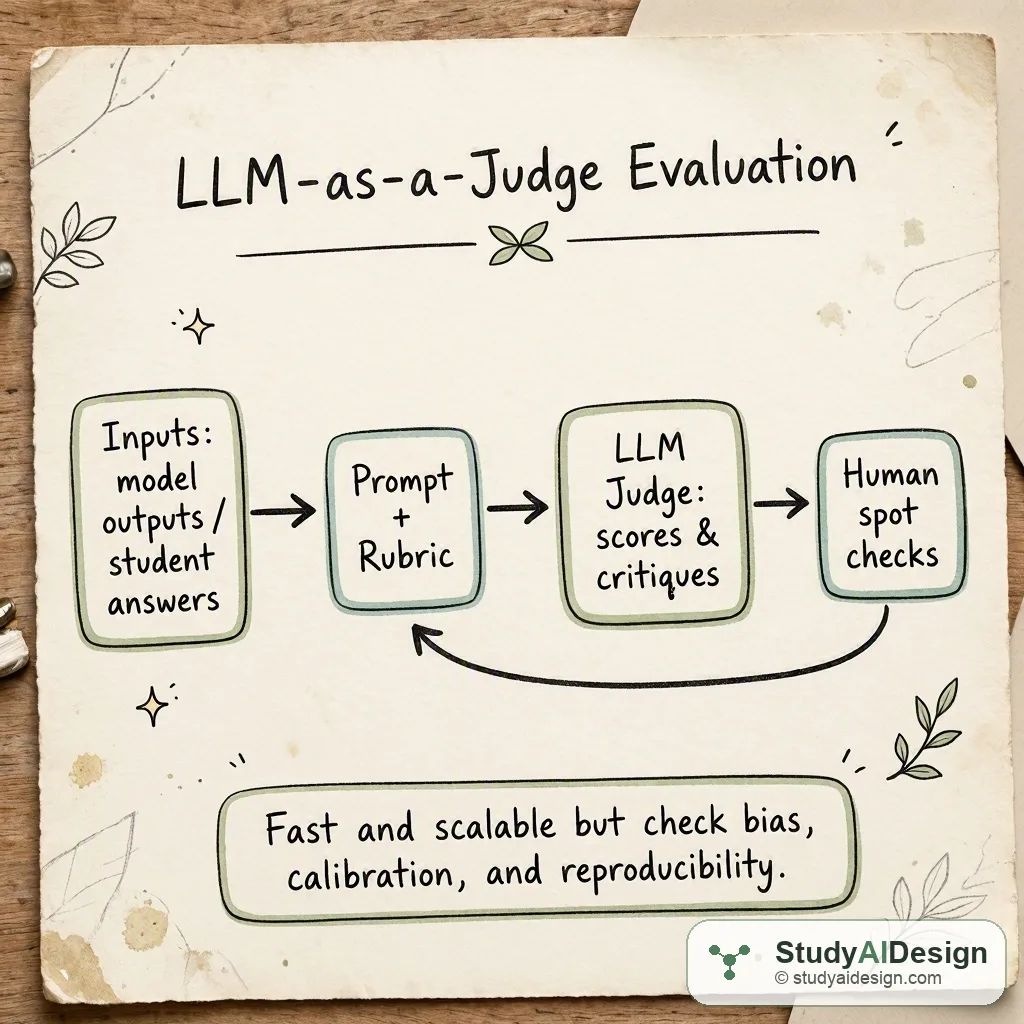
TL;DR
- LLM-as-a-judge evaluation uses a language model to score, rank, or critique outputs from models or people.
- It can run at scale and express complex rubrics inside prompts for rapid evaluation.
- Main limitations are systematic bias, calibration errors, sensitivity to prompt design, and reproducibility challenges. Key tradeoffs: speed and scale versus reliability and interpretability.
In this question, we will learn what LLM-as-a-judge evaluation is, how people run it, and where it breaks.
We will cover the following:
- The basic idea and common protocols
- A concrete worked example with numbers
- Practical variants, best practices, and failure modes
- Interviewer questions and what they are testing
LLM-as-a-judge evaluation is the practice of using a language model to score, rank, or critique other model outputs or human answers, usually by encoding a rubric in the prompt. It is valuable for scaling evaluations and capturing nuanced criteria, but you must apply calibration, ensembling, and human spot checks to avoid biased or brittle judgments.
The intuition (an analogy that makes it click)
Think of the LLM as a junior grader you hire to mark short answers. The grader can follow a written rubric and work fast, but they bring a particular interpretation and blind spots. We want the speed and consistency of that grader while keeping periodic human oversight to catch systematic mistakes.
How it actually works (the real mechanics, with one concrete worked example)
A typical protocol is:
- Define an explicit rubric with clear criteria and a few exemplar judgments.
- Construct a prompt that presents the rubric, examples, and the target output to judge.
- Choose model settings such as temperature, max tokens, and sampling strategy.
- Request a numeric score, a label, or a pairwise preference for each candidate output.
- Aggregate judgments and run validation against a human-labeled holdout.
Concrete example. Suppose we have student answers to a short math question and we ask a judge to give a score from 0 to 5. Human scores and an LLM judge scores might look like this:
| answer id | human score | LLM score | absolute difference |
|---|---|---|---|
| 1 | 5 | 5 | 0 |
| 2 | 3 | 2 | 1 |
| 3 | 2 | 4 | 2 |
We can compute mean absolute error as
In this small example with the MAE is . We typically report MAE, Pearson or Spearman correlation, and confusion matrices when the rubric is categorical.
Practical variants and protocols
- Pairwise comparison: the LLM is asked which of two outputs is better. Comparisons often yield higher agreement than absolute scores.
- Rubric-based numeric scoring: prompts include precise criteria and examples to map responses to a numeric scale.
- Explain-then-score: the model first explains its reasoning and then gives a score, which helps audits and error analysis.
- Ensemble judging: run multiple prompts or models and aggregate with majority vote or mean to reduce single-judge noise.
When to trust an LLM judge and how to improve it
We increase trust by calibrating and stress testing the judge. Useful actions include:
- Calibration: learn a mapping from raw LLM outputs to human scales using a validation set.
- Prompt validation: test sensitivity to prompt paraphrases and to different exemplar choices.
- Adversarial checks: include edge cases, ambiguous items, and distributions that differ from training data.
- Human spot checks: audit a random sample and all items the judge flags as low confidence.
Tradeoffs and failure modes
LLM judges enable scale but bring risks. They can confidently produce incorrect assessments, favor particular writing styles, or be brittle to small prompt changes. They also inherit biases present in training data and can shift labels when the target population differs from the validation set.
Questions the interviewer might ask
Some follow-up questions you might get:
Why would you use an LLM judge instead of only humans?
You use it for scale, faster iteration, and consistent application of a written rubric. Humans remain necessary for final judgment and tricky or high-stakes cases.
How do you measure whether the LLM judge is good enough?
Compare the judge against a human-labeled validation set using MAE, correlation, and confusion matrices. Also track subgroup performance to detect biases.
How do you reduce bias in LLM judgments?
Calibrate on representative human labels, use diverse prompts and exemplars, analyze subgroup gaps, and include human review for sensitive groups or high impact items.
What are prompt engineering pitfalls to avoid?
Avoid leading language, ambiguous rubrics, and too few or unrepresentative examples. Those produce overconfident, inconsistent judgments.
When should you prefer pairwise comparisons?
Use pairwise when quality is subjective or relative. Comparisons are often easier for the model to make consistently than scoring on an absolute numeric scale.
Some things to note:
- Validate with a human-labeled holdout before trusting automated scores.
- Use multiple metrics and sanity checks, not a single number.
- Budget time and cost for regular audits and calibration runs.
What the interviewer is really testing
They want to know you grasp both the operational benefits and the technical limits. Show that you can quantify judge quality, identify bias and calibration issues, and propose practical mitigations like ensembling, calibration, and human spot checks. Concrete examples and metrics will make your answers credible.
Further reading in the curriculum
Go deeper on the fundamentals behind this question.
- Choosing the Right Model A practical framework for navigating the 2026 model landscape and picking the right model for your use case, budget, and latency requirements.
- Evaluating AI Systems How to measure, monitor, and improve LLM system quality from offline eval sets through production observability.
Related questions
How would you rate the quality of this article?
Prepare for your AI engineering interview
This is one of many detailed questions and explainers on StudyAIDesign. Browse the full set, work through the curriculum, and walk into your interview ready.