How does Claude Code work? and How does Cursor work?
Claude Code and Cursor system-design: explain how Claude Code models are specialized for coding tasks and how Cursor ties a code-aware editor to model inference and retrieval. Compare their architectures, retrieval and execution flows, and tradeoffs for latency, security, and accuracy.
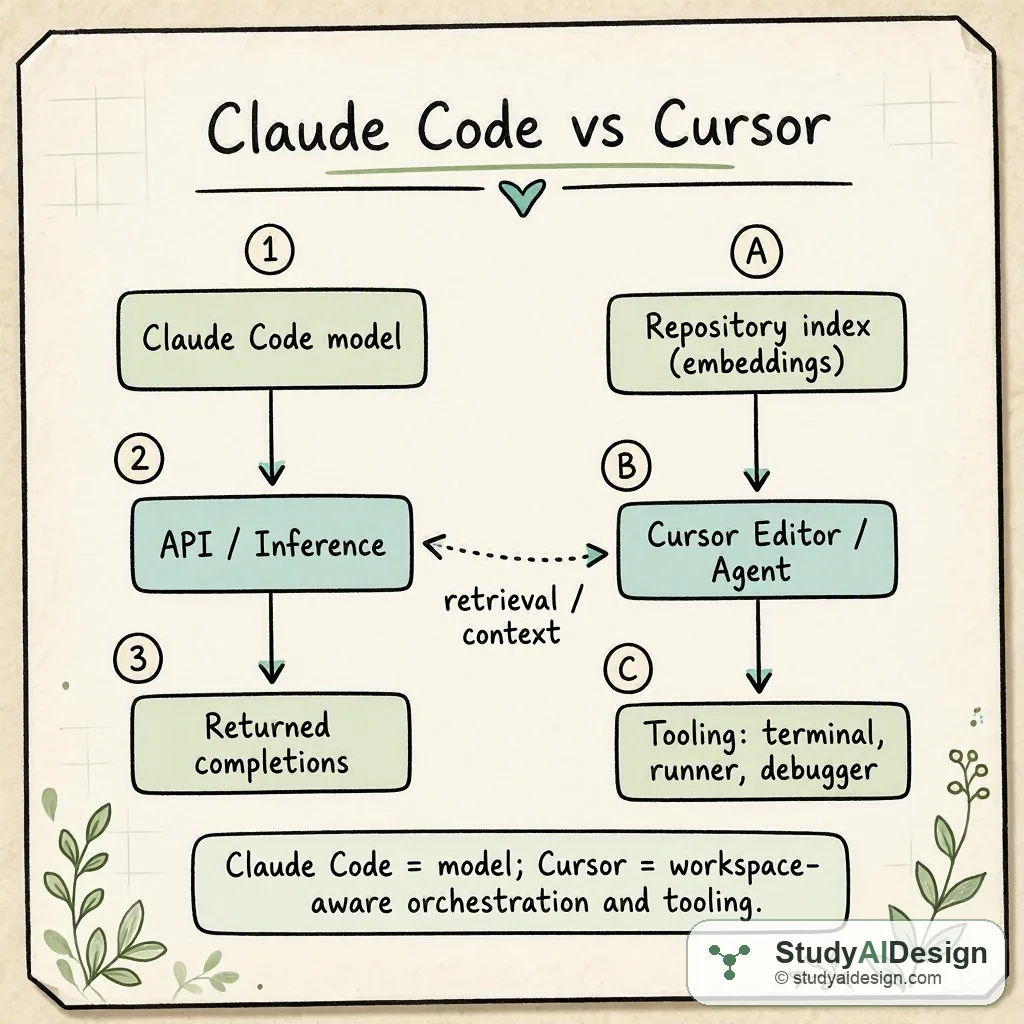
TL;DR
- Claude Code is a code-optimized language model and inference stack that focuses on code understanding, synthesis, and safety checks.
- Cursor is a developer-facing environment that combines local or remote models, repository embeddings, retrieval, and tool integrations to provide workspace-aware coding assistance.
- Together they form two layers: a model layer that generates code and a workspace orchestration layer that retrieves context, runs tools, and manages state. Key tradeoffs: latency versus context breadth, private execution versus managed safety, and retrieval cost versus freshness.
In this question, we will learn how Claude Code and Cursor work and how they fit together when you build a code assistant. We will explain the core pieces, a concrete example of a developer prompt flow, integration patterns, and the main tradeoffs.
We will cover the following:
- The intuition
- How it actually works
- Integration patterns and developer UX
- Deployment, scaling, and latency
- Tradeoffs and failure modes
- Questions the interviewer might ask
- What the interviewer is really testing
Short answer: Claude Code is a model and inference stack trained and tuned to handle code semantics, formatting, and safety; Cursor is a workspace-aware orchestration layer that indexes your repository with embeddings, retrieves relevant context, wires in tools like terminals and test runners, and routes prompts to a model like Claude Code or another LLM. Together they let a developer query code with higher relevance and run code safely, at the cost of retrieval, storage, and orchestration complexity.
The intuition (an analogy that makes it click)
Think of Claude Code as a specialist programmer you hire: they know syntax, idioms, and testing patterns. Cursor is the assistant that brings that specialist into your office, hands them the exact files, runs tests, and records the edits. The specialist writes code but the assistant provides local context, runs tools, and keeps history so answers fit your repo.
How it actually works (the real mechanics)
We split the system into two layers: the model layer and the workspace orchestration layer.
Claude Code core pieces
- A code-tuned transformer model trained on large corpora of code plus instruction examples for editing, synthesis, and refactoring.
- Safety and alignment layers: filters, classifiers, or rejection sampling to avoid insecure suggestions.
- Tokenization and positional handling for long code contexts; may use techniques to handle larger windows like long context transformers or chunking.
Cursor core pieces
- An indexer that chunks repository files and creates embeddings for each chunk.
- A vector store to perform similarity search against developer queries.
- A retrieval and prompt-construction layer that assembles a concise context to send to the model.
- Tool integrations: terminal, test runner, debugger, file editor. Each tool can be called by the orchestration layer or by a model agent.
Worked example: implement a function to parse dates in a 10k-line repo
- Cursor indexes files and stores embeddings for chunks of size ~512 tokens.
- You ask: "Add robust parse_date handling YYYY, MM/DD, and text months." Cursor computes an embedding for your prompt and retrieves the top k relevant chunks.
- Cursor builds a prompt: a brief instruction, the most relevant code chunks, and the failing tests or target files, then sends it to Claude Code via API or a local model.
- Claude Code returns candidate code changes and tests; Cursor applies the edit, runs the test runner, and reports results.
Compare remote model vs local model within Cursor
| Metric | Remote Claude Code (managed API) | Local model inside Cursor |
|---|---|---|
| Latency | moderate to high (network + queue) | low for small models, higher for large models |
| Privacy | managed, requires repo upload | local-first option keeps code private |
| Cost | pay per token | infrastructure and GPU cost |
| Freshness | immediate model updates from provider | you manage model updates |
Similarity search cost for retrieval is proportional to the number of chunks times the embedding dimension. For a naive linear search that cost is
where is the number of chunks and is embedding dimensionality. Practical systems use approximate nearest neighbor indexes to reduce query time.
Integration patterns and developer UX
There are two common integration patterns.
- Thin-orchestration pattern
- Cursor acts mostly as a retriever and test runner. It assembles a tight context and calls Claude Code as the primary generator. This minimizes orchestration complexity and leverages the provider for model improvements.
- Agentic-orchestration pattern
- Cursor runs a local or remote model that can call tools. The orchestration layer exposes terminal, file I/O, and test execution as callable tools. The model generates tool calls, and Cursor executes them and returns results as observations.
UX considerations
- Streaming completions keep latency perception low. Present partial edits early and finalize after tests pass.
- Show provenance: which file snippets led to the suggestion and which tests were run. This helps developer trust.
Deployment, scaling and latency
Scaling considerations
- Indexing and embedding: incremental updates when files change is cheaper than reindexing the whole repo.
- Vector store: choose an ANN index for large repos; memory and disk cost grows with .
- Model inference: batch similar requests for throughput, but batching increases latency.
Latency strategies
- Cache retrieval results and model responses for repeated queries.
- Use a small local editor-tuned model for quick suggestions and fall back to a larger Claude Code for heavy synthesis or refactoring.
Tradeoffs and failure modes
Other failure modes
- Stale retrieval: embeddings may return irrelevant chunks if indexing is not kept up to date.
- Context truncation: sending too many tokens loses important information; chunk selection must prioritize tests and changed files.
- Cost surprises: large context windows and many retrievals increase token usage and embedding calls.
Questions the interviewer might ask:
Some follow-up questions you might get:
How do you prevent leaking secrets from the repo to the model? Use local-only inference for sensitive repos, redact secrets before embedding, and configure the orchestration to exclude protected files from indexing.
When should you prefer a remote model versus a local model? Choose remote managed models when you need the latest model improvements and do not have strict privacy needs. Choose local when data sensitivity, offline operation, or low-latency local responses are priorities.
How do you choose chunk size and retrieval ? Chunk size is a tradeoff between context completeness and retrieval precision; common values are 256 to 1,024 tokens. Select to cover diverse contexts while keeping prompt size under the model window.
How do you verify code changes suggested by a model? Automatically run unit and integration tests, run linters and static analyzers, and present diffs for human review before merging.
How would you scale vector search for millions of chunks? Use approximate nearest neighbor indexes like HNSW or FAISS with sharding, and prefilter by file metadata to reduce the candidate set.
Some things to note:
- Always prioritize reproducible tests and provenance metadata for suggestions.
- Streaming and incremental feedback improve developer trust and perceived speed.
What the interviewer is really testing
They want to see that you can separate model capabilities from orchestration needs, reason about tradeoffs in privacy, latency, and cost, and design safe, test-driven flows. Show you know retrieval costs, tool integration patterns, and practical mitigations for hallucination and leakage.
Related questions
How would you rate the quality of this article?
Prepare for your AI engineering interview
This is one of many detailed questions and explainers on StudyAIDesign. Browse the full set, work through the curriculum, and walk into your interview ready.