What is the Plan-and-Execute agent pattern?
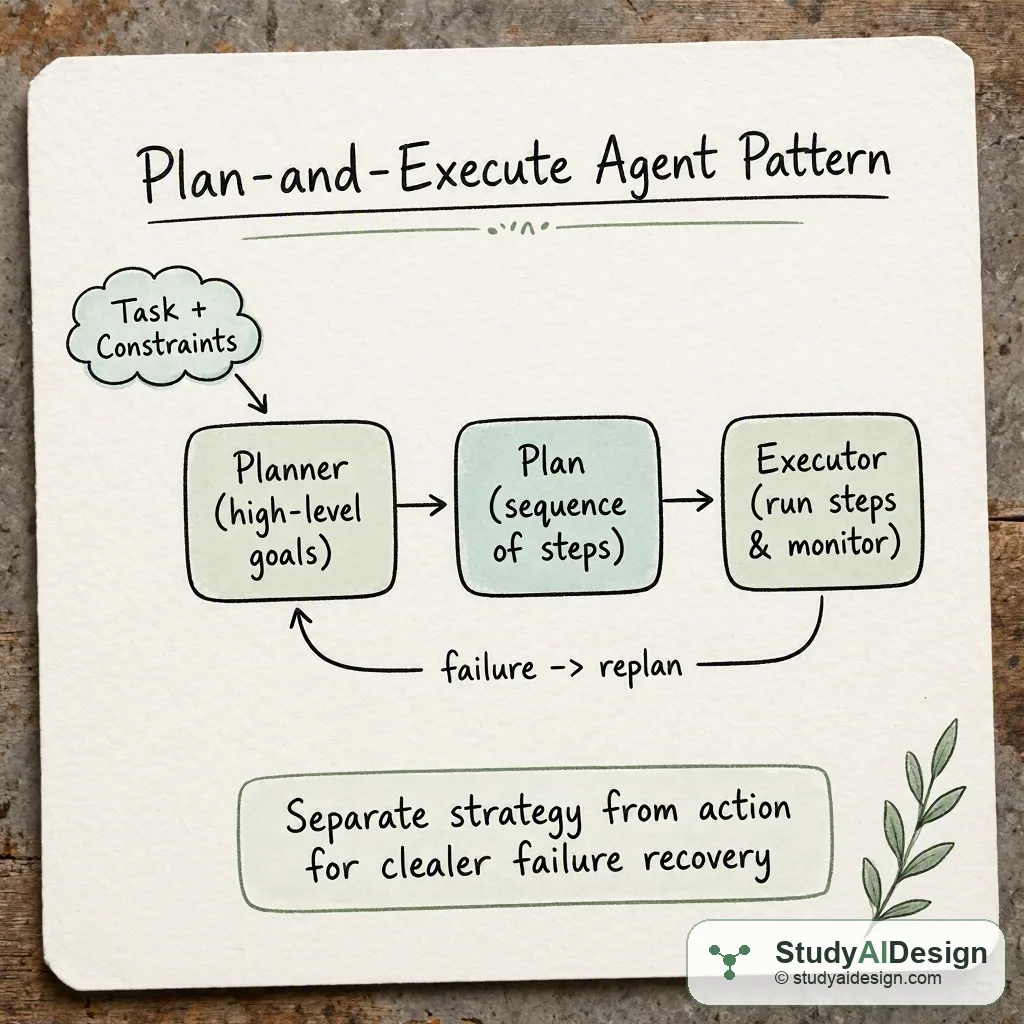
Plan-and-Execute agent pattern splits an agent into a planner that generates a high-level plan and an executor that performs and monitors steps. It clarifies error handling, enables targeted replanning, and balances deliberation with responsiveness for multi-step tasks.
TL;DR
- Plan-and-Execute separates a planner that produces a sequence of steps from an executor that runs steps and reports progress.
- The planner decomposes the task into substeps and constraints; the executor performs actions, checks outcomes, and triggers replanning when needed.
- This pattern improves robustness, makes failure handling local, and keeps planning cost manageable. Key tradeoffs: planning time versus execution robustness and reactivity.
In this question, we will learn what the Plan-and-Execute agent pattern is, why teams use it, and how to reason about its costs and failure modes so you can explain and defend it in an interview.
We will cover the following:
- The intuition
- How it actually works
- Variations and when to use
- Tradeoffs and failure modes
- Questions the interviewer might ask
- What the interviewer is really testing
Direct answer: The Plan-and-Execute agent pattern splits an agent into a planner that produces a high-level plan and an executor that carries out the steps and monitors outcomes. The planner focuses on decomposition and sequencing for subgoals while the executor focuses on reliable action and local recovery; together they balance deliberation and responsiveness.
The intuition (an analogy that makes it click)
Think of a conductor and musicians. The conductor creates the score and cues the sections; the musicians play the notes and raise a hand if something goes wrong. The conductor does not micro-manage every finger movement, and the musicians do not decide the overall structure. That separation keeps the performance coherent while allowing quick local fixes.
For you as an engineer, the planner is the conductor and the executor is the ensemble. You separate strategy from execution so each side can be simpler and more testable.
How it actually works (the real mechanics, with one concrete worked example)
At a high level the planner receives a task and constraints and returns an ordered plan of steps. The executor takes each step, issues low-level actions, checks success, and either proceeds or requests replanning. A minimal interface looks like:
- Planner: input task, output plan = with optional constraints and subgoal checks.
- Executor: consume , perform actions, return success or failure and observations.
Worked example: book a business trip.
Planner output (example, ):
- Search flights.
- Reserve hotel.
- Add travel insurance.
- Confirm and pay.
Executor behavior:
- Execute step 1. If seat is unavailable, try alternate flight or report partial failure to planner.
- If step 2 fails due to date mismatch, executor reports and planner replans step 2 and possibly step 1.
A simple cost model helps reason about tradeoffs. Let be the planner cost for steps and be the executor cost. Total cost is:
If we allow frequent replanning after failures, planner cost grows with the number of replans. If the planner is conservative and produces many contingencies, increases but may decrease.
Comparison table for three approaches:
| Approach | Strengths | Weaknesses |
|---|---|---|
| Reactive (no planner) | Fast response, simple loop | Hard to achieve long-range goals, brittle for multi-step tasks |
| Planner-only (monolithic) | Coherent global strategy | Slow to adapt to execution failures, expensive to replan |
| Plan-and-Execute | Balance of structure and reactivity, clear failure paths | Planner and executor must coordinate, added interface complexity |
Variations and when to use each
-
Hierarchical planning: Planner itself is layered. A top-level planner gives coarse goals and a lower-level planner provides fine actions. Use when tasks have natural abstraction levels.
-
Continuous monitoring and execution-time adaptation: Executor applies local heuristics to fix small problems without full replanning. Use when failures are common but cheap to fix locally.
-
Contingent plans and branches: Planner returns a tree with branches for likely outcomes. Use when the outcome space is small and predictable.
When to use Plan-and-Execute:
- Multi-step tasks with intermediate observability.
- Situations where failure handling benefits from localized responses.
- When you want to keep planning computational cost manageable while preserving global coherence.
Tradeoffs and failure modes
Key tradeoffs include planning cost versus execution responsiveness. A heavy planner that considers many contingencies raises and slows initial response. A lightweight planner reduces but shifts more recovery burden to the executor, increasing and possibly cumulative replanning.
Common failure modes:
- Stale plans: the environment changes between planning and execution so later steps are invalid.
- Overfitting plans: planner assumes ideal outcomes and the executor must replan often.
- Interface mismatch: unclear step semantics cause repeated misinterpretation.
Questions the interviewer might ask
Some follow-up questions you might get:
How do you decide the granularity of steps? Choose granularity so each step has a clear success check and manageable recovery cost. Too coarse and failures are expensive to recover. Too fine and you incur unnecessary interface overhead.
When should the executor try local fixes versus requesting replanning? Define a policy based on failure type and cost. If a fix can be done with bounded tries and low risk, executor handles it. For structural failures that change constraints, request replanning.
How do you handle nondeterministic outcomes and branching? Use contingent plans or let the executor report observations that trigger the planner to branch. For small outcome spaces, build branches into the plan; for large spaces, rely on replanning.
How do you evaluate the pattern quantitatively? Measure metrics like time-to-completion, number of replans per task, and failure recovery time. Compare and across designs.
What coordination protocol do you use between planner and executor? Simple APIs include step status messages: success, partial-success with data, failure with error code. Ensure deterministic, versioned step schemas.
How do you test the system? Unit test planner logic, integration test end-to-end scenarios, and chaos test by injecting executor failures and environmental changes.
Some things to note:
- Define clear step success conditions to avoid thrashing.
- Track partial progress so replanning can reuse completed work.
- Measure both planning and execution costs, not just final success rate.
What the interviewer is really testing
They want to see that you can separate concerns: planning for strategy and execution for robustness. They are testing your ability to reason about interfaces, recovery strategies, and cost tradeoffs like versus . A strong answer shows practical choices for granularity, replanning triggers, and monitoring, with awareness of common failure patterns.
Further reading in the curriculum
Go deeper on the fundamentals behind this question.
- Agent Fundamentals From single LLM calls to autonomous agents: planning, tool use, memory, and the control loop.
- AI Design Patterns A catalog of recurring architectural patterns for LLM systems, with tradeoffs, failure modes, and guidance on when to combine or avoid each.
Related questions
How would you rate the quality of this article?
Prepare for your AI engineering interview
This is one of many detailed questions and explainers on StudyAIDesign. Browse the full set, work through the curriculum, and walk into your interview ready.