How does an AI agent decide which tool to call?
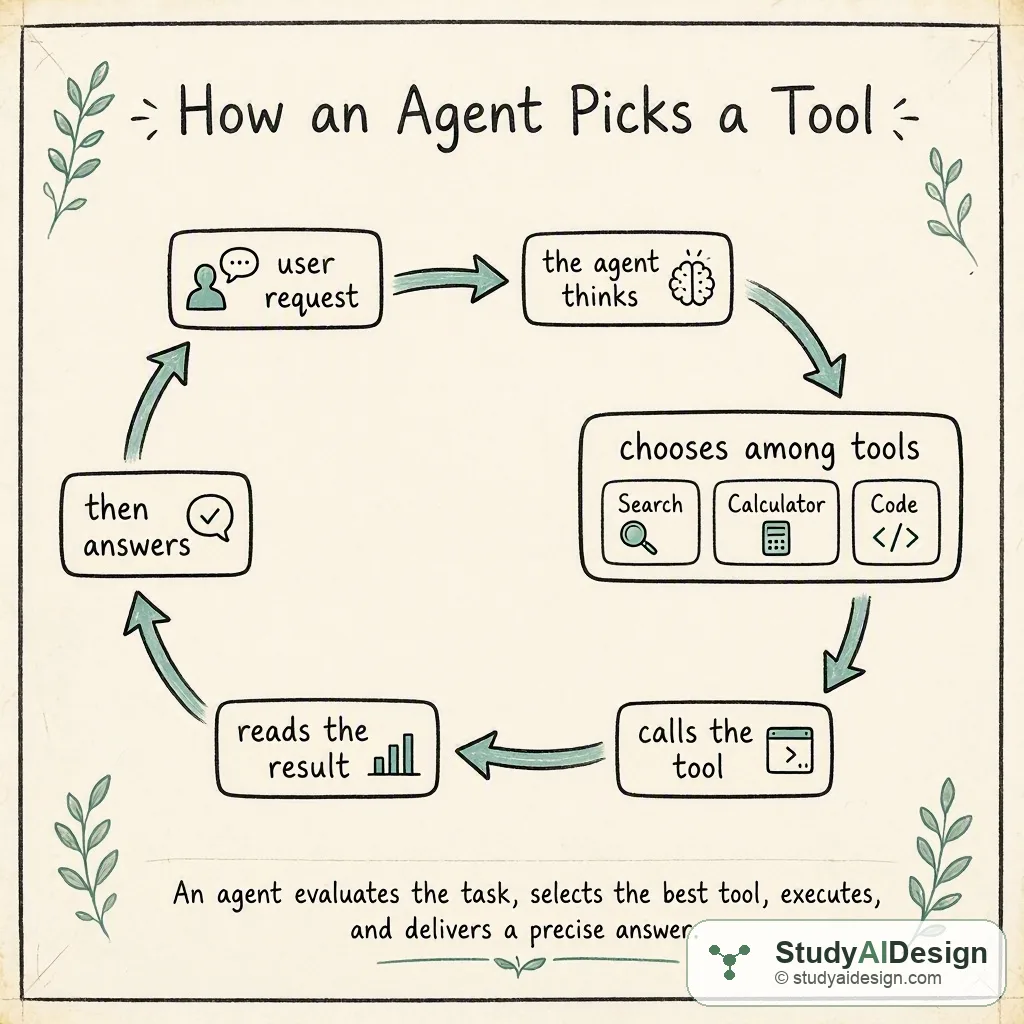
An agent picks a tool by reasoning over the task, the available tool descriptions, and the current state, then emitting a structured tool call. Here is how the loop works and what interviewers probe for.
TL;DR
- An agent chooses a tool by estimating which action maximizes expected utility given the observation, cost, and constraints.
- Common architectures: rule-based routing, prompt-based classifiers, and learned policies (supervised or reinforcement learning).
- Practical factors matter: latency, monetary cost, privacy, and composition needs can override pure success probability. Key tradeoffs: accuracy versus cost and latency; determinism versus exploration; single-step choice versus multi-step planning.
In this question, we will learn how an AI agent decides which tool to call, from simple heuristics to learned decision policies. We will keep the math light and focus on the decision logic you would explain in an interview.
We will cover the following:
- The concise answer
- The intuition (an analogy that makes it click)
- How it actually works (mechanics and a worked example)
- Common architectures and comparisons
- Tradeoffs and failure modes
- Interview follow-up questions and what the interviewer is testing
An agent picks the tool that maximizes expected benefit after accounting for accuracy, cost, latency, and constraints. Practically, this means estimating a score or probability for each tool and either choosing the highest score or sampling according to a soft policy. Architectures used range from simple rules to classifiers to learned policies trained with supervised learning or reinforcement learning.
The intuition (an analogy that makes it click)
Think of the agent as a diner picking a utensil. For soup we pick a spoon, for steak a knife and fork, for slippery noodles chopsticks. You know roughly which utensil will make the job easiest. If you are unsure, you pick the utensil that gives the highest chance of finishing the dish without making a mess. The agent performs the same reasoning: which tool gives the best chance of solving the subtask while keeping cost and delay acceptable.
How it actually works (the real mechanics, with a worked example)
At the core is expected utility. For each tool the agent estimates:
- , the probability the tool succeeds on input .
- , the value or reward for a successful result.
- , the cost (API money, compute, privacy loss, or latency penalty).
A simple expected utility model is: The agent often selects the tool with highest expected utility:
Worked example. Suppose an agent has three tools: Search, Calculator, and WebAPI. We estimate the following for a math query that might require exact computation or external facts.
| Tool | (utility) | (cost) | ||
|---|---|---|---|---|
| Calculator | ||||
| Search | ||||
| WebAPI |
Here the Calculator has the highest , so the agent picks it. If latency matters and we penalize slow responses by adding to , a different tool could win. If the agent is uncertain about , it might instead use a soft policy: where is a score (for example ) and controls exploitation versus exploration.
In implementation, and come from:
- A rule-based classifier that matches patterns in .
- A prompt-based LLM classifier returning tool labels.
- A trained model that outputs logits for each tool, trained on labeled routing examples.
- A policy network trained with reinforcement learning to maximize long-run reward under real costs.
Architectures and comparisons
We commonly see three patterns:
| Approach | How it decides | Pros | Cons |
|---|---|---|---|
| Rules / Heuristics | If-then rules or regex | Simple, predictable, fast | Fragile, hard to scale |
| Prompt-based classification | LLM is prompted to choose a tool | Flexible, quick iteration | Sensitive to prompt, can be inconsistent |
| Learned policy | Classifier or RL policy outputs probabilities | Can optimize complex tradeoffs, learns from data | Needs labeled data or exploration budget |
Rules are great for deterministic, narrow cases. Prompting is useful when you can craft few-shot examples. Learned policies win when you have many examples or need to balance long-term rewards.
Composing calls and multi-step decisions
Tool selection is not always a single choice. We often need a plan:
- Decide whether to call a tool or answer directly.
- If calling, decide which tool or a sequence of tools.
- Use intermediate outputs to re-evaluate.
A practical pattern is gated calls: first a cheap classifier decides if external tools are required. If yes, a second model picks the specific tool. This reduces unnecessary expensive calls.
You can also use meta-reasoning: estimate the value of information of calling a tool. If expected improvement in final answer is less than cost, skip the call.
Tradeoffs and failure modes
Tool selection failures arise when the agent misestimates , ignores hidden costs, or the tools produce unexpected outputs.
If the agent overestimates a tool's reliability it will call expensive APIs unnecessarily and may leak private data. Conversely, underestimating a tool can cause the agent to rely on hallucinated model output instead of accurate external tools. Always validate routing decisions and log outcomes to calibrate .
Other failure modes:
- Covariate shift: trained on old distribution no longer holds.
- Tool mismatch: tool output format is incompatible with downstream steps.
- Nonstationary costs: API throttling or changes in latency can flip decisions.
Questions the interviewer might ask
Some follow-up questions you might get:
- How do you estimate in practice? Use historical success rates, model calibration techniques, or have a small classifier that predicts success probability from the request features.
- When would you prefer rules over learning? For high-stakes or low-data cases where predictability matters and the rule coverage is sufficient.
- How does exploration work when training a policy? Use bandit algorithms or RL with constrained exploration, and simulate costs to avoid expensive mistakes in production.
- How do you handle tool composition? Plan sequences by estimating marginal value of each call and re-evaluate after intermediate outputs, or use hierarchical policies.
- What metrics do you monitor? Success rate, average cost per request, latency distribution, and privacy incidents.
- How do you calibrate confidence scores? Use temperature scaling, isotonic regression, or Platt scaling on held-out validation data.
Some things to note:
- Log every decision and outcome to recalibrate estimates continuously.
- Incorporate hard constraints (data residency, forbidden APIs) into routing logic early.
- Cost, latency, and privacy can dominate the choice even when is similar.
What the interviewer is really testing
They want to see that you understand decision-theoretic framing, can balance multiple objectives, and know practical tradeoffs in production systems. They also want to hear concrete approaches: rules for safety, learned models for scale, and monitoring to correct misestimates. Finally, they check whether you can reason about uncertainty and design fallback behaviors.
Further reading in the curriculum
Go deeper on the fundamentals behind this question.
- Prompting and Context Engineering How to structure prompts and fill the context window so models produce reliable, grounded, and cost-efficient outputs.
- Agent Fundamentals From single LLM calls to autonomous agents: planning, tool use, memory, and the control loop.
- AI Design Patterns A catalog of recurring architectural patterns for LLM systems, with tradeoffs, failure modes, and guidance on when to combine or avoid each.
Related questions
How would you rate the quality of this article?
Prepare for your AI engineering interview
This is one of many detailed questions and explainers on StudyAIDesign. Browse the full set, work through the curriculum, and walk into your interview ready.