Explain the difference between full fine-tuning and parameter-efficient fine-tuning (PEFT).
Full fine-tuning and parameter-efficient fine-tuning (PEFT) compare two ways to adapt pretrained models to new tasks. This page explains the practical differences, common PEFT methods, and when to prefer full tuning versus PEFT. You will get a concrete example and tradeoffs to discuss in an interview.
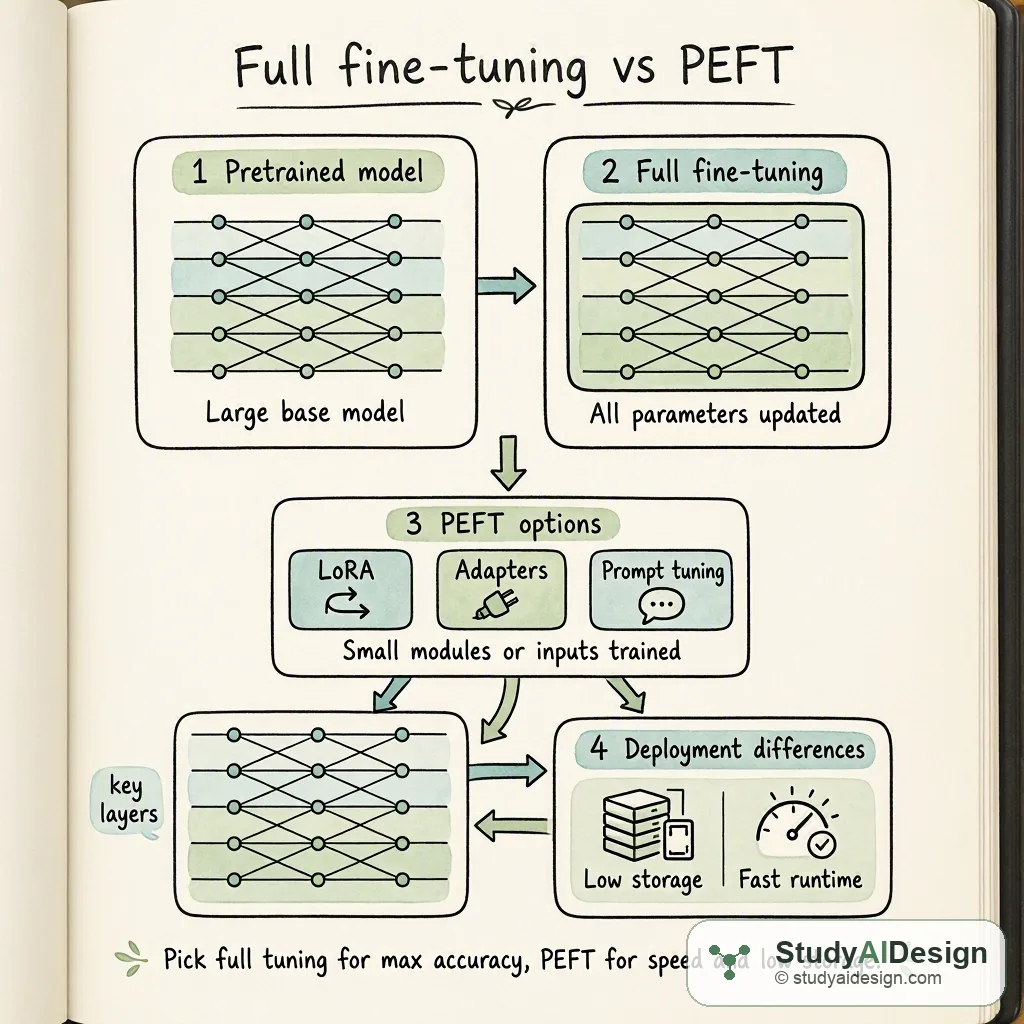
TL;DR
- Full fine-tuning updates every parameter in the pretrained model for the target task.
- Parameter-efficient fine-tuning (PEFT) modifies only small extra modules or low-rank updates so you train and store far fewer parameters.
- Common PEFT methods include LoRA, adapters, prefix tuning, and prompt tuning, each with different tradeoffs in performance and storage. Key tradeoffs: accuracy versus compute and storage overhead.
In this question, we will learn how full fine-tuning and parameter-efficient fine-tuning (PEFT) differ, and why you might choose one approach over the other for a given task.
We will cover the following:
- The direct answer and short summary
- The intuition behind each approach
- How PEFT methods actually work with a concrete example and formulas
- Practical tradeoffs and failure modes
- Likely follow-up interviewer questions and concise answers
Full fine-tuning updates all model weights by backpropagating into every parameter, while PEFT freezes most of the pretrained parameters and trains small additional modules or low-rank updates to achieve task adaptation. Full fine-tuning often gets the best possible task performance but costs more in compute, memory, and model storage. PEFT usually reaches close-to-full performance with orders of magnitude fewer trainable parameters and smaller checkpoints.
The intuition (an analogy that makes it click)
Think of a pretrained model as a ship built for many oceans. Full fine-tuning is like rebuilding large parts of the ship for a new sea condition. You get a vessel tailored to the new water, but that takes time and materials. PEFT is like adding targeted attachments and lightweight sails that change how the ship handles without replacing the hull. Those attachments are cheaper to install, and you can switch them in and out quickly for different voyages.
How it actually works
Full fine-tuning: every weight matrix and bias scalar is a trainable variable. If the model has parameters, training updates all .
PEFT: the pretrained weights stay fixed. We introduce additional small parameter groups or structured updates. A general low-rank scheme like LoRA adds low-rank matrices to existing weight projections. For a weight matrix of size , LoRA parameterizes the update as where is and is . The extra parameters are about
and the relative fraction for that matrix is
Worked example. Suppose you have a model with billion parameters and attention projection matrices that are roughly square with dimension . If you apply LoRA with rank across the major projections, the added parameters per matrix are about . Summing across many projection matrices gives an extra few million parameters, typically under of billion.
Compare typical outcomes:
| Method | Trainable parameters | Checkpoint size | Inference change |
|---|---|---|---|
| Full fine-tuning | (100%) | Full model copy per task | No runtime change beyond model size |
| LoRA / Adapters | to a few percent | Small delta file per task | Minimal to no latency increase |
| Prompt tuning | Very small | Tiny prompt vectors | No model parameter change, small token prep |
Note that exact numbers depend on where you insert PEFT modules and the chosen ranks or hidden sizes.
Other PEFT flavors and how to pick
- Adapters: small bottleneck feedforward modules inserted between layers. They typically add a few million parameters and work well when you need a modular change per task.
- Prefix and prompt tuning: optimize continuous prompts or key/value prefixes that steer the transformer. These use very few parameters but can be less effective on tasks needing deeper representation change.
- LoRA: low-rank additive updates to specific projection matrices. Often a sweet spot for many NLP tasks because it targets attention and projection layers directly.
When to pick each: if you need near state-of-the-art and can afford storage and compute for multiple full checkpoints, choose full tuning. If you need to support many tasks, fast experiments, or limited GPU memory, choose PEFT.
Tradeoffs and failure modes
PEFT advantages: far lower training memory, quicker experiments, and tiny per-task checkpoints so you can ship many task adapters. Full tuning advantages: the maximum representational flexibility and often slightly better final accuracy on difficult distribution shifts.
Questions the interviewer might ask
Some follow-up questions you might get:
Why does LoRA use low-rank updates? Low-rank updates restrict the update space to a small subspace, which reduces parameters and focuses learning on dominant directions in weight changes. This often captures task-specific shifts without rewriting the whole matrix.
How do you store PEFT checkpoints in production? You typically store the base model once and save small delta files per task that contain adapter weights or LoRA matrices. At load time you merge or apply those deltas to the base model.
Does PEFT affect inference speed? Most PEFT methods add negligible latency. Adapters and LoRA add small matrix operations. Prompt tuning has essentially zero change to model FLOPs but adds token prep cost.
Can PEFT reach full-tuning performance? On many tasks PEFT approaches come very close. For some tasks that require wholesale feature reconfiguration, full fine-tuning can still win. Empirical validation matters.
How do you choose hyperparameters like LoRA rank or adapter bottleneck size? Start small and scale up until validation performance saturates. Use few-shot sweeps because these hyperparameters control capacity and overfitting risk.
Some things to note:
- PEFT makes experimentation with many tasks affordable because checkpointing cost is tiny.
- Always validate that the chosen PEFT method can represent the necessary task change.
- For safety and auditing, storing deltas separately keeps base model immutable.
What the interviewer is really testing
They want to see that you understand practical tradeoffs: compute, memory, storage, and final accuracy. They also test whether you can reason about how structural constraints like low-rank adapters change the model update space and how that affects generalization. Finally, they may probe deployment concerns, such as checkpoint management and inference implications.
Further reading in the curriculum
Go deeper on the fundamentals behind this question.
- Fine-Tuning and Adaptation How to adapt pretrained language models to specific tasks using full fine-tuning, LoRA, instruction tuning, and preference alignment, and when each approach is the right tool.
Related questions
How would you rate the quality of this article?
Prepare for your AI engineering interview
This is one of many detailed questions and explainers on StudyAIDesign. Browse the full set, work through the curriculum, and walk into your interview ready.