How do you handle failover and fallback strategies for AI systems?
Failover and fallback strategies for AI systems: how to keep ML services available, meet latency and accuracy SLOs, and recover safely when models or infra fail. This question focuses on monitoring, graceful degradation, circuit breakers, retries, and fallback models with clear tradeoffs between cost, accuracy, and user experience.
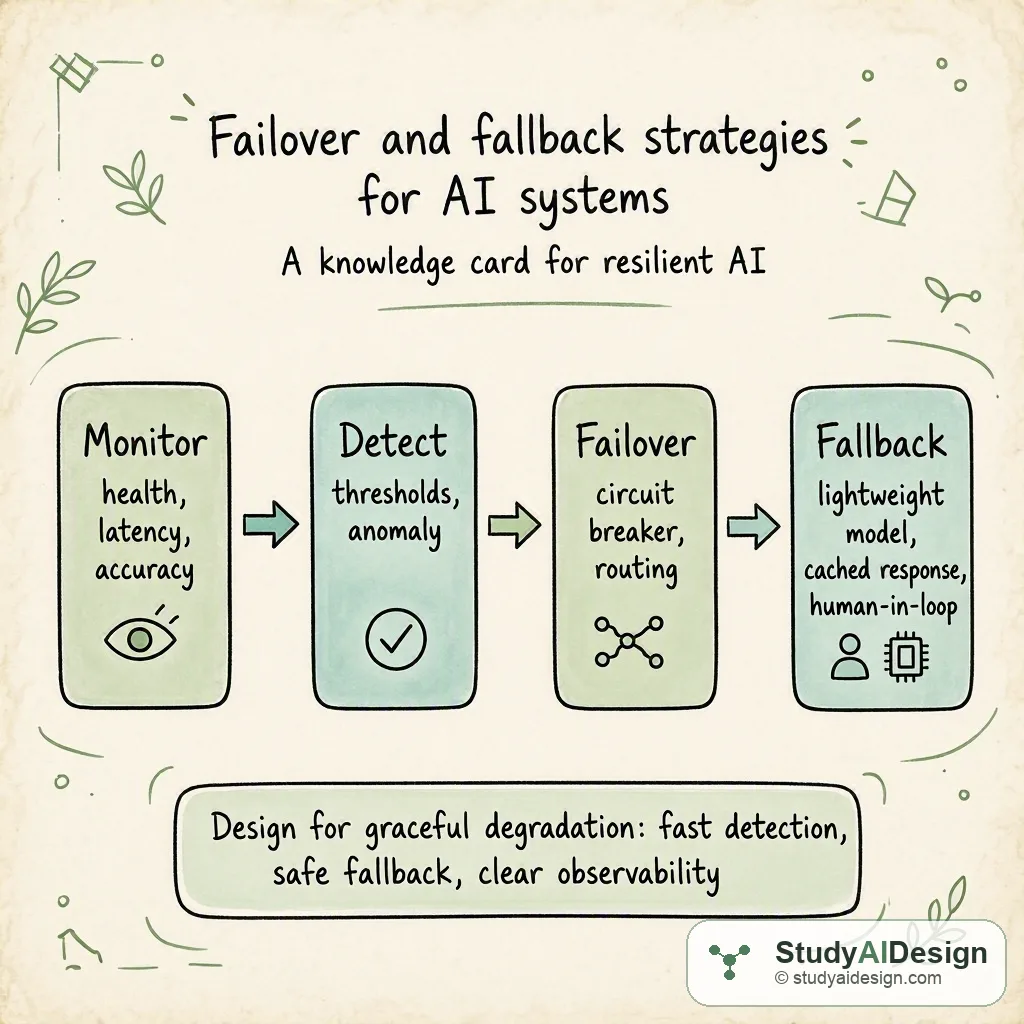
TL;DR
- Failover and fallback strategies for AI systems keep services available by detecting failures and routing requests to backups or degraded behavior.
- Build fast health checks, circuit breakers, retries with backoff, and lightweight fallback models or cached outputs to meet latency SLOs.
- Test canaries, monitor SLOs and signals, and prepare human-in-the-loop routes for high-risk predictions. Key tradeoffs: faster recovery versus accuracy and cost.
In this question, we will learn how to design failover and fallback strategies for AI services so you can keep a product usable when models or infrastructure misbehave. We will focus on what to detect, how to switch safely, and how to evaluate the tradeoffs between latency, accuracy, and cost.
We will cover the following:
- The intuition
- How it actually works
- Implementation patterns and a worked example
- Tradeoffs and failure modes
- Questions the interviewer might ask
- What the interviewer is really testing
Direct answer: implement layered detection, fast routing, and graceful degradation: use health checks and anomaly detection to trigger circuit breakers, route requests to a lightweight fallback model or cached response, and apply retries with jitter only when safe. Design for observability, test with canaries, and document SLO-driven decision thresholds.
The intuition (an analogy that makes it click)
Think of an AI service like a bridge that carries traffic across a river. We do not want all traffic to pile up on a single lane when a section weakens. We build sensors to detect cracks early. When a problem appears we redirect cars to a parallel lane, let heavier vehicles wait, and occasionally let people get off and use a ferry if the bridge is unusable. The parallel lane is your fallback model, the sensors are health checks and monitors, and the ferry represents human-in-the-loop or cached content.
How it actually works (the real mechanics, with one concrete worked example)
Core components:
- Observability: latency, error rate, model accuracy drift, resource saturation.
- Decision logic: thresholds, anomaly detectors, circuit breakers, and service-level objectives (SLOs).
- Fallbacks: lightweight model, heuristic, cached response, or human routing.
- Recovery: automated warmup, canary releases, and gradual traffic ramp.
Worked example
Scenario: a text-summarization API has a primary large model, and a smaller distilled model as fallback. Latency budget is 500 ms for 99% of requests. Primary has average latency when cold but normally . Fallback has . Primary fails or times out with probability .
Expected latency when using fallback on primary failure:
For example with and ms and ms:
That expected latency still misses the 500 ms budget when the primary is frequently slow. Switching to routing most traffic to the fallback model when exceeds a threshold reduces missed SLOs but may lower accuracy. Below is a simple comparison table for choices in this scenario.
| Option | Typical latency | Cost | Typical accuracy | Notes |
|---|---|---|---|---|
| Primary-only | 300 ms | high | 0.95 | Best accuracy, vulnerable to cold starts and infra failures |
| Retry with backoff | up to 1200 ms | medium-high | 0.95 | Helps transient errors, increases latency and load |
| Fallback model | 200 ms | low | 0.85 | Fast and cheap, lower accuracy, good for soft failure |
| Cached response | 50 ms | tiny | variable | Best for repeated requests, stale risk |
Implementation steps
- Instrument everything: request traces, model response codes, CPU/GPU utilization, queue lengths, and model quality signals.
- Define SLOs and observability alerts. Pick thresholds that matter to users, for example 99th percentile latency below 500 ms and error rate below 0.5%.
- Implement circuit breaker logic that trips if error rate or queue length exceed thresholds for a short window. When tripped, route to fallback immediately.
- Add retry with exponential backoff and jitter for transient infra errors, but cap retries to avoid overload.
- Prepare fallbacks: distilled models, heuristics, or cached outputs. Label responses so clients know they are degraded when necessary.
- Test with canary traffic, chaos experiments, and simulated heavy load. Measure end-to-end user impact.
Implementation patterns and details
- Circuit breaker: track moving window of successes and failures. Open when failures exceed a threshold, half open after cooldown to test recovery.
- Health checks: separate liveness and readiness checks. Readiness should reflect model warmup and availability. Liveness prevents stuck processes.
- Graceful degradation: prefer returning partial content or a shorter summary rather than failing outright. Add metadata that indicates confidence.
- Human-in-the-loop: for safety critical outcomes, route low-confidence or failed requests to an operator queue with clear SLAs.
Tradeoffs and failure modes
- Accuracy vs latency: fallback models are faster but less accurate. Set thresholds so degraded answers are acceptable for the user flow.
- Cascading retries: aggressive retries can worsen overload. Use backoff, caps, and circuit breakers.
- State consistency: stateful sessions complicate failover. Prefer idempotent, stateless requests or a shared session store with replication.
Questions the interviewer might ask
Some follow-up questions you might get:
How do you decide when to route to a fallback model? We pick thresholds based on SLOs and observed signals such as tail latency, error rate, and model confidence. Start with conservative thresholds and tune with canaries and experiments.
What signals indicate model failure versus infrastructure failure? Model failures include sudden drops in accuracy, unnatural confidence distributions, or data drift. Infrastructure failures show increased resource usage, timeouts, and node-level errors. Combine signals for better decisions.
How do you prevent fallback from becoming the permanent route? Add periodic canary traffic to the primary, monitor quality and cost, and implement decay timers that attempt to shift traffic back when conditions improve.
How do you handle stateful conversations during failover? Use shared session storage with replication or stateless request formats. If state cannot be replicated, record the failure and surface it to the user rather than silently switching context.
When do you use human-in-the-loop rather than an automatic fallback? When false positives or harmful outputs are high risk. Human-in-the-loop is appropriate for safety critical decisions, legal content, or high-stakes summaries.
How would you test these strategies? Use chaos testing, canary rollouts, synthetic loads, and replay real traffic at scale. Validate both user-perceived metrics and model quality metrics.
Some things to note:
- Label degraded responses so downstream systems and users can react.
- Design time budgets for retries to avoid violating latency SLOs.
- Train fallback models on realistic degraded scenarios to reduce surprise behavior.
What the interviewer is really testing
They want to know you can think operationally: detect failures early, choose safe automated responses, and measure impact on users. They also test tradeoff reasoning between latency, accuracy, and cost and whether you can design systems that fail visibly and safely instead of silently producing bad outputs.
Further reading in the curriculum
Go deeper on the fundamentals behind this question.
- Reliability and Safety How to build AI pipelines that fail gracefully and refuse to produce harm, from input guardrails to circuit breakers to ensemble verification.
Related questions
How would you rate the quality of this article?
Prepare for your AI engineering interview
This is one of many detailed questions and explainers on StudyAIDesign. Browse the full set, work through the curriculum, and walk into your interview ready.