How do you design an AI system for high availability and fault tolerance?
How do you design an AI system for high availability and fault tolerance? This question asks you to design redundancy, failover, and operational practices for an AI service so it stays available under failures. Focus on redundancy patterns, state handling, and observable recovery paths.
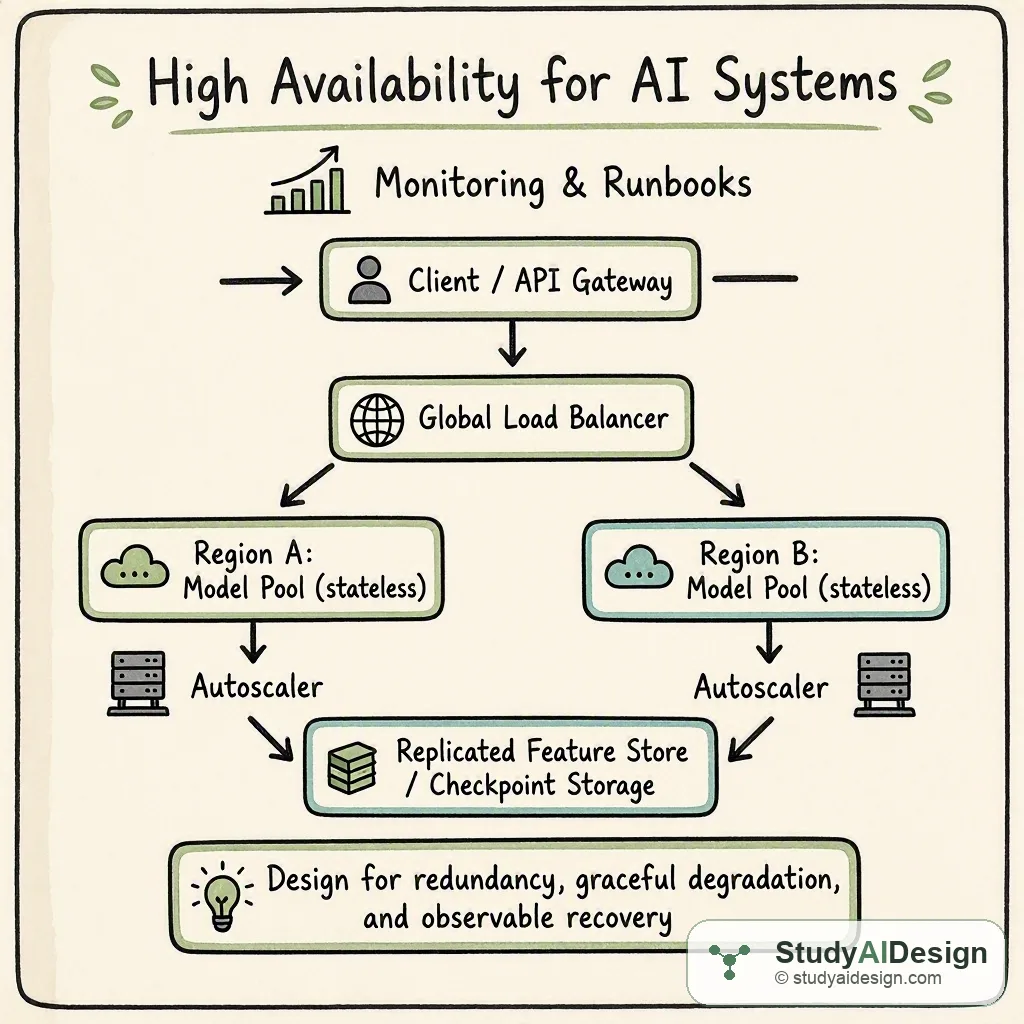
TL;DR
- Design redundancy across compute and data: multi-AZ or multi-region model pools with replicated storage and leader election for stateful parts.
- Make model serving stateless where possible, use retries with backoff, circuit breakers, and graceful degradation for heavy models.
- Define SLOs and compute allowed downtime, then design capacity and failover to meet them while keeping observability and runbooks. Key tradeoffs: consistency versus availability, cost versus redundancy, and complexity versus recoverability.
In this question, we will learn how to design an AI system for high availability and fault tolerance starting from requirements and ending with operational practices. We will keep the example concrete so you can explain choices to an interviewer. The goal is an architecture that continues serving useful responses under partial failures.
We will cover the following:
- The direct short answer
- The intuition
- How it actually works with a worked example
- Patterns, state handling, and testing
- Tradeoffs and failure modes
- Questions the interviewer might ask
- What the interviewer is really testing
Design for redundancy at compute and data layers, make serving stateless where possible, provide graceful degradation and clear recovery paths, and validate with SLO-driven capacity planning plus chaos testing. This means you pick replication boundaries, plan failover, and instrument runbooks so you can restore service within the SLO.
The intuition (an analogy that makes it click)
Think of the AI service as a ferry route between two islands of users and models. If one ferry engine fails you want another engine ready, a nearby lifeboat, and a radio system to redirect traffic. Redundancy is the extra engines and lifeboats. Observability and runbooks are the radio and drills that let the crew respond quickly. Graceful degradation is reducing passenger count but still getting people across rather than stopping service.
How it actually works (the real mechanics, with a worked example)
Start with an SLO. Suppose you need 99.95 percent availability per month. Compute allowed downtime per month with and a 30 day month of hours:
So you have about minutes of downtime per month. That drives redundancy and recovery-time goals.
Architecture pattern: clients hit a global load balancer that routes to regions. Each region runs an autoscaled pool of stateless model servers and a local cache. Checkpoints and epoch artifacts live in a replicated object store. Stateful components like leader-based metadata stores use consensus (for example Raft) with multi-AZ replicas.
Compare three deployment options with a simple availability model where independent components have availability . The end-to-end availability for serial components is and for parallel redundant pools you use
Example numeric comparison
| Design | Components | Approx availability |
|---|---|---|
| Single region, single pool | Model server , LB | |
| Multi-AZ pool with redundant LB | Two pools each , LB | |
| Multi-region active-passive | Active region , passive warm |
From the numbers you can see multi-AZ or multi-region redundancy quickly raises availability, but costs and complexity increase.
Workload-specific decisions
- Make model servers stateless so any instance can serve any request. Statelessness simplifies autoscaling and failover. If you must maintain state, use external replicated stores with consistent snapshots.
- For heavy models, implement graceful degradation: route to a smaller model or queue requests. That lets you keep responses working under load spikes.
- Use exponential backoff for retries and a circuit breaker to avoid cascading failures.
Patterns for state and consistency
Stateful components need clear replication strategies. Use consensus-based stores for metadata and leader election and eventual consistency for large feature stores where strong consistency would harm availability. Choose replication factor so that you can tolerate failures where for consensus.
When writing checkpoints and model artifacts prefer write-once immutable objects and replicate to at least two regions to enable cold failover without complex re-sync.
Testing, observability, and runbooks
- Instrument SLOs and SLIs such as request success rate, latency P95 and error budgets.
- Build automated runbooks that map specific alerts to remediation steps and owner roles.
- Run chaos tests that simulate node and region loss, then observe failover and record mean time to recovery.
A short runbook example entry
| Alert | Probable cause | Immediate action |
|---|---|---|
| Increased 5xx rate in Region A | Model process crash or OOM | Reroute traffic to Region B, scale model pool, rollback recent model deploy |
Tradeoffs and failure modes
Designers face these tradeoffs: stronger consistency usually reduces availability or increases latency. More redundancy raises cost and operational complexity. Faster failover may require warm replicas, which cost more.
Common failure modes
- Split brain in leader election that causes conflicting writes.
- Thundering herd on failover because traffic shifts to fewer healthy nodes.
- Unreplicated local caches returning stale or inconsistent data.
Mitigations include quorum writes, graceful client retries, priority backoff, and cache invalidation with versioning.
Questions the interviewer might ask
Some follow-up questions you might get:
How would you meet a 99.99 percent SLO? You would calculate the allowed downtime and then increase redundancy, add multi-region active-active routing, pre-warm instances, and tighten recovery runbooks to meet the reduced error budget.
How do you handle model upgrades without downtime? Use canary or blue-green deploys, keep the old model serving until the new pool passes health checks, and use traffic shaping to shift gradually.
What if the feature store is the bottleneck? Introduce read replicas and caches, bulk prefetch for model inputs, and degrade to approximate features if exact features are unavailable.
How do you prevent cascading failures during a region outage? Circuit breakers at the client, rate limiting, backpressure on queues, and consumer-side quotas help prevent overload of remaining regions.
How do you ensure reproducibility and state recovery for long training runs? Persist periodic checkpoints to replicated storage and use immutable artifacts with versioned metadata stored in a consensus-backed metadata store.
How would you design monitoring to detect partial failures? Combine synthetic probes, real traffic tracing, and artifact health checks. Alert on error budget burn rate, not only raw error counts.
Some things to note:
- SLOs drive architecture and testing choices.
- Stateless serving simplifies failover but shifts complexity to storage.
- Chaos testing will reveal hidden assumptions quicker than design reviews.
What the interviewer is really testing
They want to see system-level thinking: you must combine redundancy patterns, state management, capacity planning, and operational practices. They are also testing whether you understand tradeoffs between availability, consistency, cost, and complexity and whether you can propose measurable recovery paths and tests that validate those paths.
Related questions
How would you rate the quality of this article?
Prepare for your AI engineering interview
This is one of many detailed questions and explainers on StudyAIDesign. Browse the full set, work through the curriculum, and walk into your interview ready.