Explain the ReAct (Reasoning + Acting) agent architecture.
Explain the ReAct (Reasoning + Acting) agent architecture and how it interleaves explicit reasoning traces with actions. Learn the pattern of Thought, Action, Observation and when to apply ReAct for tool-enabled multi-step tasks.
TL;DR
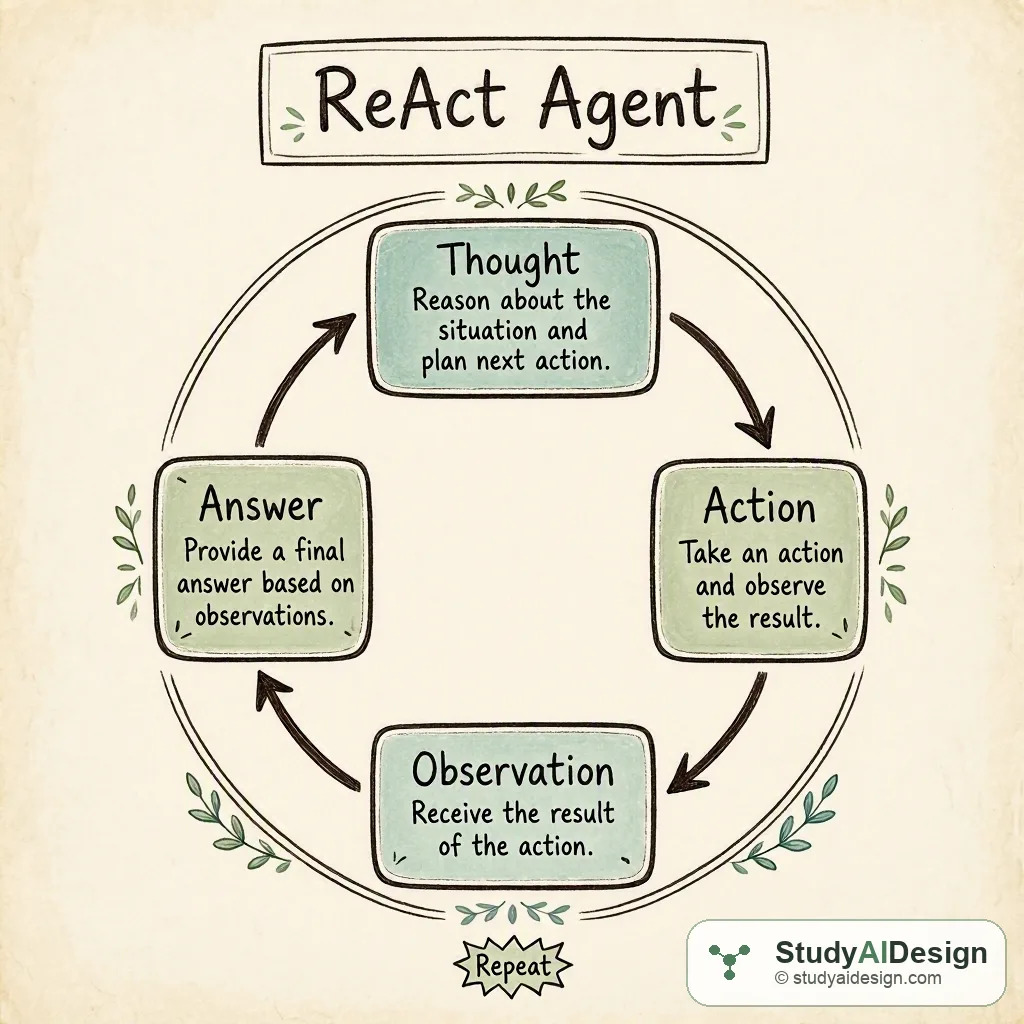
- ReAct interleaves explicit reasoning traces with concrete actions so a model can plan and use tools step by step.
- The agent alternates "Thought", "Action", and "Observation" so you get interpretable reasoning and recoverable actions.
- It is ideal for multi-step tasks that need tool access, but it increases the number of model calls and latency. Key tradeoffs: interpretability and flexibility versus cost and potential loop failures.
In this question, we will learn how the ReAct architecture structures agent behavior by alternating explicit reasoning and actions, why that helps when using tools, and how to answer design and debugging questions about it.
We will cover the following:
- Direct answer
- The intuition
- How it actually works
- When to use ReAct and implementation tips
- Tradeoffs and failure modes
- Questions the interviewer might ask
- What the interviewer is really testing
ReAct is an agent pattern where the model emits an explicit internal reasoning step labeled "Thought", then emits a concrete "Action" such as a tool call, receives an "Observation", and repeats; this alternation makes chains of thought interpretable and enables reliable tool use in multi-step tasks. It trades lower latency and fewer model calls for clearer debugging, stepwise correction, and safer tool integration.
The intuition (an analogy that makes it click)
Think of ReAct like a driver using a GPS and a map while asking a passenger for confirmation. The driver (the agent) says aloud what they are thinking about the route, decides to take an exit, checks the GPS or map (a tool), sees the new position, and then updates the plan. Speaking the thoughts out loud gives the passenger a chance to spot missteps and helps the driver correct course quickly.
That spoken stream of thought is the chain of reasoning we keep, and the exit-taking is the action. Because we record both, we can audit decisions or intervene when the agent uses a tool incorrectly.
How it actually works (the real mechanics, with one concrete worked example)
At each turn the agent produces a short reasoning token labeled "Thought", then a concrete token labeled "Action", which the environment executes and returns as "Observation". The loop continues until a terminal condition is reached.
A minimal turn sequence looks like this:
Thought: I need the latest exchange rate to convert 100 euros to USD. Action: call_api(get_exchange_rate, base=EUR, quote=USD) Observation: 1 EUR = 1.08 USD Thought: Multiply 100 by 1.08 to get the answer. Action: return_answer("108 USD")
Worked numeric step: if the exchange rate is and the principal is then the calculation is:
This explicit pattern keeps the arithmetic and tool call separate and auditable.
When we compare ReAct to simpler approaches we can summarize strengths and costs in a compact table.
| Approach | Interpretability | Model Calls | Best for |
|---|---|---|---|
| Single-shot answer | Low | Low | Quick fact recall |
| Chain-of-thought only | Medium | Medium | Complex reasoning without tools |
| ReAct | High | Higher | Tool-enabled, multi-step tasks |
ReAct typically requires more model interactions because each action produces an observation that the model ingests. If is the number of action-observation cycles and is the cost per model call, the simple cost model is
This makes tradeoffs clear: more cycles give better control and debugging surface but increase cost and latency.
When to use ReAct and implementation tips
Use ReAct when the task requires external tools, step-by-step verification, or when you want interpretable agent traces for auditing. Avoid ReAct for tiny lookups or single-step tasks where the overhead does not pay off.
Practical tips:
- Design short, consistent templates that label segments exactly as Thought, Action, and Observation so the model learns the pattern.
- Limit Thought length to a few sentences to reduce hallucination risk and keep actions unambiguous.
- Validate action parameters before invoking a tool with a quick sanity check thought like "Action params look valid: yes/no".
- Add a maximum step budget to avoid infinite loops and a fallback path to return a best-effort answer after the budget expires.
Implementation details and common prompt patterns
A common prompt contains examples showing the alternation and a clear stop token for final answers. Use structured examples that include tool calls and returned observations. Keep action formats strict JSON or a simple function-call syntax so parsers can reliably extract actions.
When the model suggests an action, parse and validate it before executing. If an action fails, return an explicit Observation like "ToolError: timeout" and allow the agent to recover by planning another action.
Tradeoffs and failure modes
ReAct gives you transparency and corrective loops but opens several failure modes. Increased model calls raise latency and cost. The agent can also get stuck repeating the same thought-action pattern, or it can craft actions that look plausible but are invalid for the tool.
Questions the interviewer might ask
Some follow-up questions you might get:
How does ReAct differ from chain-of-thought? Chain-of-thought is focused on internal reasoning output without necessarily performing external operations. ReAct explicitly combines that reasoning with actions that interact with tools or the environment.
How do you prevent infinite loops in a ReAct agent? Set a maximum number of cycles, track state changes between cycles, and add fallback behavior like summarizing progress or returning a partial answer.
How do you handle actions that have side effects? Use dry-run or simulation modes where possible, require explicit confirmation steps for destructive actions, and log and audit every action with timestamps and parameters.
When would you choose a planner-controller split instead of ReAct? If planning requires heavy global optimization and actions are low-level, a separate planner and controller may be cleaner. ReAct shines when short, transparent interleaving of thought and action is sufficient.
How do you measure success for a ReAct agent? Measure task completion, correctness of tool usage, number of cycles to completion, and human interpretability of the trace. Track failure modes and rates of invalid actions.
Some things to note:
- Keep action formats strict and machine-parseable.
- Validate everything before executing external calls.
- Use step budgets and fallback behaviors to avoid getting stuck.
What the interviewer is really testing
They want to see that you understand how to structure an agent that both reasons and acts, and that you can weigh interpretability against cost and reliability. They are checking that you can design robust prompts, handle tool failures, and implement safeguards like validation and step budgets. Demonstrate practical tradeoff thinking and concrete mitigation strategies.
Further reading in the curriculum
Go deeper on the fundamentals behind this question.
- Prompting and Context Engineering How to structure prompts and fill the context window so models produce reliable, grounded, and cost-efficient outputs.
- Agent Fundamentals From single LLM calls to autonomous agents: planning, tool use, memory, and the control loop.
- AI Design Patterns A catalog of recurring architectural patterns for LLM systems, with tradeoffs, failure modes, and guidance on when to combine or avoid each.
Related questions
How would you rate the quality of this article?
Prepare for your AI engineering interview
This is one of many detailed questions and explainers on StudyAIDesign. Browse the full set, work through the curriculum, and walk into your interview ready.