What is instruction tuning, and why is it important for chat models?
Instruction tuning explains how instruction tuning adapts a pretrained model to follow user instructions and why it matters for chat models, improving helpfulness, safety, and consistent behavior. Learn the basic pipelines, a worked example, tradeoffs, and likely interviewer questions.
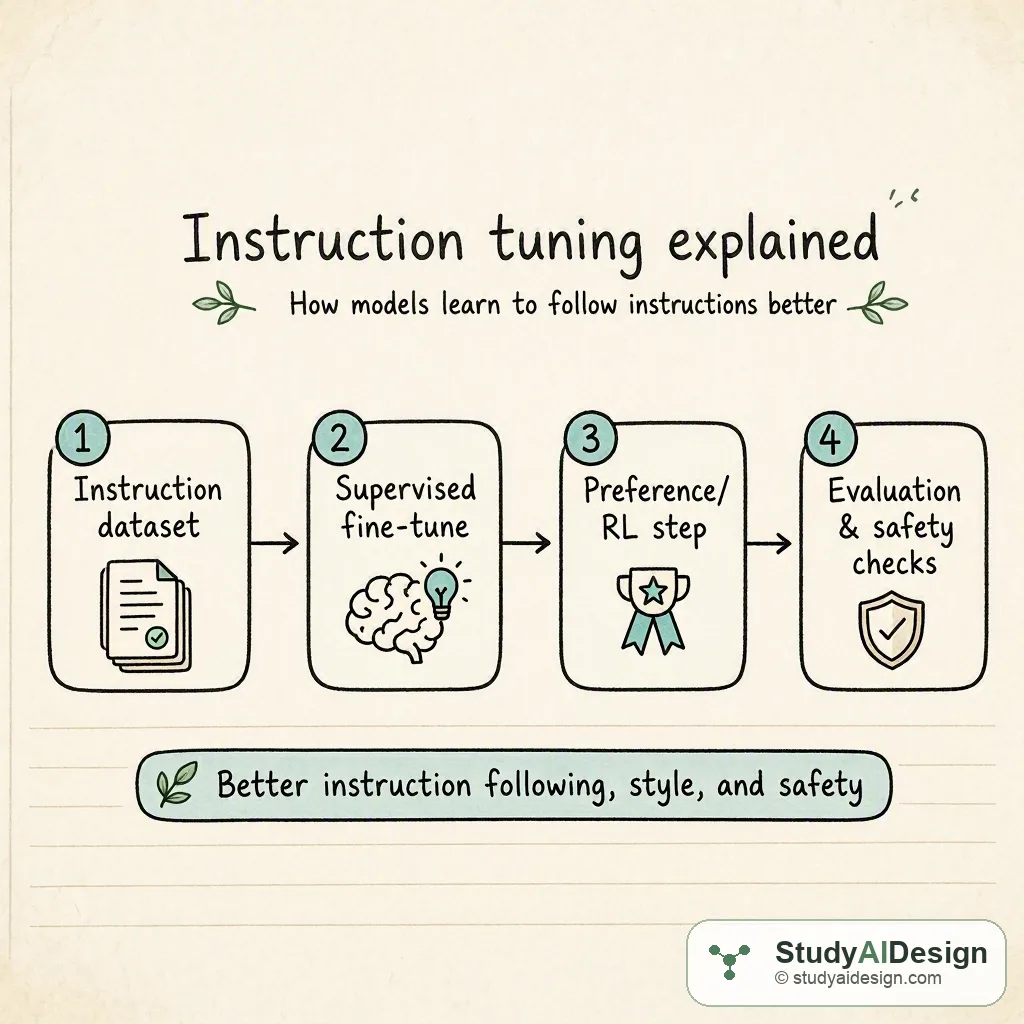
TL;DR
- Instruction tuning adapts a pretrained model to follow instructions using paired examples or human preferences, improving reliability for chat use cases.
- Typical pipelines are supervised fine-tuning on instruction-response pairs and reinforcement learning from human feedback to refine behavior.
- The method increases helpfulness and consistency but costs human data, can overfit style, and can introduce failure modes if rewards are misspecified. Key tradeoffs: data and labeling cost versus improved instruction-following and controllability.
In this question, we will learn what instruction tuning is, how it changes a pretrained model for chat tasks, and why it matters for building helpful and safe chat models.
We will cover the following:
- The intuition (an analogy that makes it click)
- How it actually works (the real mechanics and a worked example)
- When to use instruction tuning and comparison to other tuning methods
- Tradeoffs and failure modes
- Questions the interviewer might ask
Direct answer: Instruction tuning is a fine-tuning process that adapts a pretrained language model to follow human-style instructions and produce the desired format, tone, and behaviors. It commonly uses supervised fine-tuning on instruction-response pairs and often adds reinforcement learning from human feedback to align outputs with human preferences. The result is a model that is more helpful, consistent, and controllable in chat settings.
The intuition (an analogy that makes it click)
Think of the pretrained model as a very smart but shy specialist who learned a lot from reading. Instruction tuning is like giving that specialist a set of sample tasks and the preferred form of the answers, plus direct feedback on which answers people liked. The specialist already knows the facts and language and after seeing examples and feedback they learn how to frame answers when you ask a question.
This training does not teach the model new general facts the way pretraining does. Instead it teaches the model a better habit for responding to the kinds of prompts humans will give.
How it actually works (the real mechanics, with one concrete worked example)
There are two main practical phases you will see in interview answers: supervised fine-tuning and preference-based tuning.
Supervised fine-tuning (SFT)
We collect a dataset of instruction and response pairs where is the instruction plus context and is the desired reply. We then maximize the conditional likelihood of the responses under the model. A common loss is:
This changes the model parameters so the model prefers reply style and formats seen in the data.
Worked example
Suppose we have three instruction-response pairs: "Summarize this paragraph", "Give a numbered list", and "Provide a one-sentence answer". After SFT on these examples, the model learns to prefer concise summaries, numbered lists when asked, and single-sentence outputs when the instruction requests it.
Preference-based tuning (RLHF)
To refine behavior beyond style, we collect human preference comparisons between multiple model outputs for the same prompt. A reward model is trained to predict the human ranking. Then a policy update, often via PPO or other policy optimization, pushes the model to produce outputs with higher reward. The rough objectives are:
- Train reward model: fit to human pairwise labels.
- Optimize policy: increase expected reward while constraining deviation from the pretrained model to avoid drifting.
Comparison table of typical pipelines
| Pipeline | What it optimizes | Typical outcome |
|---|---|---|
| Pretraining | Language modeling | Broad knowledge and syntax |
| SFT | Conditional likelihood | Instruction format and style |
| RLHF | Expected human reward | Preferred behaviors, fewer undesired replies |
When to use instruction tuning vs other methods
Use instruction tuning when you need the model to reliably follow instructions, adopt a certain tone, or obey task-specific output constraints. If you only need factual accuracy improvements, more pretraining or retrieval may help instead. If safety and alignment with nuanced human preferences matter, add preference-based steps.
A short decision guide:
- Need consistent answer style or format: use SFT.
- Need to reduce harmful or nonsensical outputs according to human judgment: add RLHF.
- Need fresh facts or up-to-date knowledge: prefer retrieval or continued pretraining on recent data.
Tradeoffs and failure modes
Instruction tuning brings clear benefits, but it has costs and limits. It requires labeled data or human comparisons. It can make models over-confident in the tuned style, and a mis-specified reward can nudge the model to game the metric.
Practical failure modes to mention in an interview:
- Overfitting to instruction style: model repeats training formats even when not appropriate.
- Reward hacking: the policy finds shortcuts that maximize the reward but fail user intent.
- Cost and scalability: human labeling is expensive, so coverage of instructions can be limited.
Questions the interviewer might ask
Some follow-up questions you might get:
How is supervised fine-tuning different from pretraining? Pretraining learns general token prediction across large corpora. Supervised fine-tuning conditions on the instruction and focuses model probability on desired reply formats and behaviors.
What role does the reward model play in RLHF? The reward model predicts which outputs humans prefer. It converts human comparisons into a scalar signal that the policy optimization can use to improve behavior.
How do you prevent the model from becoming too conservative after RLHF? Constrain policy updates to stay close to the base model using KL penalties or trust-region methods and validate performance on a diverse set of prompts.
Can instruction tuning add new factual knowledge? Not reliably. It teaches how to present answers, not necessarily new facts. Use retrieval or additional pretraining for up-to-date knowledge.
How do you evaluate instruction following? Use human evaluation on a representative set of instructions, automated checks for format adherence, and targeted adversarial tests for safety.
What data should you collect for SFT? Diverse instruction types, clear desired outputs, and edge cases. Include negative examples and safety-focused prompts.
Some things to note:
- Human evaluation remains the gold standard for judging instruction following.
- Balanced and diverse data reduces overfitting to a narrow style.
- Reward models can be brittle; monitor for distribution shift.
What the interviewer is really testing
They want to know you understand both the conceptual goal of instruction tuning and the practical steps to get there. Show you can distinguish SFT from RLHF, explain why human data and reward models matter, and articulate concrete tradeoffs such as cost, overfitting, and reward hacking. Demonstrating evaluation strategies and failure mode awareness signals readiness to build and iterate on chat models.
Further reading in the curriculum
Go deeper on the fundamentals behind this question.
- Fine-Tuning and Adaptation How to adapt pretrained language models to specific tasks using full fine-tuning, LoRA, instruction tuning, and preference alignment, and when each approach is the right tool.
Related questions
How would you rate the quality of this article?
Prepare for your AI engineering interview
This is one of many detailed questions and explainers on StudyAIDesign. Browse the full set, work through the curriculum, and walk into your interview ready.