What are the key considerations for multi-region deployment of AI systems?
Multi-region deployment of AI systems requires balancing latency, consistency, cost, and compliance. Learn the operational, data, and architectural considerations you must weigh when running models across regions.
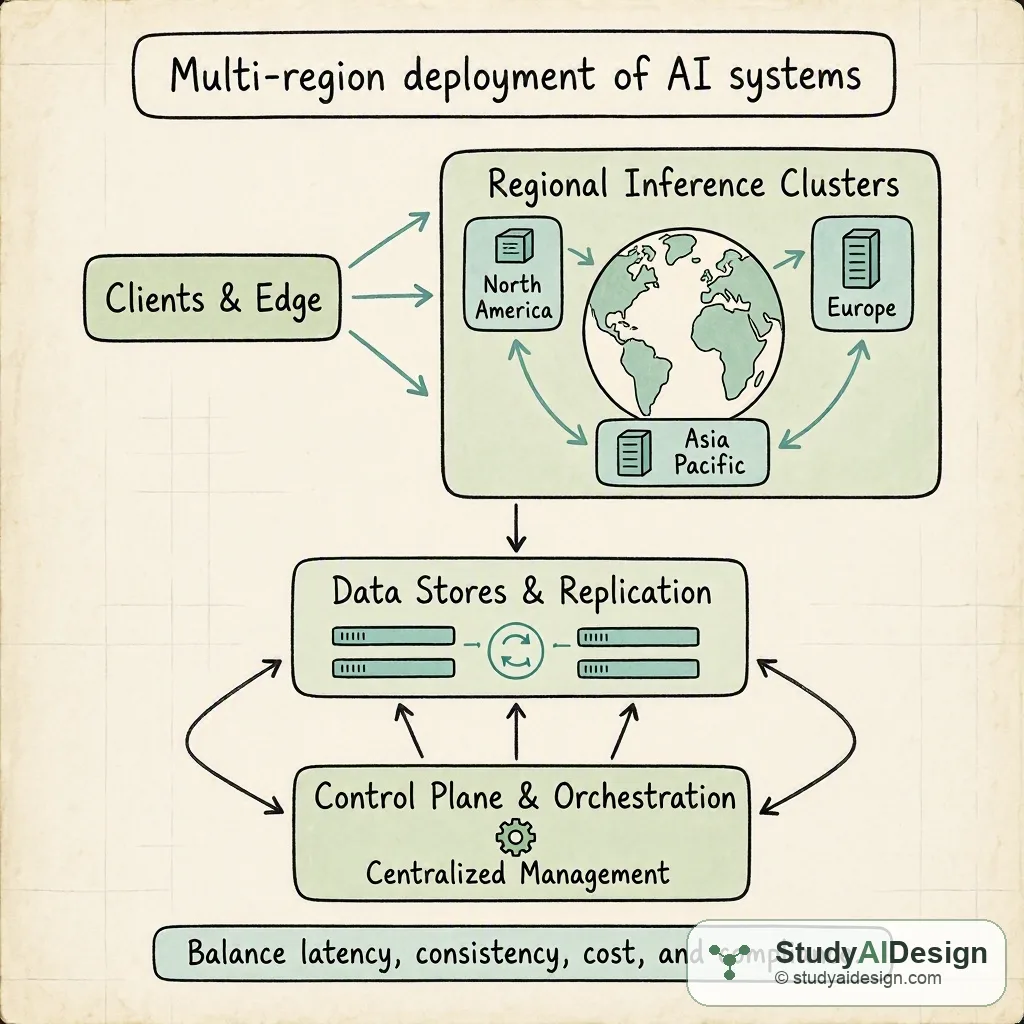
TL;DR
- Multi-region deployment of AI systems focuses on latency, availability, and legal compliance while managing cost and complexity.
- Key architecture choices: global inference with local caching, regional inference with model replication, and read/write data patterns with replication strategy.
- Operational needs include automated CI/CD for models, telemetry and synthetic tests, and region-aware throttling and failover. Key tradeoffs: latency versus consistency, data residency versus model freshness, and cost versus resilience.
In this question, we will learn how to design and evaluate multi-region deployments for AI systems, including inference, training artifacts, and data. We will approach practical architecture patterns, the operational controls you need, and the compliance and cost tradeoffs.
We will cover the following:
- The intuition
- How it actually works
- Design patterns and example comparison
- Monitoring, rollout, and operational controls
- Tradeoffs and failure modes
- Questions the interviewer might ask
Direct answer: Design your multi-region AI system by placing inference close to users for latency, replicating models and metadata with a clear consistency model, and isolating or partitioning data for compliance. Build automated model delivery and region-aware control planes, instrument for regional SLOs, and plan failover and cost controls.
The intuition (an analogy that makes it click)
Think of the system as a chain of regional pharmacies that fill prescriptions. Each pharmacy holds the same drugs (models) but may have differing supplies (data) and shipping times (latency). You want customers to get medicine quickly, but some drugs must be stored locally for legal reasons. If you keep everything in one central warehouse, shipping is slow. If you replicate everything everywhere, inventory and cost explode. We aim for the sweet spot: replicate models broadly, store sensitive patient records locally, and have clear rules about where writes happen.
How it actually works (the real mechanics, with one concrete worked example)
Key elements: model replication, data replication or partitioning, routing and caching, and the control plane.
Worked example: three-region deployment for a personalization model with EU, US, and APAC users. Requirements: 50 ms inference latency for 95% of requests, EU data residency for user profiles, and 99.99% region-available inference.
Architecture choices compared:
| Option | Inference location | Data residency | Consistency | Estimated median latency |
|---|---|---|---|---|
| Central (single region) | One region | Centralized | Strong | 180 ms |
| Regional replicas | Each region hosts model | Profiles partitioned to region | Eventual or per-region strong | 35 ms |
| Hybrid (edge cache) | Edge + regional cluster | Profiles in region, cache at edge | Stale reads possible | 20-50 ms |
For user profile writes we choose a partitioned model: EU profiles stay in EU data stores and do not leave the region. For model parameters and weights we replicate asynchronously to all regions; model updates follow a blue/green rollout orchestrated by the control plane.
Consistency rules for metadata and counters can use a quorum. If you have replicas and require write quorum and read quorum , ensure:
This inequality ensures strong consistency for reads after a write. If we pick , , and , the system provides read-after-write guarantees but increases write latency.
Model rollout strategy: build a CI pipeline that publishes signed model artifacts to a global artifact store. Regions pull artifacts and validate signatures, then move through stages: canary, regional, global. Add a model-serving sidecar that supports immediate rollback and config-driven routing.
Design patterns and example comparison
Common patterns:
- Regional inference replicas with local state: keeps latency low, good for data residency, requires state partitioning.
- Global control plane with local data plane: central orchestration, local autonomy on failures.
- Read-through caches at the edge: reduce latency for cold-start model downloads and for frequently accessed user metadata.
Compare tradeoffs with a small table of attributes:
| Pattern | Latency | Data residency | Operational complexity | Cost |
|---|---|---|---|---|
| Regional replicas | Low | High | Medium-High | High |
| Centralized | High | Low | Low | Low |
| Hybrid (cache) | Medium-High | Medium | Medium | Medium |
When to pick each: if latency SLOs are strict, prefer regional replicas. If cost and simplicity are paramount and latency tolerates network hops, a centralized approach may suffice. Hybrid is common when you must serve many regions with variable load.
Monitoring, rollout, and operational controls
Operational controls you must implement:
- Region-aware SLOs and dashboards for latency, tail latency, error rates, and model accuracy drift.
- Synthetic canaries that exercise model inference paths from each region.
- Automated rollback hooks in model CI/CD and feature flags for routing traffic.
- Cost caps and autoscaling policies per region to avoid runaway spend during incidents.
Example metrics to track from each region: median latency, 99th percentile latency, model output distribution divergence, and resource utilization. Use health checks that simulate real traffic patterns.
Tradeoffs and failure modes
Tradeoffs you will explain: latency versus consistency, fresh model parameters versus deployment risk, global availability versus local compliance, and cost versus redundancy. Be explicit about the operational cost of replicating large models and of cross-region egress fees.
Questions the interviewer might ask
Some follow-up questions you might get:
How do you ensure model freshness across regions? We use a signed artifact repository and a staged rollout with region-level canaries. Regions pull model versions and report success before traffic is routed.
How would you handle user profiles that must remain in their region? Partition user profiles by region and route reads and writes to the owning region. Use federated queries only when needed, and replicate derived non-sensitive features across regions.
What consistency model would you choose for counters or personalization state? If strict read-after-write is required, use quorum writes and reads with . For metrics or analytics where eventual consistency suffices, replicate asynchronously.
How do you control cost with multi-region model serving? Use autoscaling, spot instances for non-latency-critical workloads, model compression or quantization to reduce footprint, and tiered model placement based on traffic.
How do you test disaster recovery and regional failover? Run regular chaos experiments that simulate region outages, validate failover routing, and verify data reconciliation and rollback procedures.
How do you prevent model skew across regions? Track model output distributions by region and run periodic re-training or calibration with region-specific data. Use shadow testing before promoting a model.
Some things to note:
- Account for egress and replication costs early in capacity planning.
- Prefer automated, auditable control planes for model delivery and rollback.
What the interviewer is really testing
They want to know if you can balance availability, latency, cost, and compliance while providing operational guarantees. Expect to justify concrete choices: where data lives, how models get updated, how you detect and recover from failures, and how you measure success. Show that you can reason about tradeoffs and specify practical mechanisms for deployment, monitoring, and governance.
Related questions
How would you rate the quality of this article?
Prepare for your AI engineering interview
This is one of many detailed questions and explainers on StudyAIDesign. Browse the full set, work through the curriculum, and walk into your interview ready.