What is red teaming, and how do you red team an LLM application?
Red teaming LLM application: what red teaming is and how to red team an LLM application, including probe design, metrics, and mitigation steps for jailbreaks, data exfiltration, and hallucination risks. Practical process, example probes, and tradeoffs for building realistic adversarial evaluations and improving model safety.
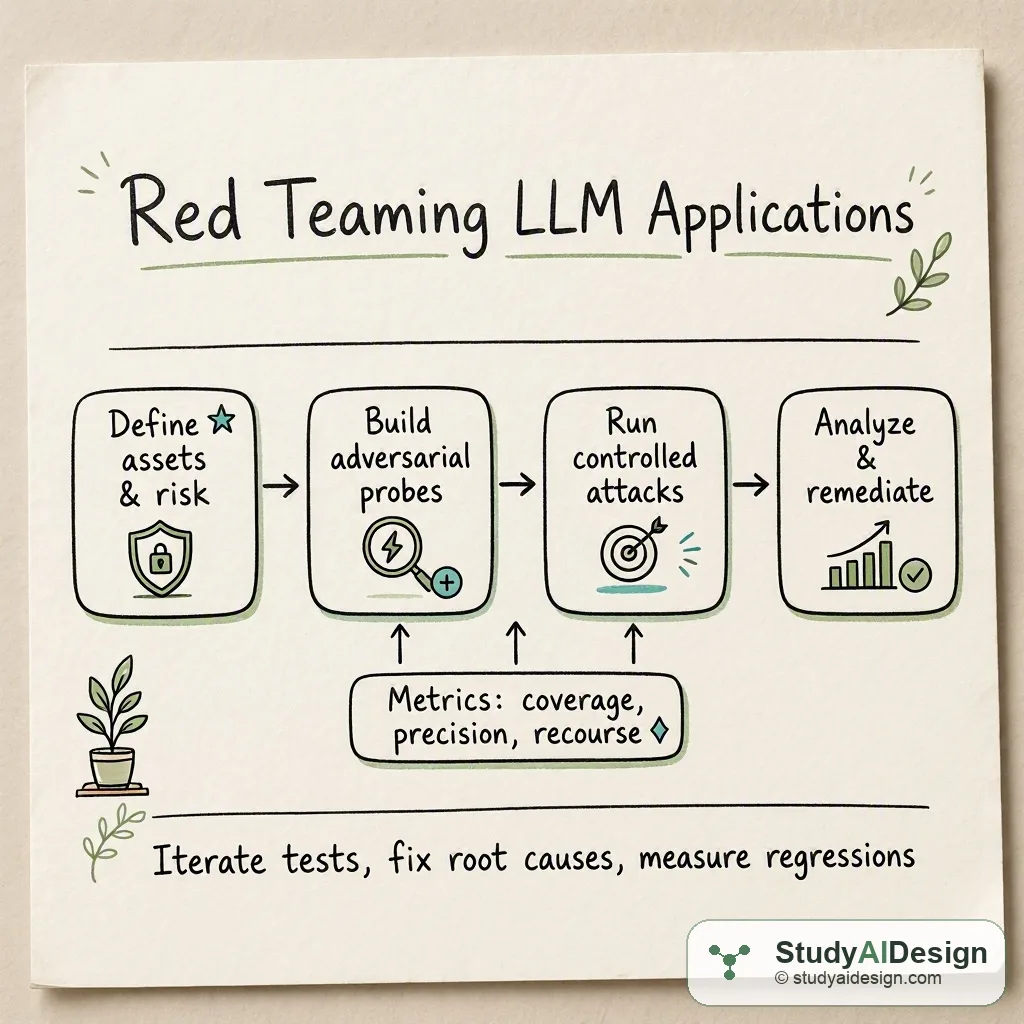
TL;DR
- Red teaming LLM application: simulate realistic attackers and misuse to find safety failures before they reach users.
- Focus on assets, threat models, probe design, measurement, and remediation loops with automated and human-in-the-loop tests.
- Use targeted probes: jailbreaks, data exfiltration, privacy probes, and hallucination triggers, then analyze root causes and mitigations. Key tradeoffs: cost versus coverage, automated scale versus human creativity, and short-term patches versus system redesign.
In this question, we will learn what red teaming is and how to red team an LLM application. We will treat the system as a product with assets and adversaries, then design probes, run experiments, and interpret results so you can suggest practical fixes.
We will cover the following:
- The intuition
- How it actually works
- Designing red team probes
- Tradeoffs and failure modes
- Questions the interviewer might ask
- What the interviewer is really testing
Direct answer: Red teaming an LLM application is the structured process of emulating realistic attackers and misuse scenarios to find safety, privacy, and integrity failures; you do this by defining assets and threat models, crafting a mix of automated and human-written probes (jailbreaks, extraction, prompt-injection, poisoning), measuring outcomes with clear metrics, and iterating remediation with regression tests. In practice you combine automated fuzzing and prompt mutations with expert human attackers and then prioritize fixes based on risk and feasibility.
The intuition (an analogy that makes it click)
Think of an LLM application like a physical building. Red teaming is the set of exercises where actors try to break in, cause damage, or steal sensitive items while the team watches. We need low-effort probes that quickly reveal obvious failures, and high-effort, expert attacks that reveal subtle weaknesses. That balance helps prioritize fixes: stop the door from opening before redesigning the foundation.
How it actually works (the real mechanics, with a concrete worked example)
We break the process into steps: asset inventory, threat modeling, probe design, execution, measurement, and remediation. Here is a concrete example: a customer-support LLM that has access to user PII and an internal knowledge base.
- Asset inventory: user PII, internal KB, escalation APIs.
- Threat model: an attacker who can chat with the bot, supply prompts, and may try to extract PII or bypass safety filters.
- Probe design: write prompts to coax the model to reveal PII, jailbreak content filters, or append instructions to override system prompts.
- Execution: run automated mutations at scale and a small team of human red-teamers for advanced jailbreaks.
- Measurement: record success rate, false positive rate, and coverage.
- Remediation: fix policies, add filtering, or change architecture (e.g., move PII behind gated APIs).
Compare probe types and a small synthetic measurement example:
| Probe type | Example goal | Typical detection metric |
|---|---|---|
| Jailbreak prompt | Evade content guard to produce disallowed text | detection precision |
| Data exfiltration | Get the model to output internal strings | success rate |
| Prompt-injection | Overwrite system instructions via user input | attack coverage |
We often measure expected harm as an aggregate risk score. For a discrete set of probes with probability of unsafe output and cost , expected risk is:
That formula guides prioritization: fix high- and high- failures first.
Designing red team probes
Good probes span automated fuzzing and high-quality human attacks. Techniques:
- Mutation-based fuzzing: take benign prompts and mutate keywords, punctuation, or structure to trigger edge cases.
- Spec-based probes: create scenarios that reflect realistic attacker goals, e.g., extract a credit-card number from a multi-turn conversation.
- Role-based jailbreaks: instruct the model to role-play a persona that ignores safety rules.
- Context-aware exfiltration: stitch outputs across turns to leak a secret held in context.
A practical pipeline:
- Seed library of known jailbreak patterns and domain-specific prompts.
- Automated generation producing thousands of variants per seed.
- Human review on top-ranked failures to validate severity and craft next-generation probes.
When to use automated vs human red teaming
Automated tests are cheap and repeatable. They give broad coverage and guardrails for CI. Humans are expensive but creative and find novel chains of vulnerability. Use automation for continuous regression tests and humans periodically or when automation indicates persistent or ambiguous failures.
Tradeoffs and failure modes
Red teaming is time and resource intensive, and some defenses cause usability regressions or false positives.
Common failure modes:
- Overfitting defenses: patching prompts without fixing root cause, which attackers bypass in new ways.
- Measurement blind spots: only measuring immediate success misses delayed leakage across turns.
- Usability regressions: heavy-handed filters block legitimate requests.
Questions the interviewer might ask
Some follow-up questions you might get:
How do you prioritize probes? Prioritize by expected risk , focusing on high-impact and high-probability failures first, then on coverage gaps.
What metrics do you choose? Use precision and recall on unsafe labels, attack coverage, time-to-exploit, and operational metrics like false positive rate and user friction.
How would you test for data exfiltration specifically? Store synthetic secrets in the context and design probes that attempt to reconstruct them across many prompts, tracking success and fragmentation strategies.
When do you escalate a finding to a remediation? Escalate when a finding has nontrivial probability and cost, or when it can be trivially reproduced by low-skilled actors. Use a risk threshold and business impact criteria.
How do you avoid regressions when deploying fixes? Add failing probes into CI as regression tests and rerun automated suites after each change; keep periodic human audits to catch emergent issues.
Some things to note:
- Always pair automated detection with human validation for high-risk outputs.
- Treat red team findings as hypotheses: reproduce, triage, and root-cause before patching.
What the interviewer is really testing
They want to see that you can think like an attacker and a system designer at once: define realistic threat models, design scalable tests, interpret safety metrics, and recommend fixes that balance security and usability. They also want evidence that you know how to operationalize findings: add regression tests, prioritize by expected harm, and close the loop with developers and product stakeholders.
Related questions
How would you rate the quality of this article?
Prepare for your AI engineering interview
This is one of many detailed questions and explainers on StudyAIDesign. Browse the full set, work through the curriculum, and walk into your interview ready.