How does a Reranker work?
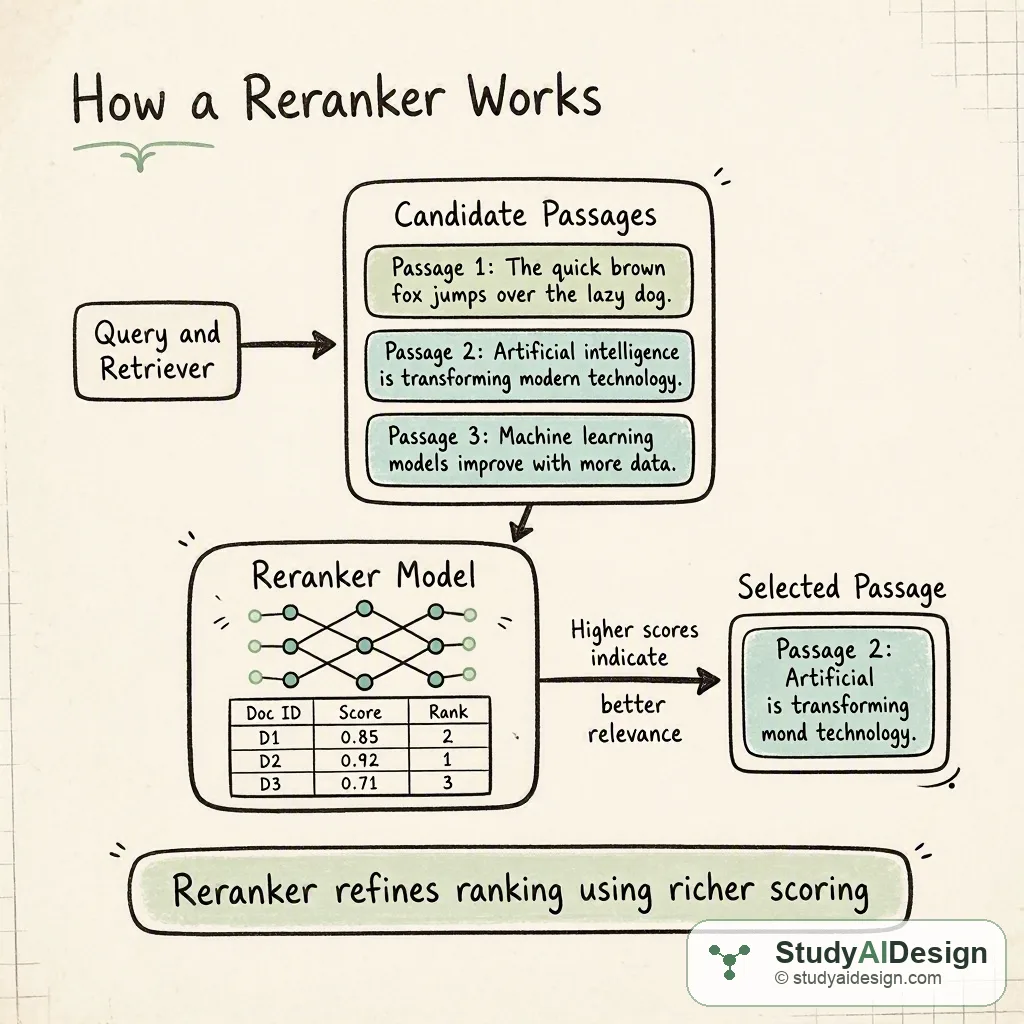
Reranker: how does a reranker work in a RAG pipeline and why do we add a second-stage model? This page explains reranker roles, scoring, and a concrete worked example showing how reranking changes final selection. It also covers when to use a reranker and common tradeoffs.
TL;DR
- Reranker: a second-stage model that rescoring candidate documents from a retriever to improve relevance and context matching.
- It takes a query and a small set of retrieved passages and produces new scores or probabilities that better reflect final-task relevance.
- Rerankers reduce errors from approximate retrieval and give the generator higher-quality context for RAG. Key tradeoffs: more latency and compute for better quality vs simpler single-stage retrieval for speed.
In this question, we will learn what a reranker does inside a RAG pipeline and why you might add one between the retriever and the generator. We keep the explanation practical with a small worked example so you can explain tradeoffs and failure modes in an interview.
We will cover the following:
- The intuition (an analogy that makes it click)
- How it actually works (the real mechanics, with an example)
- When to apply a reranker and practical tips
- Tradeoffs and failure modes
- Questions the interviewer might ask
Answer: A reranker is a second-stage scoring model that takes the top-k results from a retriever and assigns refined relevance scores, often using richer cross-attention between query and document, so the generator receives better context. It trades extra compute and latency for higher precision and better answer grounding in RAG.
The intuition (an analogy that makes it click)
Think of searching a library with a student assistant. The retriever is the assistant who runs quickly along aisles and returns a stack of likely books. The reranker is the senior librarian who skims the returned books carefully and orders them by how well each answers the student's precise question. We prefer the librarian's ordering when the answer must be accurate, even if it takes a bit longer.
How it actually works (the real mechanics, with one concrete worked example appropriate to the question; use a markdown table if you compare options or show numbers, and inline LaTeX for any math)
A simple pipeline looks like this:
- Retriever returns top- candidate passages for query based on approximate similarity, often using dot product of dense vectors or BM25.
- Reranker consumes each candidate with the query, usually in a cross-encoder architecture that concatenates and passage and scores the pair with a transformer.
- The reranker outputs a score for each candidate. You can normalize scores into probabilities using softmax if you need a distribution.
A common scoring normalization is:
Worked example: query "treatment for mild dehydration in adults". Retriever returns three passages with coarse scores. The reranker produces refined scores.
| passage id | retriever score | reranker score |
|---|---|---|
| 0.78 | 2.1 | |
| 0.60 | 0.5 | |
| 0.58 | 1.8 |
After reranking the order becomes , , because the reranker recognized that directly cites steps for oral rehydration while is tangential. If you convert reranker scores to probabilities you can compute:
This gives the generator clearer, higher-quality context.
Architectures and training signals:
- Cross-encoder reranker: concatenates and and runs full attention, highest accuracy, highest latency.
- Bi-encoder or interaction-lite reranker: computes richer representations than retriever but allows some batching and speed tradeoffs.
Training targets can be pointwise labels ( or ), pairwise margin losses, or listwise objectives such as normalized Discounted Cumulative Gain (NDCG). A simple pointwise loss is binary cross-entropy on relevance labels; a pairwise hinge loss trains the model to prefer positive over negative candidates.
When to apply a reranker
- You need higher precision for the top-1 or top-3 passages that will condition the generator.
- The retriever is fast but noisy, for example when using approximate nearest neighbor over many documents.
- You have labeled pairs or implicit click signals to train the reranker.
When not to apply one:
- Extremely latency-sensitive applications where extra round-trip time is unacceptable.
- When compute cost must be minimal and the retriever already achieves acceptable precision.
Practical tips for training and inference
- Hard negative mining matters: include negatives that are close to the query in embedding space but are incorrect. This teaches the reranker fine distinctions.
- Use truncated context windows: rerankers operate on trimmed passages, so choose passage size to balance signal and compute.
- Two-stage batching: run retriever to get top-, then run reranker in batch over those candidates to amortize transformer cost.
- Calibration: if you combine retriever and reranker scores, normalize or rescale them; raw logits may not be directly comparable.
Tradeoffs and failure modes
Rerankers improve precision but add compute, latency, and an extra model to maintain. They can also overfit to the kinds of negatives seen during training, missing novel failure modes at inference.
Questions the interviewer might ask
Some follow-up questions you might get:
How does a cross-encoder reranker differ from a bi-encoder? Cross-encoder processes query and passage together with full attention and typically gives better relevance estimates. Bi-encoder encodes query and passage separately and is faster at inference but usually less precise.
What is a suitable value for top- from the retriever? Common choices are to depending on retrieval quality and reranker speed. Larger increases chance of including the correct passage but also increases reranker cost.
How do you get training labels for a reranker? Use human relevance labels, weak signals like clicks, or create synthetic positives from downstream answers. Hard negative mining improves training effectiveness.
Can we combine retriever and reranker scores? Yes. You can linearly combine or use learned weights. Always validate the combination on held-out data because logits have different scales.
How does reranking affect RAG hallucination? Better reranking supplies the generator with passages that actually contain relevant facts, which reduces hallucination risk. However, a generator can still hallucinate if passages do not contain required facts.
What latency optimizations exist for rerankers? Batching, quantized weights, smaller cross-encoder architectures, and using bi-encoder like models with lightweight interaction layers help reduce latency.
Some things to note:
- Hard negatives and real-world validation are often the highest-impact improvements.
- Reranker gains are task dependent: reading-comprehension and QA show larger improvements than broad summarization.
What the interviewer is really testing
They want to see that you understand the retrieval stack and tradeoffs between speed and precision. Interviewers look for concrete awareness of architectures, training signals like hard negatives, and how reranking changes downstream generator behavior. Explain when the extra complexity is worth it and how you would validate the reranker in production.
Related questions
How would you rate the quality of this article?
Prepare for your AI engineering interview
This is one of many detailed questions and explainers on StudyAIDesign. Browse the full set, work through the curriculum, and walk into your interview ready.