What is ReAct (Reasoning + Acting) prompting, and how does it work?
ReAct (Reasoning + Acting) prompting explains how to interleave explicit chain-of-thought style reasoning with external actions like tool calls or searches. This page shows how ReAct works, a concrete step example, tradeoffs, and common interviewer questions.
TL;DR
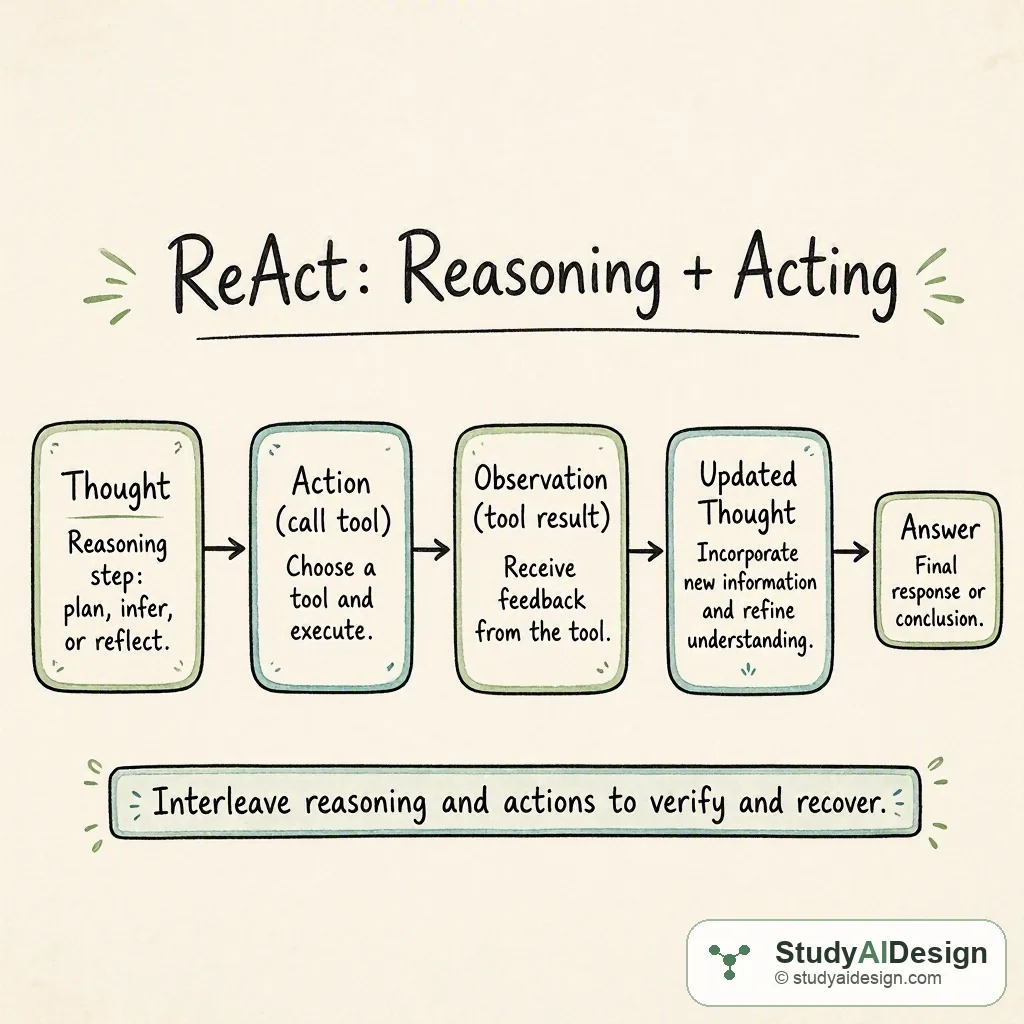
- ReAct prompting interleaves explicit reasoning steps with concrete actions such as tool calls, database queries, or computations.
- The model writes a short internal thought, issues an action, receives an observation, and then updates its thought until it can answer.
- This pattern improves correctness for multi-step tasks that need external information or verification. Key tradeoffs: increased transparency and controllability versus higher latency and potential verbosity.
In this question, we will learn what ReAct (Reasoning + Acting) prompting is, why people use it, and how a model alternates thinking and acting to solve problems that need tools or checks.
We will cover the following:
- The intuition
- How it actually works
- ReAct versus chain-of-thought and tool-only approaches
- Step-by-step worked example
- Tradeoffs and failure modes
- Questions the interviewer might ask
Direct answer: ReAct is a prompting pattern where the model writes brief reasoning steps labeled as thoughts, then issues explicit actions (for example a search or calculator call), reads observations returned by those actions, and repeats until it produces a final answer. It makes intermediate reasoning explicit and lets the system use tools, which improves correctness and debugging while adding latency and prompting complexity.
The intuition (an analogy that makes it click)
Think of a student solving a research problem at a library desk. The student makes a short mental note like "I should check the date of study X," walks to the shelf, looks up the paper, reads the result, and returns with the new fact. ReAct is the same loop inside the model: thought, action, observation, update thought. This keeps the internal steps visible and gives an opportunity to correct mistakes after seeing concrete evidence.
How it actually works (the real mechanics, with one concrete worked example)
At prompt time we provide a scaffold that marks turns explicitly. Typical labels are Thought, Action, Observation, and Answer. Each time the model writes an Action the system executes that action with an external tool and feeds the result back as an Observation. The model may perform cycles of Thought/Action/Observation before producing an Answer.
A minimal ReAct sequence looks like this:
Thought: I need the population figure for city X. Action: search("city X population 2020") Observation: "City X population 2020: 123,456" Thought: With that population I can compute density. Action: compute_density(123456, area=50 km^2) Observation: "Density = 2469.12 per km^2" Thought: The density is above threshold so answer follows. Answer: The population density is about 2469 people per square kilometer.
Concrete worked example. Suppose we need to find the product of two numbers after confirming them from a quick lookup. We request the model to confirm the numbers before multiplying. The model may do actions: one lookup and one calculation. If each action has latency cost , total action cost is and expected actions might follow a geometric distribution if the model stops with probability each round. Expected number of actions is
Comparison table of similar approaches:
| Approach | Strength | Weakness |
|---|---|---|
| Chain-of-thought (CoT) | Rich internal reasoning, helps with complex logic | No built-in mechanism to call external tools or verify facts |
| ReAct | Makes tool calls and reasoning explicit, eases debugging | More interactions and latency; prompt management required |
| Tool-only script | Deterministic external computations | Lacks soft reasoning and fallback when tools fail |
ReAct versus chain-of-thought and tool use
ReAct builds on chain-of-thought style reasoning by making each intermediate thought actionable. Where CoT is a monologue inside the model, ReAct is a dialogue between model and tools. The key differences are:
- CoT writes long internal chains; ReAct writes short thoughts then acts. Typical ReAct thoughts are brief heuristics or next-step plans.
- ReAct requires a system to execute actions and return observations. That makes it system-dependent but also more accurate in fact-based tasks.
When to prefer ReAct: tasks where external information or verification matters, such as web search, API calls, calculators, or structured database queries. Use plain CoT for pure internal logical puzzles where no external check is needed.
Step-by-step example and prompt design tips
- Scaffold labels clearly: Thought, Action, Observation, Answer. Keep the Thought lines short so the model does not over-commit early.
- Provide tool specs: show allowed actions and the exact format for Action calls. This reduces mismatch between model text and executable calls.
- Limit cycles if you care about latency. Add a stopping criterion like "stop after 5 cycles".
Prompt snippet pattern to use:
Thought: <short plan>
Action: <tool_call>
Observation: <tool_response>
Thought: <update>
Answer: <final answer>
If you compare two designs by latency and correctness you might see something like this table:
| Design | Typical cycles | Correctness | Latency |
|---|---|---|---|
| CoT only | 0 | medium-high on logic | low |
| ReAct | 1 to 5 | higher on factual tasks | higher |
Tradeoffs and failure modes
ReAct improves transparency and often correctness, but it has real costs. Each Action means another network round trip, higher token usage, and a more complex prompt engineering surface. The model can also generate malformed actions that the tool adapter must detect and recover from.
Failure modes to watch for:
- Over-reliance on noisy tool results without skepticism.
- Verbose or irrelevant Thoughts that waste cycles.
- Hallucinated Actions that look like valid calls but are not executable.
Questions the interviewer might ask:
Some follow-up questions you might get:
Why not always use ReAct? Because it adds latency and infrastructure complexity. For purely logical tasks without tools, chain-of-thought alone is usually cheaper and simpler.
How do you prevent the model from calling arbitrary actions? Constrain allowed action names and formats in the prompt, and implement a middleware that rejects or sanitizes malformed calls before execution.
How do you handle noisy observations from tools? Ask the model to treat observations as evidence with confidence levels, or call multiple sources and let the model weigh them.
How do you debug a ReAct run? The explicit Thought and Observation lines give audit trails. Inspect the sequence to find where the model misplanned or misread a result.
How many cycles should we allow? That depends on task complexity. Use a fixed cap like and tune it. If the model rarely needs more than cycles, a low cap reduces cost.
Some things to note:
- Make Thoughts concise to avoid runaway verbosity.
- Validate every Action before executing it.
- Combine ReAct with temperature and scoring controls to balance exploration and determinism.
What the interviewer is really testing
They want to see that you understand how to combine explicit reasoning with external actions, and that you can discuss the system and operational tradeoffs. They care about prompt scaffolding, action validation, and when ReAct improves correctness versus when it only increases cost. Demonstrate that you can design prompts and a safe runtime to get the benefits without losing control.
Further reading in the curriculum
Go deeper on the fundamentals behind this question.
- Prompting and Context Engineering How to structure prompts and fill the context window so models produce reliable, grounded, and cost-efficient outputs.
- Agent Fundamentals From single LLM calls to autonomous agents: planning, tool use, memory, and the control loop.
- AI Design Patterns A catalog of recurring architectural patterns for LLM systems, with tradeoffs, failure modes, and guidance on when to combine or avoid each.
Related questions
How would you rate the quality of this article?
Prepare for your AI engineering interview
This is one of many detailed questions and explainers on StudyAIDesign. Browse the full set, work through the curriculum, and walk into your interview ready.