Explain the AI product lifecycle from ideation to production.
AI product lifecycle from ideation to production explains the stages of ideation, model development, deployment, and monitoring for LLM-driven products. This summary helps you reason through design choices, tradeoffs, and operational steps when moving an LLM feature from prototype to production.
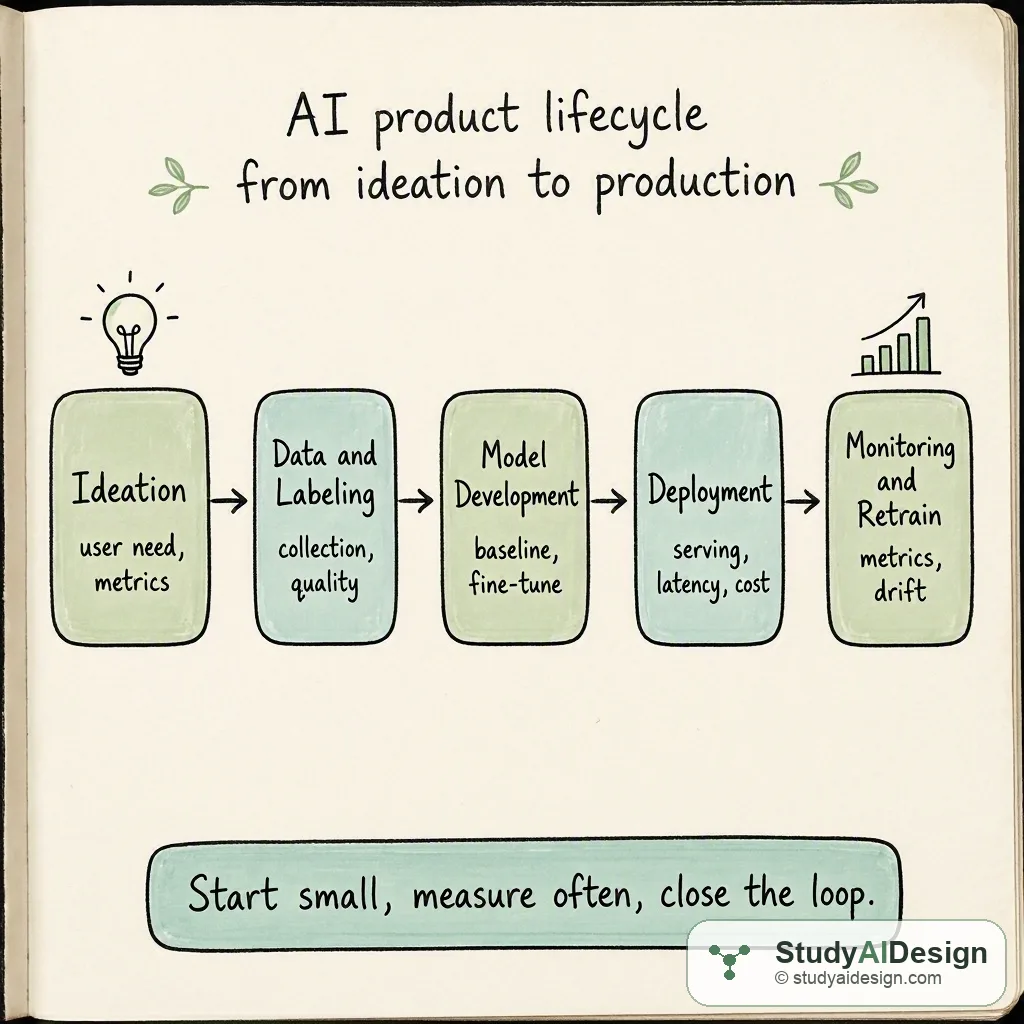
TL;DR
- The AI product lifecycle from ideation to production breaks a project into ideation, data work, model development, deployment, and monitoring.
- Focus on measurable success criteria, data quality, model cost/latency tradeoffs, and a continuous feedback loop for retraining.
- Practical checks: prototypes with a baseline, end-to-end cost and latency estimate, and clear SLOs before wide rollout. Key tradeoffs: model capability versus inference cost, speed versus accuracy, and strict privacy versus iteration speed.
In this question, we will learn the AI product lifecycle from ideation to production and how to structure decisions for LLM-driven features. We will treat the lifecycle as a sequence of engineering, product, and operational steps so you can explain each tradeoff clearly in an interview.
We will cover the following:
- The intuition
- How it actually works
- Deployment patterns and monitoring
- Scaling, retraining, and A/B tests
- Tradeoffs and failure modes
- Questions the interviewer might ask
- What the interviewer is really testing
Direct answer: The AI product lifecycle from ideation to production is a staged process that starts with a clear user problem and success metric, moves through data collection and model selection or fine-tuning, then into controlled deployment with observability and a retraining loop. Focus on measurable SLOs, cost and latency estimates, and a plan to detect data drift and failure modes before full rollout.
The intuition (an analogy that makes it click)
Think of building a restaurant feature. Ideation is choosing the menu item and defining how you will judge success. Data and labeling are your ingredients and recipes. Model development is the cook training and iterating the dish. Deployment is opening a pop-up to a limited crowd, measuring feedback, then scaling to the full restaurant. Monitoring and retraining are the regular taste tests and updates to the recipe.
This keeps decisions user-centered and measurable: we do not build a perfect model first, we validate the concept with a simple, reproducible test.
How it actually works (the real mechanics)
We will use a concrete worked example: a customer support assistant that answers user queries with an LLM.
- Ideation and success criteria
- Define user need: reduce time-to-first-response and increase resolution rate.
- Define metrics: average response time, resolution rate, and customer satisfaction score.
- Data collection and labeling
- Gather historical chats, annotate intent and correct answers, and flag private data.
- Establish a held-out test set to measure offline metrics and a small online pilot.
- Model choice and cost estimate Compare three options: open-source fine-tuned model, hosted API, and small specialist retrieval-augmented model.
| Option | Latency | Cost | Control / Privacy |
|---|---|---|---|
| Hosted API | low to medium | medium | low to medium |
| Fine-tuned local model | medium to high | high infra | high |
| Retrieval-augmented small model | low | low | medium |
We estimate inference cost with a simple formula. Let be requests per day, average tokens per request, and cost per token. Daily cost is
Example: , , dollars per token gives
a daily inference cost of $20. That helps you compare options before committing.
- Prototype and offline evaluation
- Build a small prototype: either a hosted API or a small fine-tuned model on a subset of data. Measure precision, recall, and hallucination rate on the test set.
- Controlled deployment
- Start with a canary or shadow mode. Define SLOs: latency budget , error rate threshold , and availability target such as .
- Observability and data loop
- Log inputs, outputs, confidence signals, and user corrections. Instrument for privacy and retention rules.
- Schedule periodic retraining when labeled drift is detected.
Deployment patterns and monitoring
Common patterns:
- Shadow deployment: run new model alongside production and compare outputs without affecting users.
- Feature flagging and canary: route a small fraction of traffic and compare key metrics.
- Blue-green deploys for safe rollbacks.
Monitoring signals to track:
- Latency percentiles and CPU/GPU utilization against budget .
- Accuracy proxies: user satisfaction, correction rate, or an automated verifier model.
- Data drift metrics: distribution shift in input tokens or top intents.
When you measure drift, approximate a simple divergence score or monitor per-feature histograms. If the divergence crosses a threshold, label new examples and consider a retrain.
Scaling, retraining, and A/B tests
When traffic grows, you decide between scaling horizontally (more replicas) or using cheaper models for high-volume, low-sensitivity queries. A/B tests should compare primary business metrics and fairness or error rates.
A typical retraining cadence is:
- Continuous small updates for high-volume, fast-drifting tasks.
- Scheduled periodic retrains (weekly or monthly) for stable domains.
Design the A/B test so you measure both business impact and operational cost. Include a rollback plan in case model B increases hallucinations.
Tradeoffs and failure modes
- Cost versus latency: bigger models improve quality but raise and .
- Privacy versus iteration speed: using private data on-premises slows iteration but protects users.
- Observability blind spots: without the right logs you cannot detect subtle drift or adversarial inputs.
Common failure modes:
- Data leakage or sensitive data exposure during training or logs.
- Silent performance degradation from distribution shift.
- Overfitting to labeling artifacts or evaluation sets.
Questions the interviewer might ask:
Some follow-up questions you might get:
How would you prioritize features for an LLM product? Prioritize by customer impact, risk, and cost of error. Pick a low-risk proof of value that gives measurable gains and iteratively expand.
How do you decide whether to fine-tune or prompt-engineer? Choose prompt engineering when you need speed and low infra cost; fine-tune when the domain needs consistent behavior, lower latency at scale, or stronger privacy controls.
What observability metrics are essential? Latency p50/p95, user correction rate, hallucination proxy, throughput, and distribution summaries for input features.
How do you handle sensitive user data? Apply data minimization, masking, access controls, and consider on-prem or VPC-hosted inference. Keep audit logs for data access.
When do you retrain a model? Retrain when offline metrics fall below acceptable thresholds, drift metrics exceed preset limits, or business needs change.
Some things to note:
- Always start with measurable SLOs.
- Choose the simplest model that meets business constraints.
- Instrument for the unknowns you will need to debug.
What the interviewer is really testing
They want to see that you can translate product goals into data and operational requirements, balance cost and quality, and design safe rollout and monitoring plans. They are assessing your ability to communicate tradeoffs, estimate costs, and create a repeatable feedback loop from production signals back into model improvements.
Related questions
How would you rate the quality of this article?
Prepare for your AI engineering interview
This is one of many detailed questions and explainers on StudyAIDesign. Browse the full set, work through the curriculum, and walk into your interview ready.