How does Chain-of-Thought (CoT) Prompting work?
Chain-of-Thought (CoT) Prompting explains how to get language models to produce intermediate reasoning steps to solve multi-step tasks. This page shows what CoT does, common patterns like few-shot CoT and self-consistency, and practical tradeoffs for interview answers.
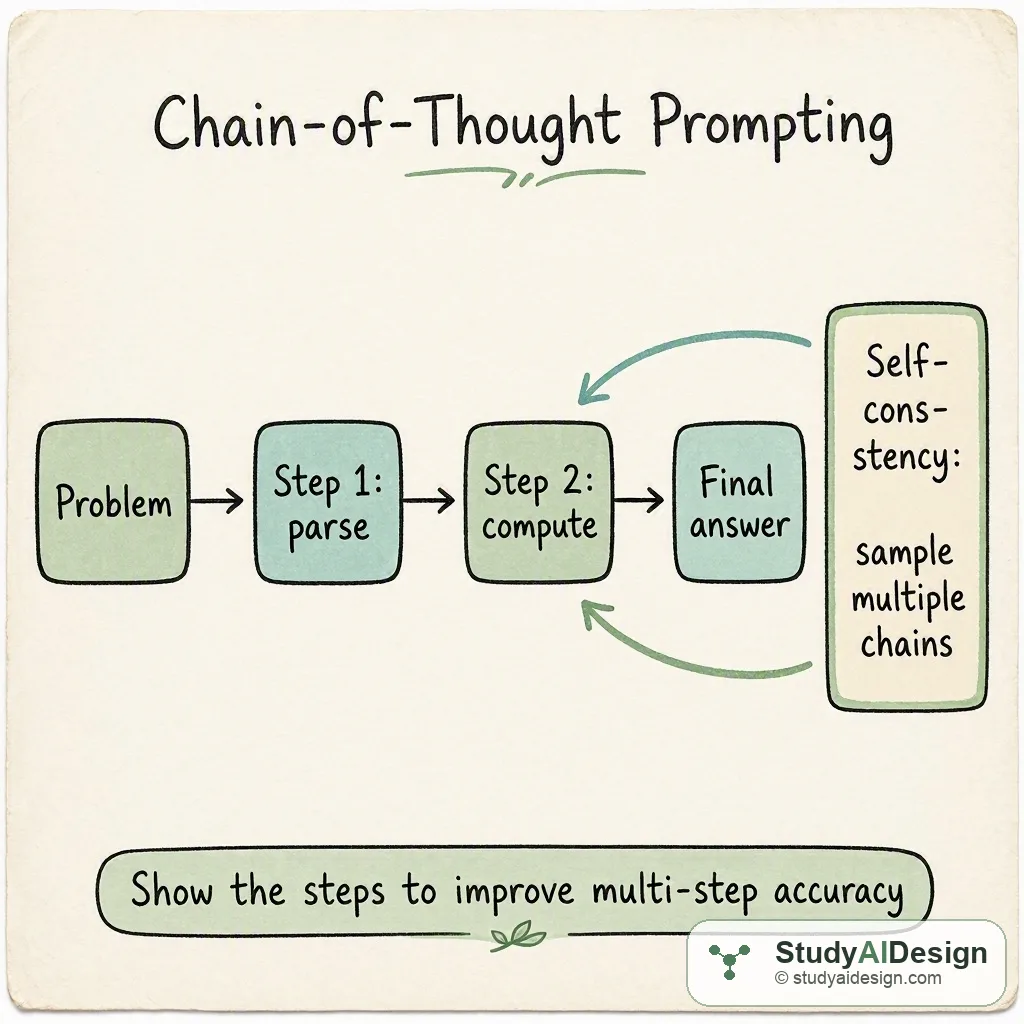
TL;DR
- Chain-of-Thought (CoT) Prompting asks the model to produce intermediate reasoning steps before the final answer, which raises accuracy on many multi-step tasks.
- You can use few-shot CoT by including demonstrations that show step-by-step reasoning, or prompt the model to "explain your steps" in a single example.
- Variants like self-consistency sample multiple chains and vote on the conclusion to reduce single-chain mistakes. Key tradeoffs: more accurate multi-step reasoning at the cost of longer outputs, higher token use, and potential for plausible but incorrect chains.
In this question, we will learn how Chain-of-Thought (CoT) Prompting works and why it often improves a model's performance on multi-step problems. We will keep things practical and show example prompts and a worked example so you can explain CoT confidently in an interview.
We will cover the following:
- The intuition
- How it actually works
- Common CoT patterns and examples
- When to use CoT and when it fails
- Tradeoffs and failure modes
- Questions the interviewer might ask
- What the interviewer is really testing
Direct answer: Chain-of-Thought Prompting guides a language model to generate intermediate reasoning steps explicitly, typically via few-shot demonstrations or an instruction to show work. By conditioning on step-by-step tokens, the model is more likely to produce logically connected substeps and a correct final answer. Common enhancements are sampling multiple chains and aggregating answers to improve robustness.
The intuition (an analogy that makes it click)
Think of CoT as asking a student to show their work on a math test instead of only grading the final number. When you see the intermediate steps you can catch small errors, and the act of writing steps helps the student move through the problem systematically. For a model, the intermediate tokens carry structure that nudges later tokens toward a correct conclusion.
How it actually works (the real mechanics, with a concrete worked example)
At base, a language model predicts the next token given previous tokens. We can write the conditional probability of an entire output sequence given input as
When we prompt the model to produce intermediate reasoning tokens, we change the conditioning context for the later answer tokens. Those extra tokens can increase the probability that the model generates a correct final answer by providing guiding context.
Concrete worked example. Prompt the model with a few-shot CoT demonstration and then a new problem:
Prompt pattern:
- Example 1: "Problem: If you have 3 boxes with 4 apples each, how many apples total? Reasoning: Each box has 4 apples, 3 boxes gives 3 times 4 equals 12. Answer: 12."
- Example 2: another worked example.
- New problem: "Problem: There are 17 groups of 13; how many items? Reasoning:" and the model continues.
A correct chain might be:
- "Multiply 17 by 10 to get 170."
- "Multiply 17 by 3 to get 51."
- "Add 170 and 51 to get 221."
- "Answer: 221."
Display formula for the multiplication result:
Empirical comparison (example numbers from typical benchmarks):
| Prompting style | Accuracy on multi-step problems |
|---|---|
| Zero-shot | 28% |
| Few-shot (no steps) | 54% |
| Few-shot CoT | 84% |
Those numbers show how explicitly showing steps in the prompt raises performance on problems that require intermediate computation or logical chaining.
Mechanically, CoT helps because the model learns the pattern of step decomposition from the demonstrations. When you sample with temperature and allow longer outputs, the model can produce those intermediate tokens that scaffold the final answer.
Common CoT patterns and examples
- Few-shot CoT: include several examples where each example contains a detailed reasoning trace. Use this when you can craft clean demonstrations.
- Zero-shot CoT: give an instruction like "Explain your reasoning step by step" before asking the question. This can work on very large models but is less reliable than few-shot CoT.
- Self-consistency: sample different chains and take the majority answer. This often beats a single deterministic chain because different sampled chains can correct each other.
Self-consistency sketch: generate chains and extract answers , then pick the most common . This reduces sensitivity to one mistaken chain.
When to use CoT and when it fails
Use CoT when tasks require multi-step reasoning, arithmetic, symbolic manipulation, or multi-hop logical inference. It effectively converts a complex mapping into a sequence of simpler steps.
CoT fails or is wasteful when the task is simple classification, direct lookup, or when token budget is tight. It can also produce plausible but incorrect chains that look convincing while being wrong.
Tradeoffs and failure modes
Other practical failure modes:
- Overconfidence in wrong chains: the model may supply a coherent but incorrect derivation.
- Degenerate verbosity: the model writes many irrelevant steps if prompts are vague.
- Sensitivity to demonstrations: poor examples produce poor chains.
Questions the interviewer might ask:
Some follow-up questions you might get:
How do you implement few-shot CoT in a prompt? Give several example problems where each example shows a labeled "Reasoning:" section that walks through substeps, then present the new problem with the same "Reasoning:" label so the model continues.
What is self-consistency and why use it? Self-consistency samples multiple reasoning traces and aggregates the final answers, reducing reliance on any single sampled chain and often improving final accuracy.
Does CoT always improve performance? No. It helps on multi-step problems and models trained to follow stepwise patterns, but it can hurt or be neutral on simple tasks or on models that cannot generate reliable intermediate tokens.
How do you verify a chain-of-thought answer? Cross-check final results with independent computation, or run a verifier prompt that checks each step; for arithmetic, recompute the final numeric answer using a trusted method.
How does temperature affect CoT generation? Higher temperature increases diversity of chains, which helps self-consistency but raises the chance of bizarre or incorrect steps. Balance temperature and sample count for best results.
Can CoT be automated without hand-crafted examples? There are approaches like automatic CoT and prompt-tuning, but they often need strong base models or extra data. Hand-crafted few-shot examples remain effective.
Some things to note:
- Self-consistency trades compute for robustness; sample more chains if latency allows.
- Verification or symbolic recomputation is often necessary for safety-critical answers.
What the interviewer is really testing
They want to see that you understand both the surface prompt pattern and the underlying mechanism: that CoT conditions later tokens on intermediate reasoning tokens to shape the final output. They also test whether you appreciate practical limits: token costs, hallucinated reasoning, and mitigation strategies like sampling and verification.
Further reading in the curriculum
Go deeper on the fundamentals behind this question.
- Prompting and Context Engineering How to structure prompts and fill the context window so models produce reliable, grounded, and cost-efficient outputs.
Related questions
How would you rate the quality of this article?
Prepare for your AI engineering interview
This is one of many detailed questions and explainers on StudyAIDesign. Browse the full set, work through the curriculum, and walk into your interview ready.