What is hybrid search, and why is it better than pure vector search?
Hybrid search and vector search: explain what hybrid search is, how it combines vector similarity and lexical matching, and why it often outperforms pure vector search for retrieval-augmented-generation and QA. Learn the scoring tradeoffs and when to tune hybrid weights for precision, recall, and latency.
TL;DR
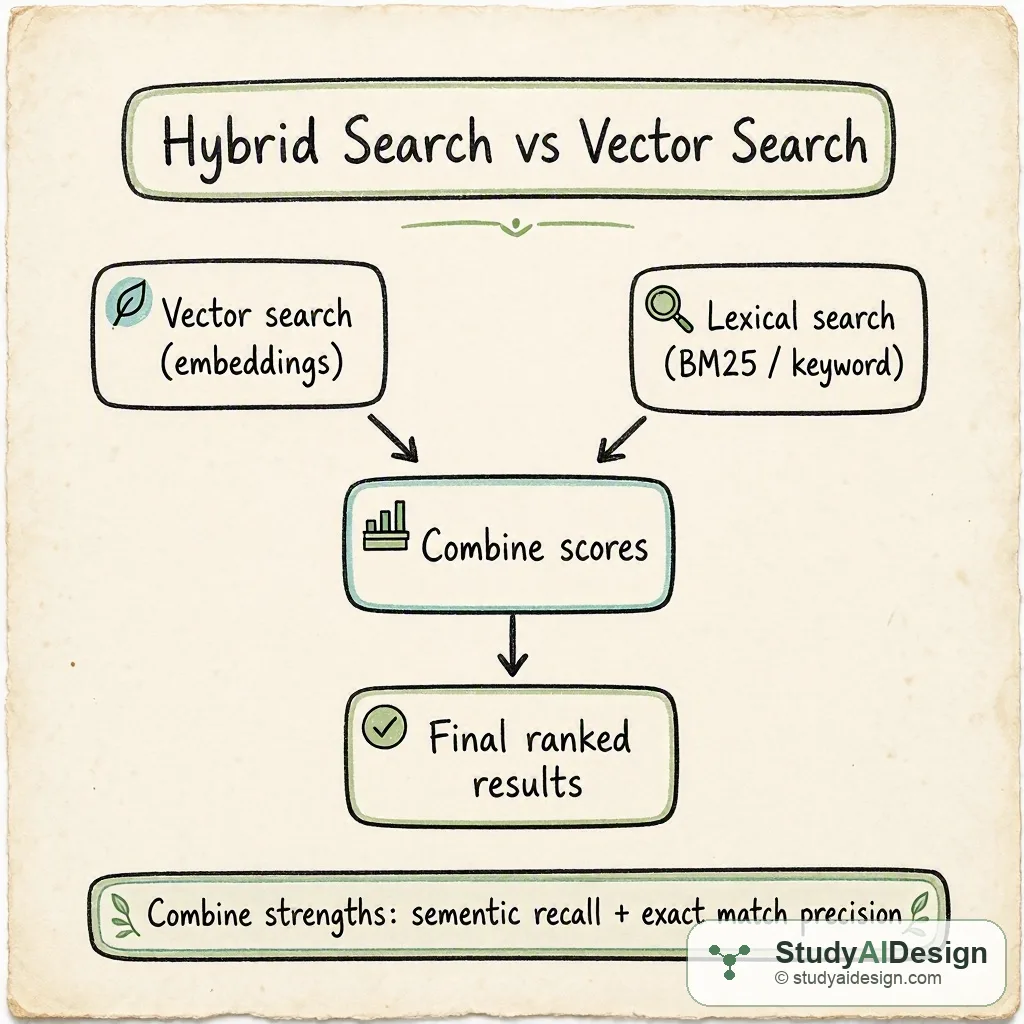
- Hybrid search combines vector similarity with lexical matching to get both semantic recall and exact-match precision.
- Pure vector search can miss facts that rely on exact tokens and can return verbose but off-target passages; lexical search can miss paraphrases.
- Hybrid scoring commonly mixes a normalized vector score and a lexical score using a weight and a rerank top candidates. Key tradeoffs: precision versus recall, latency versus quality, and tuning complexity versus robustness.
In this question, we will learn what hybrid search is, why it is often better than pure vector search, and how to implement a simple hybrid scoring and reranking pipeline for retrieval-augmented-generation.
We will cover the following:
- The direct answer
- The intuition
- How it actually works with a worked example
- When to use variants and practical considerations
- Tradeoffs and failure modes
- Questions the interviewer might ask
- What the interviewer is really testing
Hybrid search is a retrieval method that combines vector-embedding similarity with lexical matching signals to rank candidates; it is often better than pure vector search because it recovers both semantic paraphrases and exact token matches, giving higher factual precision and robustness when combined carefully. In practice we fetch candidates with one or both systems and mix or rerank their scores, tuning a weight to balance recall and precision.
The intuition (an analogy that makes it click)
Think of a library search where you have two helpers. One helper remembers themes and ideas across books and can find relevant passages even when the words are different. The other helper is a meticulous index reader who finds the exact page that contains a quoted phrase. If you only ask the theme helper you may get passages that match the idea but omit the exact fact you need. If you only ask the index reader you miss paraphrased content. Hybrid search asks both and then blends their answers so you get thematic coverage plus exact evidence.
How it actually works (the real mechanics, with one concrete worked example)
There are two common architectures:
- Score-level fusion. Compute a normalized vector score and a normalized lexical score and combine them with a weight :
- Two-stage retrieval and rerank. Use a fast lexical index to fetch top and/or a vector index to fetch top , take the union, and then rerank with a cross-encoder or the fusion formula above.
Worked example: we have 1000 documents and a user query. We compute cosine similarity for embeddings and BM25 for lexical. We normalize each score to lie in by min-max or logistic transform, set , and combine.
| method | top-5 precision | recall@100 | avg latency |
|---|---|---|---|
| pure vector | 0.60 | 0.78 | 80 ms |
| pure lexical (BM25) | 0.72 | 0.66 | 20 ms |
| hybrid (fusion ) | 0.75 | 0.82 | 90 ms |
The table shows a synthetic but realistic pattern. Vector alone finds semantically related passages boosting recall. Lexical alone often finds exact matches improving precision. Hybrid can yield the best of both with modest latency increase.
Practical numbers to keep in mind: retrieving a larger candidate set increases recall roughly like for budgeted rerankers until saturation. A cross-encoder rerank step often costs more but boosts precision.
When to use variants and practical considerations
Choice of . If you need exact factual snippets, bias toward lexical with smaller . If you need broad thematic recall, increase toward vector signal. A good starting point is in and tune on held-out queries.
Rerank vs fusion. If you have a heavy cross-encoder that computes , prefer two-stage retrieval: fetch 100 to 500 candidates with fast indexes and rerank the union. If you need very low latency and cannot afford a cross-encoder, score-level fusion with a linear combination is simpler and faster.
Normalization. Always normalize scores before mixing. Options include min-max on a sliding window of recent queries, a logistic transform calibrated on validation data, or converting scores to percentile ranks. Without normalization, one signal may dominate unpredictably.
Scaling and performance
Indexing and retrieval costs differ. Vector search typically uses approximate nearest neighbor algorithms that scale sublinearly but still cost memory for vectors and CPU for queries. Lexical indexes are compact and often faster for shallow queries.
A common pipeline to scale:
- Stage 1: fast lexical index get top .
- Stage 2: fast ANN index get top .
- Stage 3: union and rerank top with cross-encoder or fusion.
This balances latency and quality and limits expensive rerank work to a small candidate set.
Tradeoffs and failure modes
Other failure modes:
- Hallucination in RAG pipelines. Even with a strong hybrid retriever, a generator can hallucinate if the retrieved evidence is insufficient or poorly ranked.
- Token sensitivity. Lexical methods may mis-rank if the user uses synonyms or misspellings; include fuzzy matching or query expansion.
- Embedding drift. If embeddings were trained on different data or tasks, vector similarity may prioritize style over factual closeness.
Questions the interviewer might ask
Some follow-up questions you might get:
How do you normalize scores when combining them? You can use min-max normalization on a sliding candidate set, convert scores to percentiles, or calibrate a logistic transform on holdout relevance judgments. The key is consistent scaling so and are comparable.
When would you avoid hybrid search? If you have extremely tight latency or memory constraints and your task is purely semantic with no need for exact token matches, pure vector search may suffice. Also if you have no good lexical signal due to noisy text, hybrid gains may be small.
How do you pick ? Tune on a validation set that reflects production queries, optimizing a metric like precision@k or MRR. Grid search over in increments of 0.1 is a practical start.
What are cross-encoders and bi-encoders in this context? Bi-encoders produce independent embeddings for queries and docs and are fast for ANN search. Cross-encoders take query and doc together and produce a fine-grained relevance score but are slower and used for reranking.
How does hybrid search affect RAG answer quality? Better retrieval typically reduces hallucinations because the generator has more relevant evidence. Hybrid search often gives higher factual precision in generated answers when you need exact facts.
Some things to note:
- Evaluate retrieval and end-to-end generation metrics, not only embedding nearest-neighbor accuracy.
- Monitor distribution drift; re-tune normalization and after index or model updates.
What the interviewer is really testing
They want to see that you understand the complementary strengths of semantic and lexical retrieval, and that you can design a practical pipeline that balances quality, latency, and complexity. They also want to hear about normalization, validation-driven tuning, and common failure modes so you can deploy a robust retrieval component in a RAG system.
Related questions
How would you rate the quality of this article?
Prepare for your AI engineering interview
This is one of many detailed questions and explainers on StudyAIDesign. Browse the full set, work through the curriculum, and walk into your interview ready.