How do you design rate limiting and cost management for AI APIs?
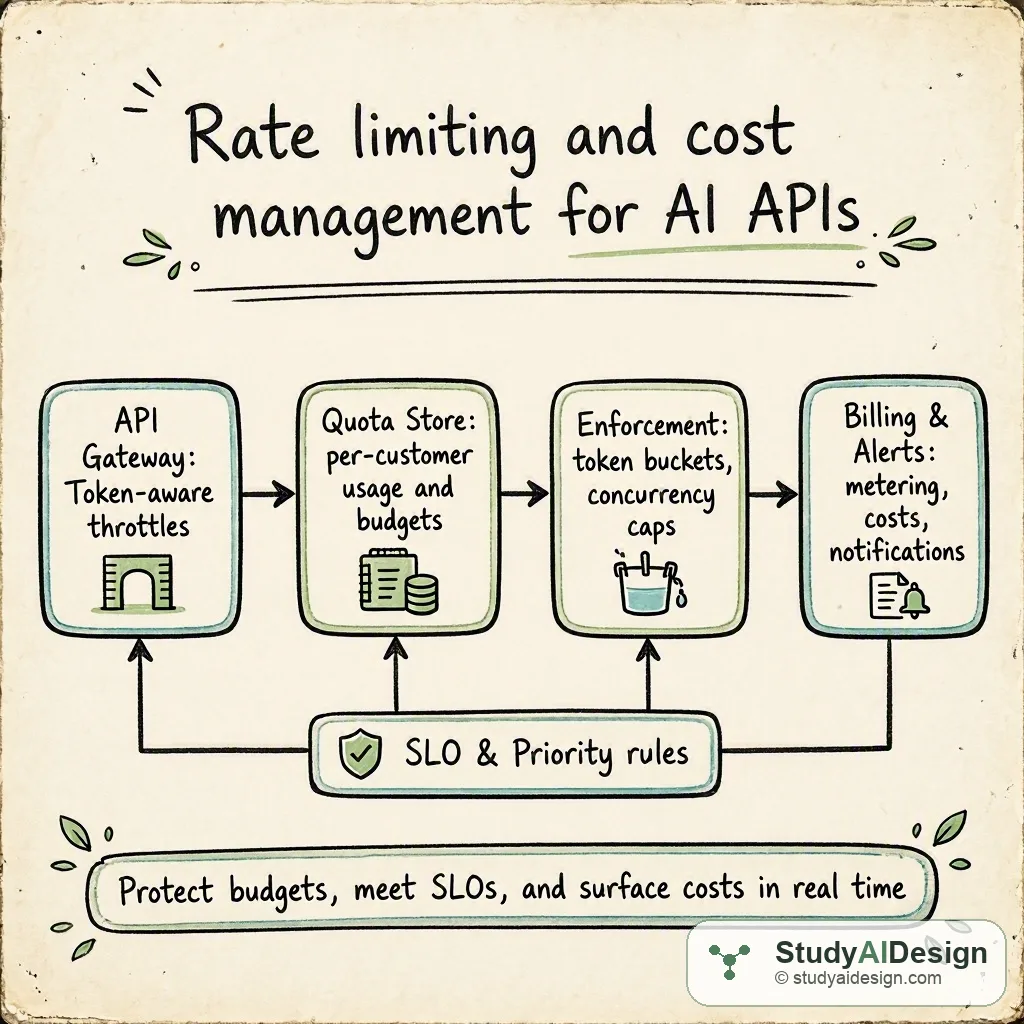
Rate limiting and cost management for AI APIs requires controlling request rates and usage costs while preserving latency and fairness. This question asks you to design token-aware throttles, per-customer budgets, and a billing pipeline with monitoring, automatic backoff, and emergency overrides. Explain architecture, policies, and tradeoffs for protecting both your users and your bill.
TL;DR
- Protect budgets and latency: combine token-aware rate limits, concurrency caps, and per-customer budgets to stop runaway costs.
- Measure and meter: real-time metering, event pipeline, and a billing store let you enforce limits and give accurate invoices.
- Adaptive policies: dynamic throttles, priority classes, and emergency overrides keep high-value traffic alive while protecting overall spend.
In this question, we will learn how to design rate limiting and cost management for AI APIs so you can prevent runaway bills while keeping latency and fairness acceptable. We will keep the design practical: policy choices, enforcement mechanisms, telemetry and a worked numeric example that shows how costs change with rate.
We will cover the following:
- The intuition (an analogy that makes it click)
- How it actually works (the real mechanics, with one concrete worked example appropriate to the question; use a markdown table if you compare options or show numbers, and inline LaTeX for any math)
- Strategies and patterns
- Architecture and components
- Tradeoffs and failure modes (include one ...)
- Questions the interviewer might ask
- What the interviewer is really testing
Direct answer: combine token-aware quotas, concurrency limits, and per-customer budgets enforced by a fast gateway with a real-time usage pipeline and a durable billing store. Add adaptive throttles, priority classes, and alerts so that you preserve critical requests while capping spend.
The intuition (an analogy that makes it click)
Think of your system as a shared water supply. Each customer has a bucket and a faucet. Rate limits control faucet flow. Budgets limit how much water a bucket can hold before we stop refilling. A separate meter measures how much water each faucet uses and raises alarms if usage spikes. We keep a priority tap open for critical customers even when the system is strained.
This keeps everyone from draining the entire reservoir while letting important users get enough water.
How it actually works (the real mechanics, with one concrete worked example appropriate to the question; use a markdown table if you compare options or show numbers, and inline LaTeX for any math)
Core mechanisms we combine:
- Token-aware quotas: charge requests by resource usage, for example tokens or model compute units. Enforce per-request cost as part of the rate-limiter decision.
- Concurrency limits: limit simultaneous in-flight requests to bound resource contention and latency.
- Budgeting and credit system: maintain a spend balance and reject or throttle when the balance is exhausted.
- Adaptive throttling: reduce allowed rate when global cost or latency thresholds cross SLOs.
Worked numeric example
Assume price per 1k tokens is USD. A user issues requests totaling tokens per second. The cost per second is:
If tokens/sec and , then cost per second is USD/sec.
Per-minute and per-hour costs are useful for budgets. For this example we compute costs for common request sizes and request rates.
| Request tokens | Requests per second | Tokens per second | Cost per minute (USD) |
|---|---|---|---|
| 500 | 2 | 1000 | |
| 2000 | 1 | 2000 | |
| 4000 | 5 | 20000 |
The table shows how bursty high-token requests quickly increase costs. Designing limits around tokens is more accurate than limiting raw request count.
Strategies and patterns
Per-customer quotas and multi-dimensional limits
-
Use multi-dimensional quotas: tokens per second, requests per second, and concurrent requests. Each protects a different failure mode. For example, concurrency caps protect latency, token rate caps protect cost, and request caps protect control-plane saturation.
-
Implement budget accounts: each customer has a credit balance that is debited in near real time. When the balance falls below thresholds, move the customer through soft throttle, hard throttle, then block.
Priority classes and emergency overrides
-
Offer priority tiers: critical or paid plans get a higher guaranteed floor and lower probability of being throttled. Keep a small emergency reservation of capacity to preserve critical SLOs.
-
Support on-demand emergency overrides with manual or automated approvals tied to billing alerts so that critical workflows keep running while finance catches up.
Adaptive control loops
-
Monitor metrics: spend rate, request latency, error rate, queue lengths. Use feedback to adaptively lower admission rates when cost or latency budgets are exceeded.
-
Backoff policies: exponential backoff at the client level plus server-side graceful reject responses with Retry-After and suggested reduced token limits.
Architecture and components
Key components in the design:
- API Gateway / Edge: enforces per-request checks, token-cost calculation, and immediate rate-limiter decisions using an in-memory store or fast cache.
- Quota Store: authoritative counters and budgets persisted in a durable store like Redis with replication. Use local caches on gateways for low-latency checks and periodic reconciliation.
- Usage Event Pipeline: publish each request event to a stream (Kafka) for real-time billing, analytics, and reconciliation.
- Billing and Billing Store: accumulate usage into invoices and trigger budget alerts. Keep an eventual-consistent reconciliation job to correct transient cache drift.
- Monitoring and Alerting: SLO dashboards and budget alerts with thresholds and automated actions.
Operational notes
- Gateways should prefer fast approximate decisions with a conservative cache TTL and reconcile occasional overages asynchronously.
- Use token buckets or leaky bucket algorithms for smooth-rate enforcement. For strict fairness you can use distributed consensus for counters but that costs latency.
Tradeoffs and failure modes (include one ... )
Tradeoffs
- Strict global correctness vs latency: strongly consistent global counters prevent overspend but add latency. Local caches reduce latency but permit small overages that must be reconciled.
- Simplicity vs fairness: simple request-count limits are cheap but unfair for heavy-token requests. Token-based billing is fairer but needs per-request cost computation.
- User experience vs cost control: aggressive throttling protects your bill but harms UX. Soft throttles and informative errors help.
Questions the interviewer might ask
Some follow-up questions you might get:
How do you account for asynchronous inference or batched jobs? Batched or async jobs should be charged by estimated compute or tokens used. Enforce queue admission by projected cost and reserve budget at enqueue time to avoid surprise charges.
How do you prevent a malicious client from spinning many small requests to evade per-request limits? Use token-based accounting and aggregate usage over sliding windows. Require authentication and per-key quotas. Detect anomalous patterns with rate-of-new-connections and implement stricter limits on new keys.
When should you use distributed counters vs local caches? Use local caches for low-latency decisions and distributed counters when strict global guarantees are required. A hybrid approach with conservative local quotas and periodic reconciliation is common.
How do you surface cost to customers in real time? Expose a usage API and web dashboard with rolling spend windows, projected monthly cost, and alerts. Provide soft-throttle notices and automated auto-top-up or charge controls.
How do you design retries and backoff to not amplify cost? Return informative Retry-After and suggested reduced token budgets. Encourage exponential backoff on clients and cap maximum retry attempts to avoid repeated billing.
Some things to note:
- Charge by the most relevant resource metric, usually tokens or compute units, not raw requests.
- Provide clear error responses and a usage API so customers can adapt their clients proactively.
What the interviewer is really testing
They want to see you balance multiple goals: protecting the provider from runaway cost, preserving latency and availability, and offering predictable billing for customers. They are testing system thinking across policies, enforcement algorithms, telemetry, and operational tradeoffs. Show you can pick practical hybrid solutions and explain their failure modes.
Related questions
How would you rate the quality of this article?
Prepare for your AI engineering interview
This is one of many detailed questions and explainers on StudyAIDesign. Browse the full set, work through the curriculum, and walk into your interview ready.