What is adapter-based fine-tuning?
Adapter-based fine-tuning is a parameter-efficient way to adapt pretrained models by inserting small trainable modules called adapters while keeping the main weights frozen. It reduces storage per task and speeds up multi-task deployment at the cost of some representational flexibility compared with full fine-tuning.
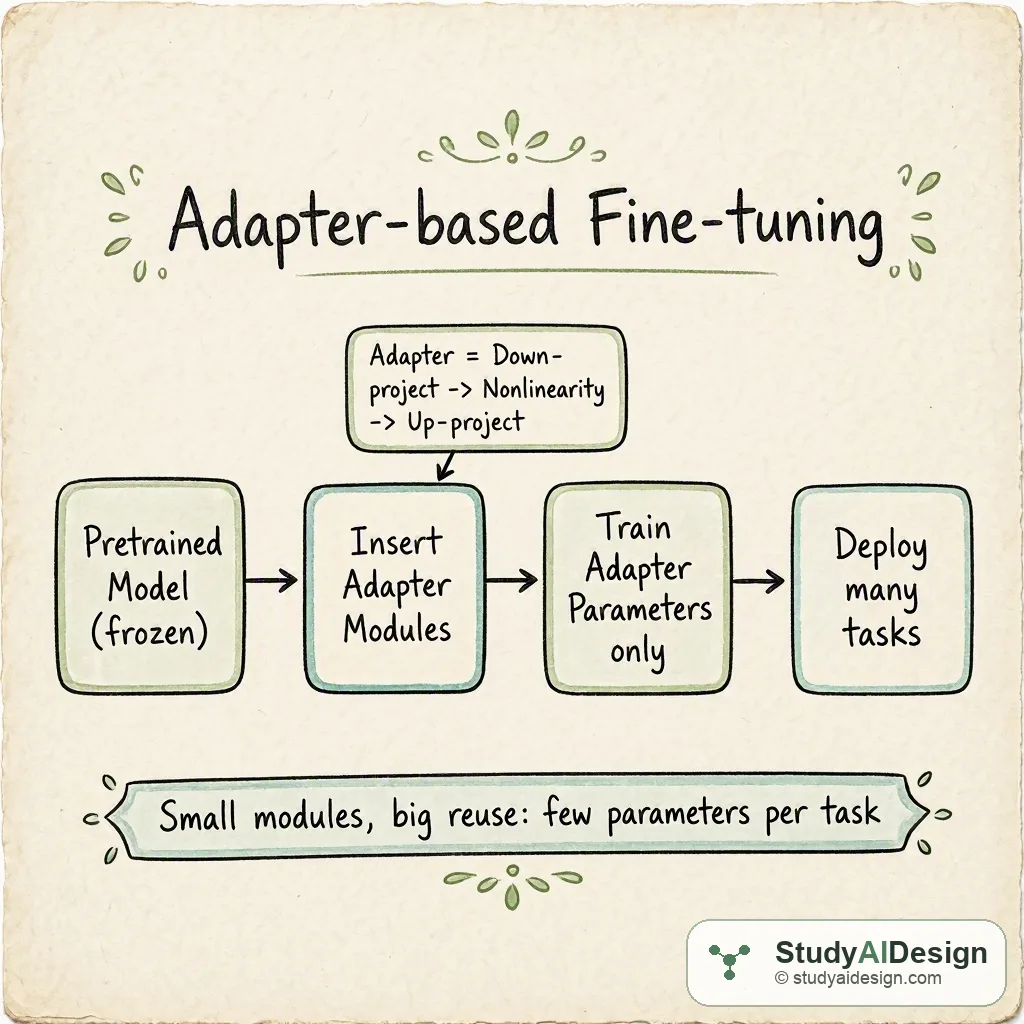
TL;DR
- Adapter-based fine-tuning inserts small trainable modules into a frozen pretrained model so you only update a tiny fraction of parameters.
- Each adapter is typically a bottleneck: a down-projection to size , a nonlinearity, then an up-projection back to , so added params scale like .
- You get compact per-task storage and fast switching between tasks, at some tradeoff in expressivity relative to full fine-tuning. Key tradeoffs: parameter efficiency vs representational flexibility.
In this question, we will learn what adapter-based fine-tuning is, how adapters are structured, and when you should choose them over full fine-tuning or other parameter-efficient methods. We will keep the math light and work a concrete numbers example so you can explain resource tradeoffs clearly.
We will cover the following:
- The intuition (an analogy that makes it click)
- How it actually works (concrete mechanics and a worked example)
- Variations and implementation details
- When to use adapters
- Tradeoffs and failure modes
- Questions the interviewer might ask
- What the interviewer is really testing
Adapter-based fine-tuning inserts small, trainable modules into a pretrained model and freezes the original weights so only the adapter parameters are updated. This yields large reductions in trainable parameters and per-task storage while keeping the base model reusable. It often works very well for moderate task shifts but can underperform full fine-tuning when the task needs major representational change.
The intuition (an analogy that makes it click)
Think of the pretrained model as a multi-purpose tool, like a Swiss Army knife. Adapters are like adding a slim, task-specific blade that clips into the knife without changing the original tools. You keep the same reliable base, and you only swap small attachments to change behavior for new tasks.
This keeps the heavy, costly core intact and only requires cheap additions for each new use. That explains why adapters make sense when you want many task heads or when you need to keep the same base model across deployments.
How it actually works (the real mechanics, with a worked example)
A common adapter design has three parts inside a Transformer block: a down-projection , a nonlinearity, and an up-projection . The adapter output is added back with a residual connection.
If the hidden size is and the bottleneck is , then the dominant parameter cost per adapter is about (two dense matrices). If you include small biases the total is slightly larger.
Display the parameter count for one adapter:
Worked example. Suppose the model hidden size is and we pick an adapter bottleneck .
If you place one adapter per Transformer layer and the model has 12 layers, the added trainable parameters are about which is roughly 1.18 million parameters.
Compare that to full fine-tuning where you might update the entire model of, for example, 110 million parameters. Here is a compact comparison:
| Method | Trainable parameters (approx) | Notes |
|---|---|---|
| Full fine-tuning | 110,000,000 | Update whole model |
| Adapter , 12 layers | 1,180,000 | Freeze base, train adapters |
| Head-only (linear) | 5,000 | Only final classifier trained |
You can see adapters sit between head-only tuning and full fine-tuning in both parameter count and flexibility.
Variations and implementation details
There are several popular adapter variants and related approaches to be aware of:
- Houlsby-style adapters: adapters inside both attention and feed-forward sublayers with layer-norm placement and residuals.
- Pfeiffer-style adapters: a simpler insertion strategy that keeps parameter sharing across layers optional.
- AdapterFusion: trains small task adapters and a fusion module that learns to mix them for multitask use.
- LoRA and prefix-tuning: alternative parameter-efficient methods. LoRA adapts by adding low-rank updates to weight matrices; mathematically also adds parameters but applied differently.
Implementation notes we often mention in interviews: adapt where it matters (after feed-forward is common), watch layer normalization ordering, and choose to trade off size and capacity. Training uses the same optimizers and learning rates as usual but with much fewer trainable variables, so effective batch sizes and learning rates may need retuning.
When to use adapters
Use adapters when you have many tasks or models to maintain and you want small per-task artifacts. They are excellent if you need to switch tasks quickly or upload many task-specific weights. They are also useful when you cannot afford to store or re-release a full fine-tuned model for each task.
Avoid adapters when the target task requires wholesale changes to internal representations. If the task needs large representational shifts, full fine-tuning or larger values may be necessary.
Tradeoffs and failure modes
Adapters give strong parameter efficiency but they can fail in a few ways.
Other failure modes include misplacement of adapters relative to layer norm causing instability, and forgetting when combining many adapters without a good fusion strategy.
Questions the interviewer might ask
Some follow-up questions you might get:
How do you compute the added parameters for adapters? You count the down and up projection matrices. For hidden size and bottleneck , the dominant cost is about per adapter, plus small bias terms.
Where in the model do you insert adapters? Commonly after the feed-forward sublayer or inside both attention and feed-forward blocks depending on the variant. The choice affects capacity and training stability.
How do adapters compare to LoRA? Both are parameter-efficient. LoRA directly parameterizes low-rank updates to existing weight matrices while adapters add small modules; LoRA can be simpler for attention matrices and integrates differently with residuals.
Does freezing the base model hurt transfer? Freezing protects the pretrained knowledge and reduces catastrophic forgetting, but it can limit adaptation if the new task needs large representational changes. Raising or fine-tuning some base layers can help.
How do you combine adapters for multitask or multilingual use? Options include training separate adapters per task and selecting them at inference, or using AdapterFusion to learn a small combiner that mixes multiple adapters.
Some things to note:
- You often retrain only a few million parameters versus tens or hundreds of millions.
- Choose by validation: small values are efficient but may underperform.
- Adapters make model management simpler when supporting many tasks.
What the interviewer is really testing
They want to see you understand parameter vs representational tradeoffs and practical deployment concerns. Explain the adapter architecture clearly, show you can compute parameter budgets, and discuss when adapters succeed or fail in practice. Demonstrating awareness of related methods like LoRA and AdapterFusion signals you can recommend appropriate tooling for real projects.
Further reading in the curriculum
Go deeper on the fundamentals behind this question.
- Fine-Tuning and Adaptation How to adapt pretrained language models to specific tasks using full fine-tuning, LoRA, instruction tuning, and preference alignment, and when each approach is the right tool.
Related questions
How would you rate the quality of this article?
Prepare for your AI engineering interview
This is one of many detailed questions and explainers on StudyAIDesign. Browse the full set, work through the curriculum, and walk into your interview ready.