How do you choose the right embedding model for your use case?
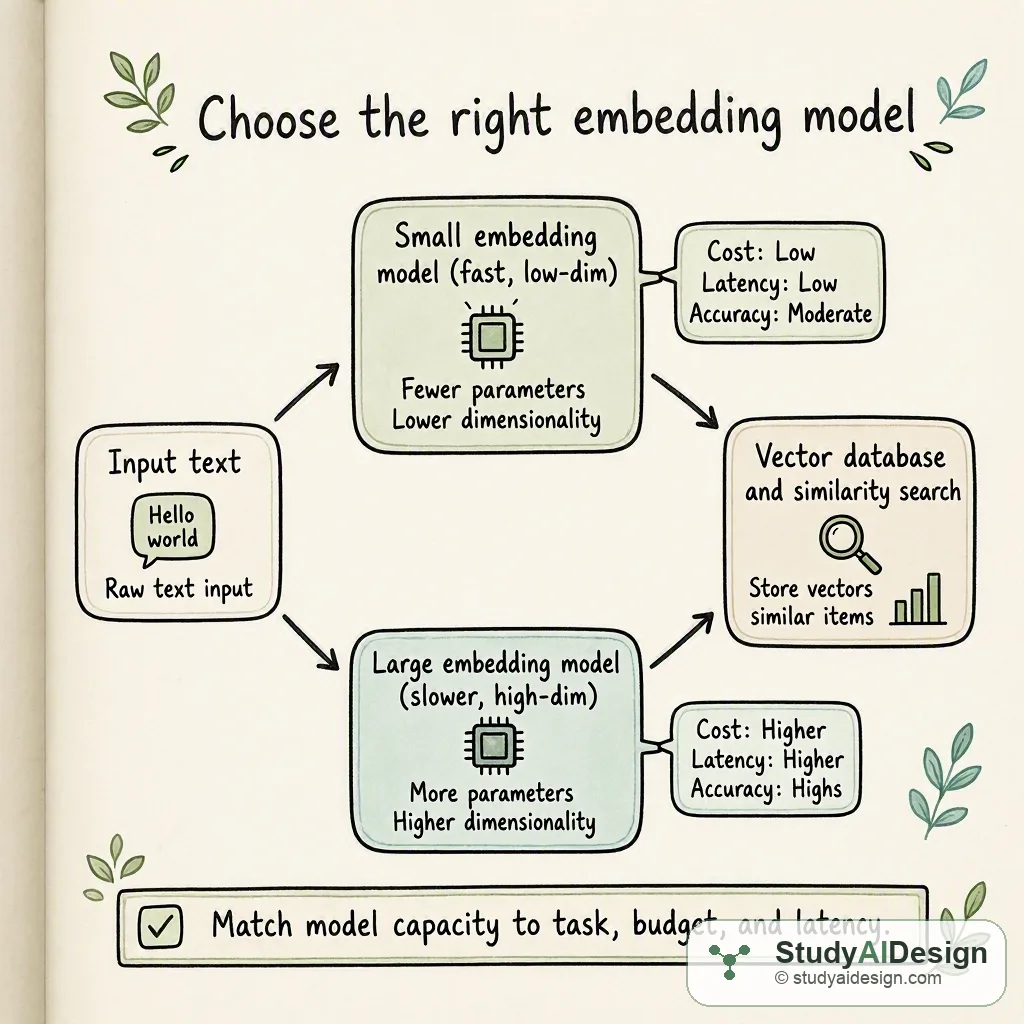
Choose the right embedding model for your vector-db use case by matching model capacity, embedding dimension, cost, and latency to your task. This page explains practical criteria, a worked storage and quality example, and a checklist to pick the best embedding model for retrieval and similarity search.
TL;DR
- Choose by task: semantic search and clustering need higher-quality embeddings than simple deduplication.
- Match embedding dimension and model size to latency, storage, and downstream models.
- Measure quality with a small labeled holdout and cost/latency in your environment. Key tradeoffs: embedding quality versus cost, inference latency, and vector storage.
In this question, we will learn how to choose the right embedding model for your vector-db use case, balancing quality, cost, latency, and storage. We will give simple rules, a concrete worked example, and practical checks you can run in an interview or an early prototype.
We will cover the following:
- The intuition
- How it actually works
- Choosing by use case
- Practical tuning and optimizations
- Tradeoffs and failure modes
- Questions the interviewer might ask
Direct answer: pick the smallest model that delivers acceptable semantic quality for your task while meeting latency and cost constraints. Run a quick evaluation on a representative dataset to compare retrieval precision and latency, then iterate: prefer lower-dimensional, cheaper models when differences in accuracy are small, and use larger models when retrieval quality materially affects the user outcome.
The intuition (an analogy that makes it click)
Think of embedding models as cameras. A cheap camera captures general shapes and colors well, which is fine for recognizing broad scenes. A higher-end camera captures fine texture and small features that matter when you need fine-grained recognition. For many search and recommendation tasks, a mid-range camera gives a sharp, cost-effective result. For nuanced semantic matching you need the high-end camera.
Embeddings compress meaning into vectors. Larger models or higher-dimensional embeddings often encode finer distinctions, but they cost more to compute, store, and search.
How it actually works (the real mechanics)
Embedding models vary primarily by architecture, output dimension , and training data. Two practical technical consequences you should measure are storage and similarity cost.
Storage per vector with 32-bit floats is roughly bytes. If you store vectors, total raw storage is about bytes.
For similarity we often use cosine similarity:
Larger increases compute per dot product and may increase index size for approximate nearest neighbor methods.
Concrete worked example
Imagine three candidate models with dimensions commonly seen in practice. We compare typical tradeoffs in one table.
| Model | Dimension | Storage per vector | Typical latency per embed | Typical use cases |
|---|---|---|---|---|
| Small | bytes (~1 KB) | low | deduplication, short-text clustering, cheap search | |
| Medium | bytes (~3 KB) | moderate | general semantic search, FAQ retrieval | |
| Large | bytes (~6 KB) | higher | complex QA, multilingual semantics, fine-grained ranking |
If you have vectors and pick , raw storage is approximately . With storage drops to roughly . Those numbers affect index choice and instance sizing.
Choosing by use case
-
Retrieval / semantic search: prefer medium to large models when your queries require paraphrase understanding or nuance. Start with if you need general purpose retrieval. If you need exceptional precision for complex queries, try .
-
Classification and clustering: lower dimensions often suffice. If class boundaries are coarse, a model can be fast and cost-effective.
-
RAG (retrieval-augmented generation): match embedding model quality to the reader model. If your generator is a large LLM, poor embeddings waste the generator's capacity. Upgrading embeddings often yields noticeable gains in final answer quality.
-
Multilingual or domain-specific text: prefer models trained on similar domains or multilingual corpora, even if dimension is moderate; domain alignment can beat pure size.
Practical tuning and optimizations
-
Evaluate quickly: create a small labeled set of queries with gold documents and measure recall@k and MRR for each candidate model. Track embed latency and cost per 1k requests.
-
Dimensionality reduction: if a large model is accurate but too costly, try principal component analysis or quantization to reduce while preserving most variance. Test whether recall drops meaningfully.
-
Use approximate nearest neighbor indices: HNSW or IVF can reduce query latency at the cost of recall. Tune index parameters once you fix the embedding.
-
Batched embedding and caching: batch inputs to improve throughput and cache frequent query embeddings to save cost and latency.
-
Monitor real-user metrics: offline metrics help, but A/B test embedding choices with real users if possible. Small improvements in retrieval precision can multiply downstream user satisfaction.
Tradeoffs and failure modes
Embeddings can fail in predictable ways. High dimensionality increases cost and latency. Small models sometimes collapse difficult distinctions or are biased by training corpora. Domain mismatch is a common root cause of poor performance.
Common failure modes:
- Domain mismatch: the model was not trained on your domain vocabulary.
- Overfitting to short queries: embeddings trained on short snippets may underperform on long documents.
- Indexing mismatch: index configuration tuned for one dimensionality can fail badly when you switch dimensions.
Questions the interviewer might ask:
Some follow-up questions you might get:
How do you measure embedding quality? Use retrieval metrics like recall@k, mean reciprocal rank, and task-specific downstream metrics. Evaluate on a held-out, representative query set.
When would you prefer a low-dimension model? When cost, storage, or latency constraints dominate and the retrieval task is coarse-grained, such as deduplication or broad topic clustering.
How does embedding dimension affect ANN index choice? Higher increases index size and may require different tuning of HNSW parameters or a switch to product quantization techniques to keep latency acceptable.
Can you compress embeddings without much loss? Yes. PCA, product quantization, and OPQ can reduce size and often keep retrieval quality acceptable; always validate on held-out tasks.
What if my domain is small and specialized? Fine-tune a base embedding model on your domain or use a domain-specific pretrained model; quality gains often beat brute-force increases in dimension.
How do you balance cost and accuracy in production? Use a candidate evaluation pipeline, A/B testing, and measure end-to-end user metrics. Start with a medium model, then optimize by caching, batching, or partial upgrades only for high-value queries.
Some things to note:
- Always hold out realistic user queries for evaluation.
- Cost and latency are as important as raw retrieval scores.
- Domain alignment can outperform sheer model size.
What the interviewer is really testing
They want to see that you understand practical tradeoffs: embedding quality versus cost, latency, and storage, and that you can design a simple evaluation strategy to choose among candidates. They also want to confirm you know how embedding dimension affects indexing and downstream model behavior, and that you can propose optimizations like PCA, quantization, caching, or A/B testing.
Further reading in the curriculum
Go deeper on the fundamentals behind this question.
- RAG Fundamentals Why retrieval-augmented generation works, and how to build a pipeline that actually grounds answers.
Related questions
How would you rate the quality of this article?
Prepare for your AI engineering interview
This is one of many detailed questions and explainers on StudyAIDesign. Browse the full set, work through the curriculum, and walk into your interview ready.