What is adversarial testing for AI systems?
Adversarial testing for AI systems explains how controlled hostile inputs and tests reveal model weaknesses and robustness limits. Learn what adversarial tests try, common attack types, metrics to measure failure, and practical steps to design useful adversarial evaluations.
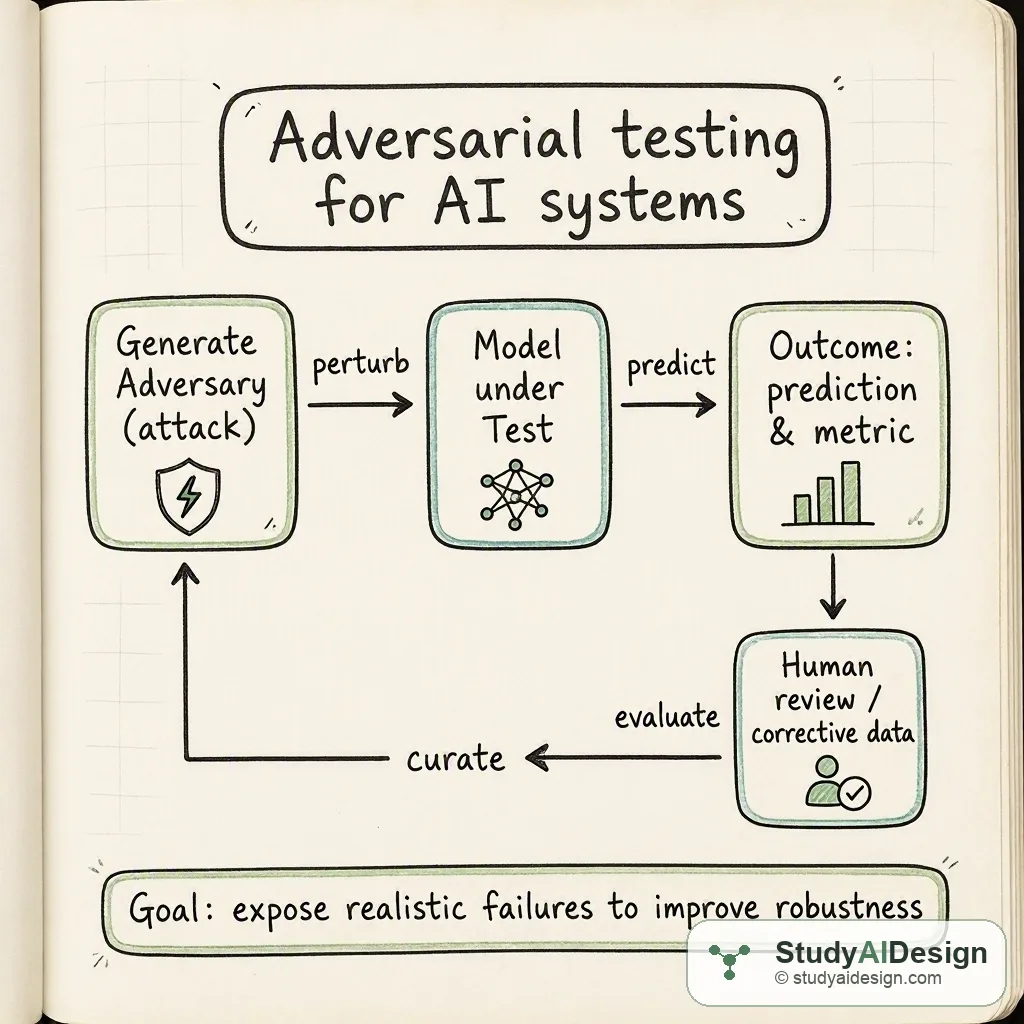
TL;DR
- Adversarial testing for AI systems means deliberately creating or searching for inputs that push a model to make wrong or unsafe predictions.
- Tests include small perturbations, realistic distribution shifts, and data poisoning; metrics track attack success rate and robust accuracy.
- Good adversarial tests are reproducible, reflect threat models, and help prioritize fixes like training, detection, or monitoring. Key tradeoffs: test realism versus breadth, automated search versus human-in-the-loop evaluation.
In this question, we will learn what adversarial testing for AI systems is, why teams run it, and how to design and interpret meaningful adversarial evaluations. We keep the focus on practical steps you can discuss in an interview.
We will cover the following:
- The direct answer
- The intuition
- How it actually works
- Common attack families and metrics
- Designing adversarial tests and interpreting results
- Tradeoffs, failure modes, and interview follow-ups
Adversarial testing for AI systems is the controlled practice of crafting, searching for, or simulating inputs that cause a model to fail in targeted ways so we can measure weaknesses and guide mitigation. We run adversarial tests both with automated attack algorithms and with human-crafted inputs, then report metrics such as attack success rate and robust accuracy to prioritize fixes.
The intuition (an analogy that makes it click)
Think of a bicycle helmet test. A helmet maker drops a head form in different orientations and velocities to see where the helmet cracks. Adversarial testing is the same but for a model: we drop crafted or shifted inputs at the model to discover where its decision boundary cracks. We do not only measure whether the model works on ordinary cases, we actively search for edge cases that cause harm.
How it actually works (the real mechanics, with one concrete worked example)
At a high level an adversarial test specifies a threat model, an attack method, and evaluation metrics. A simple worked example:
We have an image classifier that maps input to a label . We allow small perturbations under the norm with budget . An adversary tries to find such that the model's prediction on differs from the true label.
A common automated attack is projected gradient descent (PGD). The attack iteratively updates by following the gradient of the loss and then projects back to the ball of radius .
A core metric is attack success rate (ASR). If we attempt adversarial examples and cause misclassification then
Robust accuracy is simply when all attempted attacks target misclassification.
Table comparing example attack families and typical cost/goal:
| Attack family | Typical goal | Cost to run |
|---|---|---|
| FGSM (single-step) | Quick untargeted perturbation | Low |
| PGD (iterative) | Strong untargeted/targeted perturbation | Medium-High |
| Carlini-Wagner | High success, low perceptibility | High |
| Data poisoning | Backdoor or label flip at training | Varies; data access needed |
Concrete worked numbers: suppose we test 1000 images with PGD () and 300 are misclassified under attack. Then
so robust accuracy is under that threat model.
Common attack families and what they reveal
- White-box gradient attacks reveal vulnerabilities tied to model gradients and feature sensitivity.
- Black-box queries and transfer attacks test real-world attackers who cannot see weights.
- Distribution shift tests (corruptions, style shifts) reveal brittleness to realistic input changes.
- Data poisoning and backdoor tests check training-time vulnerabilities where a small subset of data controls outputs.
These are complementary: a model robust to white-box PGD may still fail under a backdoor insertion.
Designing adversarial tests and interpreting results
Design steps we recommend in interviews and on teams:
- Define the threat model: what can the attacker change, see, or access, and what cost do they incur. Make this explicit.
- Choose attack families that match the threat model: e.g., perturbations, spatial transforms, or poisoning.
- Run a mixture of automated attacks and human-in-the-loop tests that reflect real user inputs.
- Report meaningful metrics: attack success rate, robust accuracy, and per-class failure breakdown.
- Prioritize fixes: does the issue need architecture change, adversarial training, detection, or better data?
A useful table to summarize outcomes:
| Test type | Metric to report | When a high failure rate matters |
|---|---|---|
| Small perturbations | ASR | If attackers can create imperceptible inputs in deployment |
| Natural distribution shift | Accuracy under shift | If inputs will deviate in field conditions |
| Poisoning/backdoor | Trigger success rate | If training data is exposed to attackers |
Tradeoffs and failure modes
Adversarial testing finds many issues but has costs. Automated strong attacks can be compute heavy. Tests that are too synthetic may not reflect real threats. We must avoid optimizing only to pass a benchmark, because that can give a false sense of security.
Other failure modes:
- Misinterpreting ASR without considering how easy the attack is to mount in practice.
- Ignoring class imbalance: some classes may be far more vulnerable.
- Using only white-box attacks while attackers are black-box in production.
Questions the interviewer might ask
Some follow-up questions you might get:
How do you choose an appropriate threat model? Start from realistic attacker goals and capabilities. Ask whether the attacker can modify inputs at inference, poison training data, or only query the model.
What metrics do you report besides attack success rate? Report robust accuracy, per-class ASR, confidence shift, and calibration changes. Include costs like number of queries or perceptibility.
When would you use adversarial training? Use adversarial training when the threat model is well-specified and you can retrain models. It raises robust accuracy for the trained threat but can reduce clean accuracy and increase compute.
How do you validate that adversarial tests are realistic? Combine automated attacks with human red teaming or field data collections. Measure attack cost and prevalence in the target deployment.
Can passing adversarial tests guarantee safety? No. Tests reduce risk and expose weaknesses, but no finite test battery proves absolute safety. Continuous monitoring and layered defenses are needed.
Some things to note:
- Always tie tests to a clear attacker capability and cost model.
- Report both clean and robust metrics to see tradeoffs.
- Mix automated search with realistic human examples for coverage.
What the interviewer is really testing
They want to see that you understand adversarial testing as a principled engineering practice: defining threat models, choosing representative attacks, and interpreting metrics to guide fixes. They are checking for practical judgment about realism, tradeoffs, and how to prioritize mitigation rather than just naming attack algorithms.
Further reading in the curriculum
Go deeper on the fundamentals behind this question.
- Choosing the Right Model A practical framework for navigating the 2026 model landscape and picking the right model for your use case, budget, and latency requirements.
- Evaluating AI Systems How to measure, monitor, and improve LLM system quality from offline eval sets through production observability.
Related questions
How would you rate the quality of this article?
Prepare for your AI engineering interview
This is one of many detailed questions and explainers on StudyAIDesign. Browse the full set, work through the curriculum, and walk into your interview ready.