What are AI SubAgents?
What are AI SubAgents? Learn what AI subagents are, how they decompose work inside an agent system, and when to use them. This page explains design patterns, a concrete example, tradeoffs, and likely interview questions.
TL;DR
- AI subagents are smaller, focused agents that a main agent delegates parts of a task to.
- They let us split responsibilities like parsing, planning, and grounding into separate components that can run different models or algorithms.
- Subagents reduce complexity but add coordination costs and possible inconsistency. Key tradeoffs: simplicity of a single agent versus modularity and robustness of multiple subagents.
In this question, we will learn what AI subagents are, why you might create them, and how they change system design and failure modes. We will keep the explanation practical and show a concrete worked example so you can explain this clearly in an interview.
We will cover the following:
- The direct answer
- The intuition
- How it actually works
- Coordination patterns and comparison
- Tradeoffs and failure modes
- Questions the interviewer might ask
AI subagents are small, specialized agents that a top-level agent delegates parts of a larger task to. They each handle a focused responsibility like extraction, verification, or action planning, and an aggregator or controller combines their outputs into the final decision. They are a modular way to improve reliability, reuse, and parallelism, but they require careful orchestration to avoid inconsistency.
The intuition (an analogy that makes it click)
Imagine building a car in a workshop where one person does everything. That one person might be fast for simple jobs but makes errors on complex tasks and becomes a bottleneck. Now imagine a team: one person fits the engine, another paints, another tests brakes. Each specialist is a subagent. The team needs a coordinator to sequence steps and resolve conflicts. Subagents bring specialization and parallelism, but they need orchestration to make the whole car run.
How it actually works (the real mechanics, with one concrete worked example)
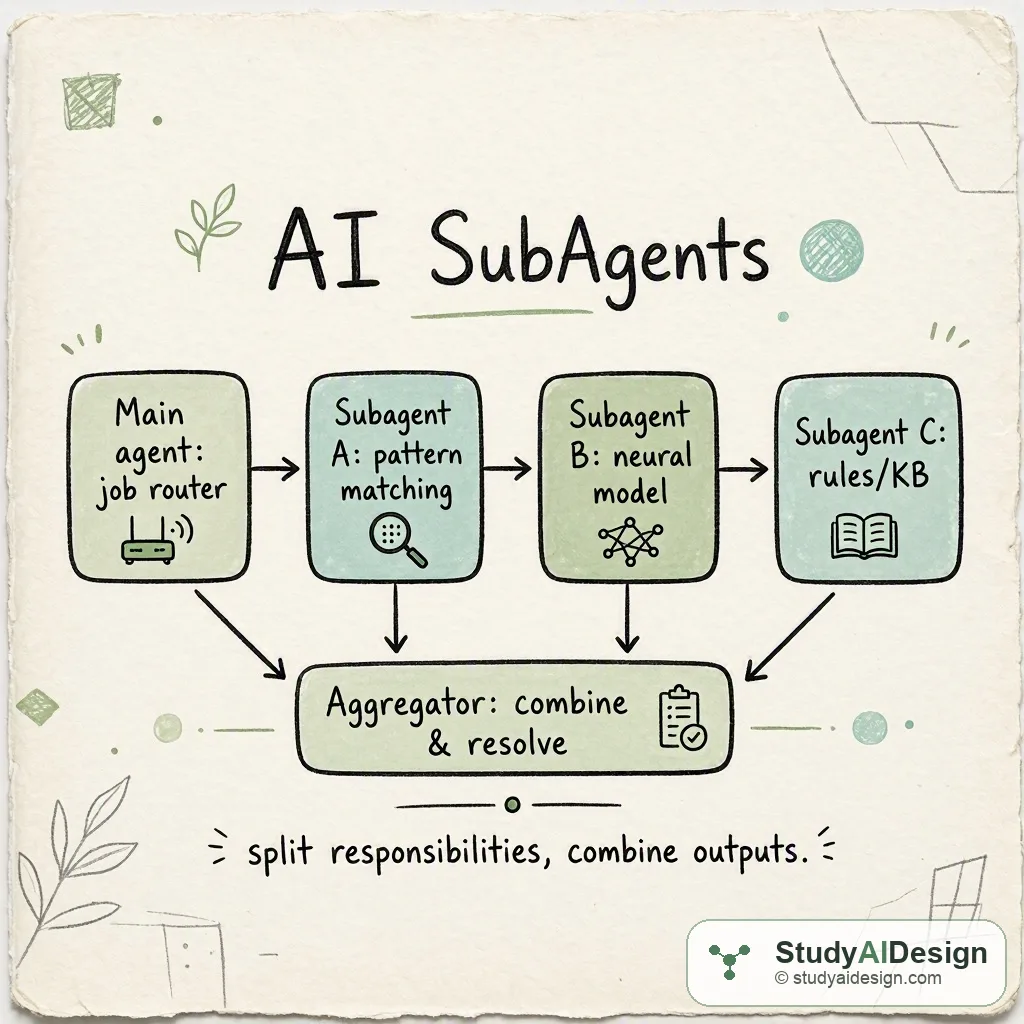
At runtime a system with subagents typically has these components: a controller or router, the subagents, and an aggregator or adjudicator. A simple control flow is: controller receives task, creates subtasks, dispatches to subagents, collects outputs, and aggregates into a final response.
Concrete example: entity extraction from a customer email. We use three subagents:
- Subagent A: regex and heuristic extractor.
- Subagent B: neural sequence tagger that outputs probabilities for entity labels.
- Subagent C: knowledge base lookup that confirms entity plausibility.
We measure precision and recall for each, then form a weighted ensemble. Suppose the models give these scores on a test set.
| Subagent | Precision | Recall |
|---|---|---|
| A (heuristic) | 0.90 | 0.60 |
| B (neural) | 0.80 | 0.85 |
| C (KB) | 0.95 | 0.50 |
We can aggregate a candidate label score using a weighted sum. If is the confidence from subagent and is its weight, the combined score is
For three subagents with normalized weights and confidences we get
We then threshold to accept or reject the entity. This example shows how specialization and simple math combine to improve end performance.
Coordination patterns and comparison
There are several common coordination patterns you should know and be ready to discuss.
-
Serial pipeline: Controller sends output of subagent 1 to subagent 2 and so on. This simplifies state flow but increases latency and cascading errors.
-
Parallel ensemble: All subagents run in parallel on the same input and an aggregator combines results. This lowers latency and improves robustness to individual errors but requires a clear aggregation rule.
-
Arbiter/Referee: An arbiter requests opinions from subagents and breaks ties using a confidence model or external verifier. This is useful when correctness matters more than raw speed.
Comparison table:
| Pattern | Latency | Robustness | Complexity |
|---|---|---|---|
| Serial pipeline | Higher | Lower if earlier errors cascade | Low to medium |
| Parallel ensemble | Lower | Higher by redundancy | Medium |
| Arbiter/Referee | Medium | Highest when arbiter is strong | High |
When you design a system pick the pattern that matches latency, cost, and correctness goals.
When to use each subagent responsibility
Use separate subagents when a part of the task benefits from a different model or data source. Typical responsibilities to separate are parsing, ranking, verification, and execution. For example, use a symbolic rules subagent when exact matching matters, and a neural subagent when flexible generalization matters.
Splitting responsibilities also helps testing and debugging. You can run unit tests on one subagent without touching others. It also enables mixed compute: cheap heuristics for most cases and expensive models for hard cases.
Tradeoffs and failure modes
Using subagents gives us modularity, parallelism, and targeted improvements. The costs are orchestration complexity, increased surface for bugs, and potential inconsistencies when subagents disagree.
Other failure modes include increased latency from synchronous coordination, mismatch of assumptions between subagents, and drift when subagents are updated independently.
Questions the interviewer might ask
Some follow-up questions you might get:
How do you choose weights for an ensemble of subagents? You can tune weights on a validation set to optimize the metric you care about or learn weights with a small meta-model that predicts reliability per input.
How do you handle conflicting outputs from subagents? Design an adjudication rule: highest confidence, weighted voting, or invoke a verifier subagent. For critical flows add human-in-the-loop or fallback heuristics.
When would you not use subagents? If the task is small and performance is adequate with a single model, the orchestration cost may not be worth it. Also avoid subagents if you need strict end-to-end latency and cannot parallelize.
How do you test a system of subagents? Unit test each subagent, integration test the router and aggregator, and monitor disagreement metrics and calibration over time.
Can subagents share state or memory? They can, but shared mutable state increases coupling. Prefer passing structured messages or use a read-only knowledge store for shared context.
Some things to note:
- Instrument disagreement and calibration metrics from day one.
- Keep subagent interfaces small and versioned to avoid coupling.
What the interviewer is really testing
They want to know if you can break a complex agent into reliable, testable pieces and reason about coordination costs. They also test your awareness of tradeoffs: modularity versus orchestration overhead and how you would detect and handle failures in a multi-agent setup. Show familiarity with concrete patterns and metrics to demonstrate practical design sense.
Related questions
How would you rate the quality of this article?
Prepare for your AI engineering interview
This is one of many detailed questions and explainers on StudyAIDesign. Browse the full set, work through the curriculum, and walk into your interview ready.