What is LLMOps, and how does it differ from traditional MLOps?
LLMOps explains how to operate large language models in production, focusing on prompts, token costs, streaming, and runtime orchestration. This question asks you to define LLMOps and contrast it with traditional MLOps across infrastructure, monitoring, and lifecycle practices.
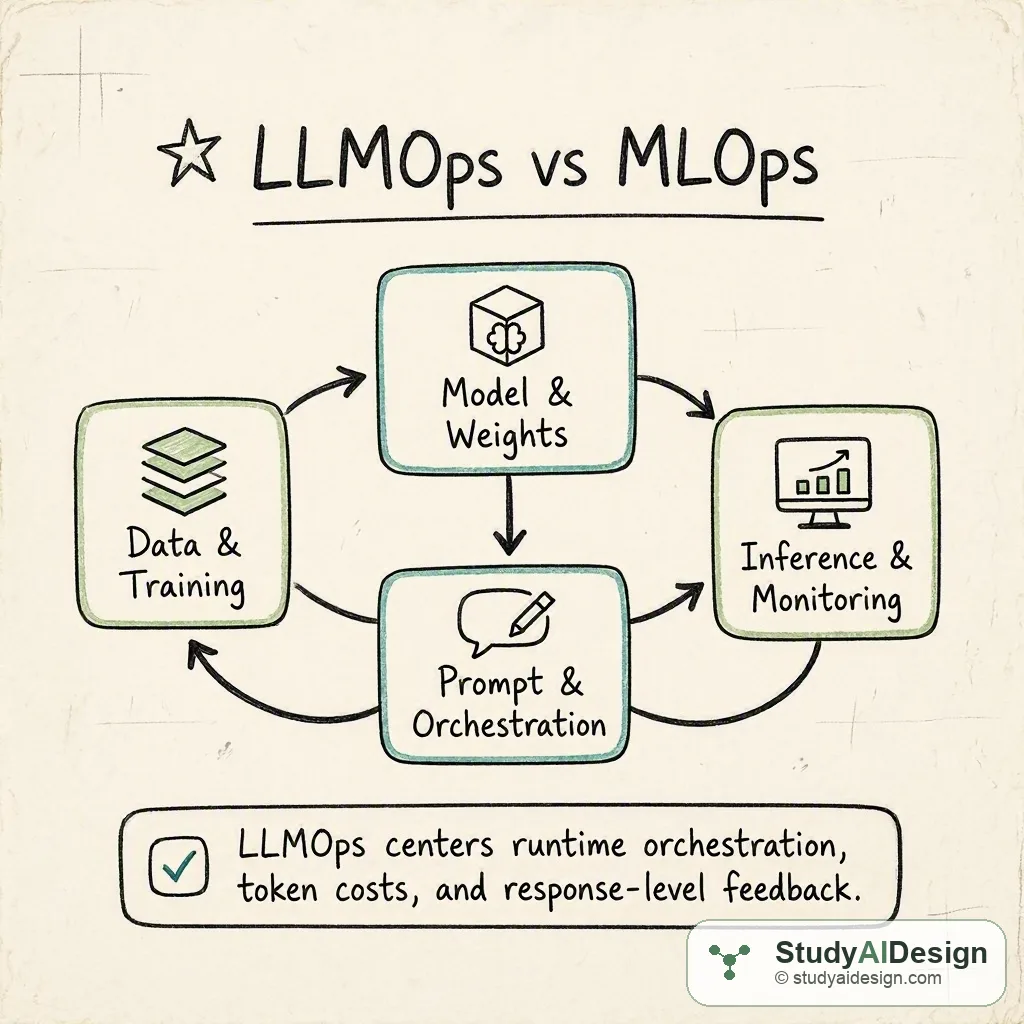
TL;DR
- LLMOps focuses on running, orchestrating, and monitoring large language models with attention to prompt design, token-level cost, and streaming responses.
- It adds runtime concerns like prompt/version management, context-window handling, and expensive inference compared with traditional MLOps training-focused workflows.
- LLMOps requires different monitoring signals, caching and batching strategies, and stronger controls for hallucination and safety. Key tradeoffs: higher operational complexity and runtime cost for flexible conversational capabilities and faster end-user iteration.
In this question, we will learn what LLMOps is, why it matters, and how it differs from traditional MLOps in infrastructure, monitoring, and lifecycle steps. We keep things practical so you can explain tradeoffs clearly in an interview.
We will cover the following:
- The intuition
- How it actually works
- Deployment and monitoring differences
- Tradeoffs and failure modes
- Questions the interviewer might ask
- What the interviewer is really testing
Direct answer: LLMOps is the set of operational practices for deploying, managing, and observing large language models in production, with special emphasis on prompt management, token-level billing, response-level evaluation, and runtime orchestration. It differs from traditional MLOps by shifting many responsibilities to inference time: prompt/version control, streaming and latency controls, caching of tokens, and different monitoring signals focused on responses rather than just dataset metrics.
The intuition (an analogy that makes it click)
Think of traditional MLOps as recording a studio album. You prepare data, train a model, validate offline, and then release a polished artifact. The work is heavy before release. LLMOps is more like running a live radio show where the host improvises from a script, the audience reacts, and the show is adjusted in real time. We must manage the live prompts, latency, and how each listener experience is composed and evaluated.
How it actually works (the real mechanics)
Key operational shifts are where they matter. Traditional MLOps centers on data pipelines, training jobs, model registries, and batch evaluation. LLMOps keeps those but adds runtime-first systems: prompt/version stores, token accounting, streaming APIs, composition/orchestration layers, and response evaluators.
A simple resource example contrasts a small fine-tuned model and a large LLM used via inference.
Consider a M parameter fine-tuned model versus a B parameter LLM. Memory for weights scales roughly with parameter count and bytes per parameter according to:
where is number of parameters and is bytes per parameter (for example for float32, for int16/quantized storage).
| Model type | Params | Raw weights (GB) (float32) | Typical GPU memory needed | Single-request latency (ms) | Cost per 1k requests (approx) |
|---|---|---|---|---|---|
| Small fine-tuned | M | GB GPU | ms | ||
| Large LLM | B | + GB GPU or sharded | ms | + |
Those numbers are illustrative. Notice how memory and inference complexity explode with model size. In LLMOps we address this with techniques like quantization, model sharding, offloading, and request-level batching.
Runtime orchestration examples you should be able to name:
- Prompt templating and versioned prompt stores so behavior is reproducible.
- Token-level caching of recent completions and embedding caches for retrieval augmented generation.
- Streaming outputs and partial-response evaluation for latency-sensitive apps.
- Router or ensemble layers that select smaller models for cheap queries and fall back to larger models when needed.
Deployment and monitoring differences
Operational differences that matter in practice:
- Metrics: In MLOps we tracked dataset-level accuracy, precision, recall. In LLMOps we add response-level metrics like hallucination rate, factuality score, token consumption, and user satisfaction.
- CI/CD: Traditional model CI focuses on retraining tests and data validation. LLMOps CI includes prompt regression tests, safety filters, and A/B testing of prompt variants in production.
- Scaling: Batch training scales with compute hours. Inference scales with concurrent requests, context window size, and streaming behavior, often causing variable cost spikes.
- Observability: LLMOps requires logging of prompts, responses, token use, and downstream effects with attention to privacy and redaction.
Tradeoffs and failure modes
LLMOps buys flexibility and interactive capability at the cost of runtime complexity and higher operational expense. Common failure modes include prompt drift, unseen token-cost spikes, emergent hallucination patterns, and data leakage through prompts.
Hallucinations and safety failures can cause silent production damage. If prompts include private data or are logged without redaction, you can leak sensitive information. Monitor token usage and set hard budget and rate limits to avoid runaway costs.
Questions the interviewer might ask
Some follow-up questions you might get:
How do you control costs when calling large LLMs? You can route cheap requests to smaller models, cache embeddings and completions, set token limits, use quantized models, and implement quota and rate limits.
What monitoring signals are unique to LLMOps? Token consumption, average tokens per response, streaming latency, hallucination or factuality scores, and prompt drift metrics are all LLM-specific.
How would you test prompt changes before rolling out? Create a prompt regression suite with labeled queries, run A/B tests in production with limited traffic, and use automatic response validators that check for format, hallucination risk, and safety violations.
When should you host an LLM yourself versus use a hosted API? Self-hosting gives control, lower per-token cost at scale, and custom privacy, but needs infra for sharding and ops. Hosted APIs simplify ops and safety, but may have higher variable cost and less control.
How do you handle privacy and logging? Avoid logging raw prompts that include secrets, apply client-side redaction, tokenize and hash sensitive fields, and maintain clear retention policies.
How do you measure hallucination? Combine automated checks against knowledge sources, n-gram overlap with expected answers, and human review for edge cases. Use these signals as monitoring alerts.
Some things to note:
- LLMOps is more runtime-driven than training-heavy.
- Cost, latency, and safety concerns dominate design choices.
- Small engineering changes at inference time can produce large behavior changes.
What the interviewer is really testing
They want to see you separate training-time concerns from inference-time responsibilities, and show familiarity with prompt/version control, token economics, and live evaluation. They also want practical mitigations: routing, caching, monitoring, and safety controls rather than only theoretical definitions.
Related questions
How would you rate the quality of this article?
Prepare for your AI engineering interview
This is one of many detailed questions and explainers on StudyAIDesign. Browse the full set, work through the curriculum, and walk into your interview ready.