What are guardrails for LLMs, and how do you implement them?
Guardrails for LLMs: what they are and how to implement them. Learn practical guardrail types, an implementation checklist, and tradeoffs to balance safety, usefulness, and latency. Includes a worked example and common interviewer follow ups.
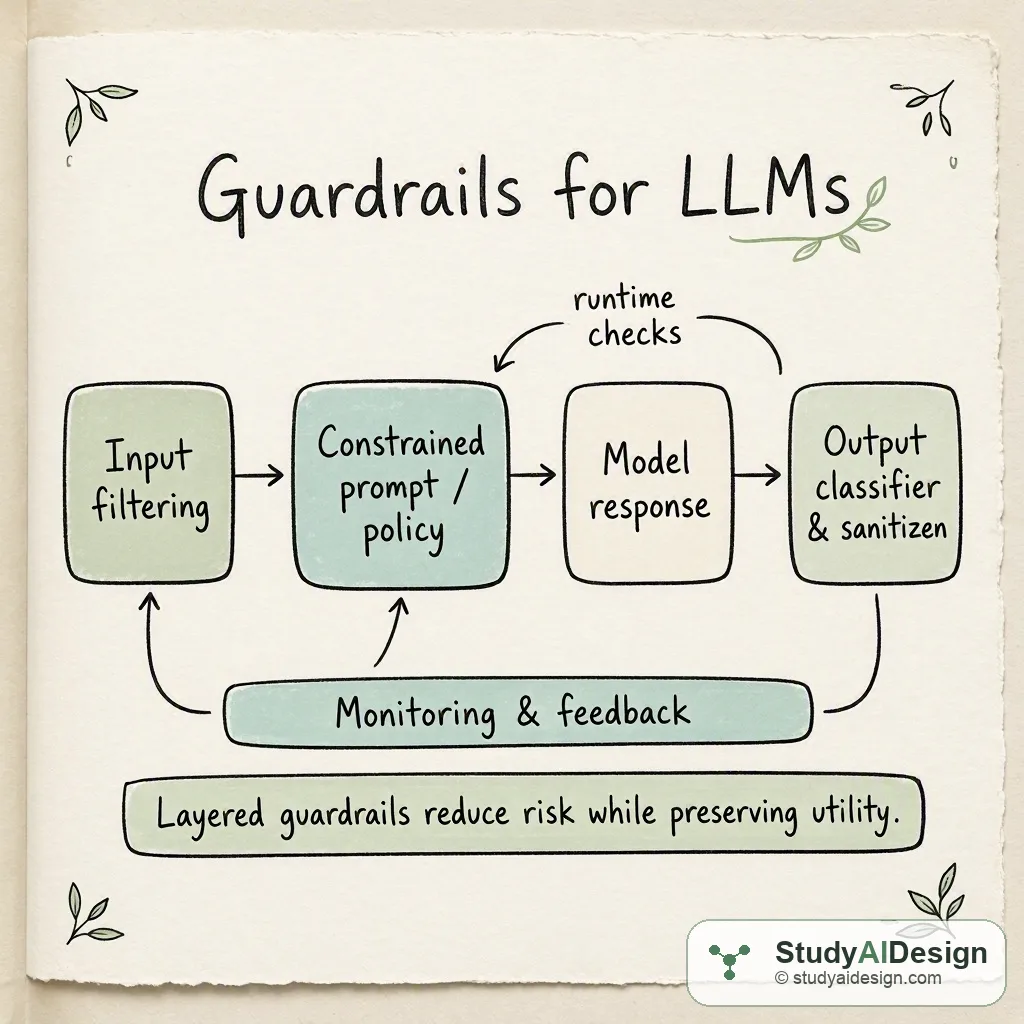
TL;DR
- Guardrails for LLMs are layered controls that keep model outputs safe and compliant while preserving useful behavior.
- Common guardrails include input filters, constrained prompts, model-level alignment like RLHF, post-output classifiers, and runtime executables or checks.
- Implement a stack: detect, constrain, predict, classify, and monitor, and tune thresholds with measurable metrics. Key tradeoffs: safety versus latency and utility versus false positives.
In this question, we will learn what guardrails for LLMs are, why you need multiple layers, and how to build a practical implementation that balances safety and usefulness.
We will cover the following:
- The short direct answer
- The intuition
- How it actually works with a worked example
- Implementation checklist and components
- Tradeoffs and failure modes
- Interviewer questions you might get
Guardrails are a layered set of detection, constraint, and validation controls placed before, during, and after LLM generation to reduce harmful, incorrect, or policy-violating outputs while keeping useful behavior. A practical implementation uses input sanitizers, constrained prompts or policy-guided generation, post-generation classifiers and sanitizers, and monitoring with feedback loops. You tune thresholds and choose layers based on the safety budget, latency, and user experience.
The intuition (an analogy that makes it click)
Imagine the model is a car traveling from A to B. Guardrails are the full safety system. Input filters are security gates that stop dangerous passengers. Constrained prompts are road signs that direct the car to allowed lanes. Classifiers after generation are inspectors checking the cargo. Monitoring is a dashboard that records incidents so we can update the road signs and gates. One component rarely suffices. Layers reduce the chance a problematic output reaches a user.
How it actually works (the real mechanics, with one concrete worked example)
At a high level the stages are detect, constrain, generate, validate, and monitor. A simple worked example is preventing toxic responses in a customer support assistant.
- Detect: run an input classifier that flags abusive or toxic queries.
- Constrain: route flagged inputs to a safe-handling flow or a specialized prompt that guides the model to de-escalate.
- Generate: the LLM produces a response, optionally with temperature control or constrained decoding.
- Validate: run a post-output toxicity classifier and a policy check; if the probability of toxicity exceeds a threshold the system either edits or refuses.
- Monitor: log incidents and human review outcomes to tune models and thresholds.
We can reason about expected operational cost using a simple risk formula. If is the false positive rate of the post-output blocker and is the false negative rate, and are unit costs for false positives and false negatives, the expected cost per request is
You tune the threshold to minimize given your cost weights.
Compare common guardrail options in the table below.
| Guardrail | Latency | Coverage of failure modes | Complexity to maintain |
|---|---|---|---|
| Prompt constraints | low | medium | low |
| Input filters | low | low to medium | low |
| Post-output classifiers | medium | high | medium |
| Model-level alignment (RLHF) | none at runtime | medium | high |
| Retrieval augmentation (RAG with citations) | high | medium | medium |
Implementation checklist and components
- Input sanitization: normalize text, remove obviously malicious payloads, and standardize sensitive fields.
- Policy-guided prompts: include explicit instructions, role prompts, and allowed/forbidden lists. Consider using template substitution to avoid injection.
- Decoding controls: reduce temperature, use top-k or nucleus sampling with tuned parameters for your safety needs. For constrained generations consider lexically constrained decoding or token-level allowlists.
- Post-processing: deterministic sanitizers for PII, classifiers for toxicity and hallucination detectors, and structured validators for numeric or logic outputs.
- Runtime guards: implement canary prompts, guardrail timeouts, and a circuit-breaker to fallback to human agents.
- Monitoring: telemetry for incidents, human-in-the-loop review queue, and automated retraining data pipelines.
When comparing label accuracy and costs, remember that a high precision blocker reduces false positives but may let more bad outputs through. A high recall blocker catches more risk but may degrade user experience through overblocking.
When to use each layer
- Use prompt constraints for broad style and policy control when latency and simplicity matter.
- Use post-output classifiers for high-risk outputs like toxicity, legal advice, or content policy enforcement where accuracy is critical.
- Use retrieval and citation for factual queries and to reduce hallucination by grounding responses.
- Use model-level alignment and safety finetuning when you can invest in model training and want consistent behavior across prompts.
Tradeoffs and failure modes
Guardrails make the system safer but introduce tradeoffs in latency, developer cost, and user utility. Overzealous blocking reduces user trust. Underactive checks increase safety incidents. Monitoring and human review are essential to close the loop and update thresholds.
Common failure modes:
- Prompt injection where user input alters the system instruction. Mitigate with strict template substitution and input escaping.
- Classifier drift when the post-output model degrades over time. Mitigate with continuous labeling and retraining.
- Latency blowups when heavy checks run synchronously. Mitigate with async checks and graceful degradation.
Questions the interviewer might ask
Some follow-up questions you might get:
How do you choose thresholds for classifiers? Tune thresholds using a validation set labeled for the target policy and optimize a metric tied to business cost like the expected cost above or a precision at a chosen recall.
What is prompt injection and how do you prevent it? Prompt injection is when user content manipulates system instructions. Prevent it by isolating system prompts from user content, escaping or tokenizing user inputs, and validating any dynamic prompt pieces.
When should you use post hoc classifiers versus model-level alignment? Post hoc classifiers are faster to deploy and iterate. Model-level alignment reduces runtime checks but requires retraining and longer development cycles. Use both when possible.
How do you measure that guardrails work in production? Track false negatives, false positives, and incident rates. Use human reviews on a sample of outputs, and compute precision and recall for critical policy classes.
How do you balance user experience with blocking? Provide helpful refusals, offer safe alternatives, and use graduated responses rather than hard blocks when possible.
How do you handle privacy and PII in guardrails? Detect and redact PII before logging, separate telemetry from user content, and follow regulatory requirements for retention and access.
Some things to note:
- Guardrails are a system design problem not a single model change.
- Continuous monitoring and labeled feedback are essential to maintain effectiveness.
What the interviewer is really testing
They want to see system-level thinking: that you know guardrails are layered and that each layer has strengths and weaknesses. They assess your ability to choose practical controls, trade off latency and utility, and plan for monitoring and iteration. Showing a concrete checklist and measurable metrics distinguishes a candidate who can ship a safe LLM product.
Further reading in the curriculum
Go deeper on the fundamentals behind this question.
- Reliability and Safety How to build AI pipelines that fail gracefully and refuse to produce harm, from input guardrails to circuit breakers to ensemble verification.
Related questions
How would you rate the quality of this article?
Prepare for your AI engineering interview
This is one of many detailed questions and explainers on StudyAIDesign. Browse the full set, work through the curriculum, and walk into your interview ready.