What is the Transformer architecture and how does it work?
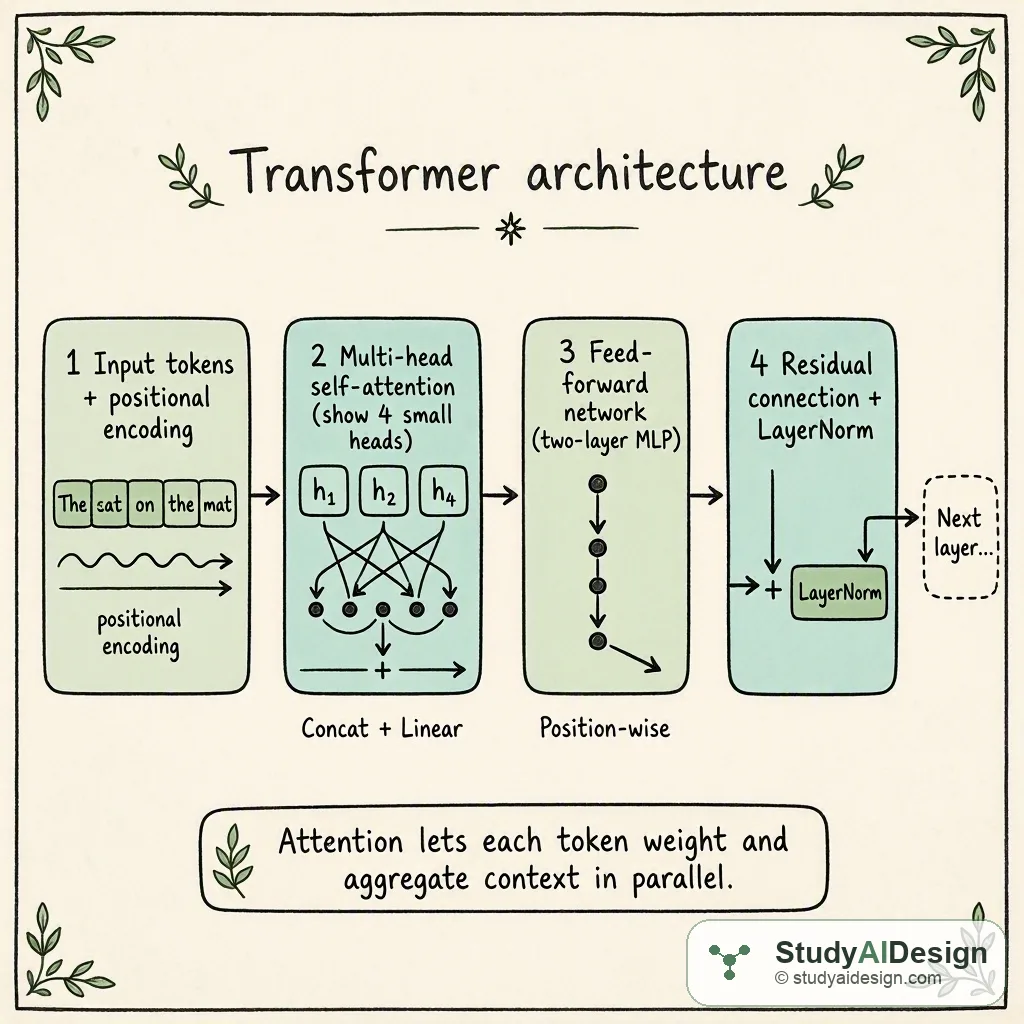
Transformer architecture is the neural-network design built around self-attention, multihead attention, residual connections, and feed-forward blocks used in LLMs. Explain how attention computes context, how layers stack, and why scaling, positional encoding, and complexity matter for model behavior and performance.
TL;DR
- Transformer architecture centers on self-attention to let every token weigh other tokens when building context.
- Key components are multihead attention, residual connections with layer normalization, position encodings, and a positionwise feed-forward network.
- Scaling choices and sequence length drive a tradeoff between performance and quadratic compute in sequence length. Key tradeoffs: model capacity and parallelism versus memory and quadratic attention cost.
In this question, we will learn what the Transformer architecture is and how its pieces work together so you can explain both the intuition and the mechanics. We will keep a small worked numerical example to show how attention scores become weighted context vectors.
We will cover the following:
- The intuition
- How it actually works
- Scaling and complexity
- Practical design choices
- Tradeoffs and failure modes
- Questions the interviewer might ask
- What the interviewer is really testing
Direct answer: A Transformer is a deep model built from stacked layers that compute self-attention and positionwise feed-forward transforms, with residual connections and layer normalization. Each layer uses multihead attention to let tokens attend to others in parallel, producing context-aware representations that are passed up through the stack.
The intuition (an analogy that makes it click)
Imagine a classroom discussion where every student can glance at notes from every other student at once and decide how much each classmate should influence their answer. Self-attention is that glance. Instead of reading tokens one at a time like an old lecture, each token forms a weighted mixture of every other token based on relevance. Multihead attention is like multiple students each using a different focus or question, then combining their answers for a richer response.
How it actually works (the real mechanics, with one concrete worked example)
At the core is scaled dot-product attention. For a set of queries , keys , and values with key dimension , an attention head computes:
Here gives raw similarity scores, we scale by to stabilize gradients, apply softmax to get weights, and multiply by to get weighted sums.
Worked example. Suppose a single query and two keys and values:
- ,
- ,
Let so . Dot products: , . Scaled scores are and . Softmax over these two gives weights approximately and . The output is the weighted sum of values: .
| item | raw score | scaled score | softmax weight |
|---|---|---|---|
| 1.000 | 0.707 | 0.670 | |
| 0.000 | 0.000 | 0.330 |
In practice we compute many queries at once, project inputs into spaces, and run several heads in parallel. Each head has its own learned linear projections. Heads outputs are concatenated and linearly projected again.
Scaling and complexity
Each self-attention layer requires computing pairwise similarities among tokens, giving time and memory cost proportional to per layer for sequence length and model dimension . This quadratic term is the main practical limit for long sequences. By contrast, recurrent models avoid the explicit matrix but lose parallelism.
| characteristic | transformer | RNN |
|---|---|---|
| parallelism | High across tokens | Low across time steps |
| complexity per layer | typically | |
| long-range info | Direct via attention | Gradual via hidden state |
To scale, practitioners use sparse attention, windowed attention, or recurrence hybrids, and rely on hardware that favors matrix multiply parallelism.
Practical design choices
- Positional encoding: Because attention is permutation invariant, we add position signals. These can be learned vectors or sinusoidal functions. They let the model encode order information without recurrence.
- Residual connections and layer normalization: Each sublayer is wrapped with a residual connection and layer norm to stabilize training. The typical block is: attention -> add & norm -> feed-forward -> add & norm.
- Feed-forward networks: A two-layer MLP with nonlinearity applied independently at each position adds capacity to transform token representations.
- Multihead count and dimension: More heads allow multiple attention patterns, but each head has lower dimension , so there is a tradeoff between head count and per-head capacity.
Tradeoffs and failure modes
Other failure modes: heads may become redundant, attention weights are not the same as causal explanation, and optimization issues can arise for very deep stacks without careful initialization and normalization.
Questions the interviewer might ask
Some follow-up questions you might get:
How does multihead attention improve representational power? Multihead attention projects inputs into different subspaces, letting each head focus on a different relationship or pattern. Concatenating heads provides a richer combined representation than a single head of equal total dimension.
Why scale by ? Scaling keeps the dot products in a range where softmax gradients do not vanish or blow up. Without it, large makes raw scores large and softmax becomes too peaky, hurting learning.
What is the role of positional encoding? Positional encodings provide tokens with a notion of order. Learned embeddings can adapt to data, while sinusoidal encodings give a fixed relative position signal that can generalize to unseen lengths.
How do you handle very long sequences? Options include sparse attention patterns, local windows, hierarchical chunking, recurrence hybrids, or compression techniques that reduce before full attention.
How do you interpret attention weights? Attention weights show which tokens the model uses to compute a representation, but they are not a guaranteed explanation for a final prediction because downstream linear maps and nonlinearity also shape behavior.
When would you use encoder-decoder versus decoder-only Transformers? Use encoder-decoder for tasks with clear input and output sequences like translation, and decoder-only for autoregressive generation such as language models.
Some things to note:
- Attention provides direct, parallel access to context but at quadratic cost in sequence length.
- Residual connections and layer normalization are essential for stable training.
- Design choices like head count and position encoding matter more at scale.
What the interviewer is really testing
They want to see you explain how self-attention computes context, why multihead attention and residual structures are used, and how design choices affect capacity and scaling. Clear knowledge of the scaled dot-product formula, complexity implications, and practical mitigations for long sequences shows you understand both the math and production constraints.
Related questions
How would you rate the quality of this article?
Prepare for your AI engineering interview
This is one of many detailed questions and explainers on StudyAIDesign. Browse the full set, work through the curriculum, and walk into your interview ready.