Explain Agentic RAG.
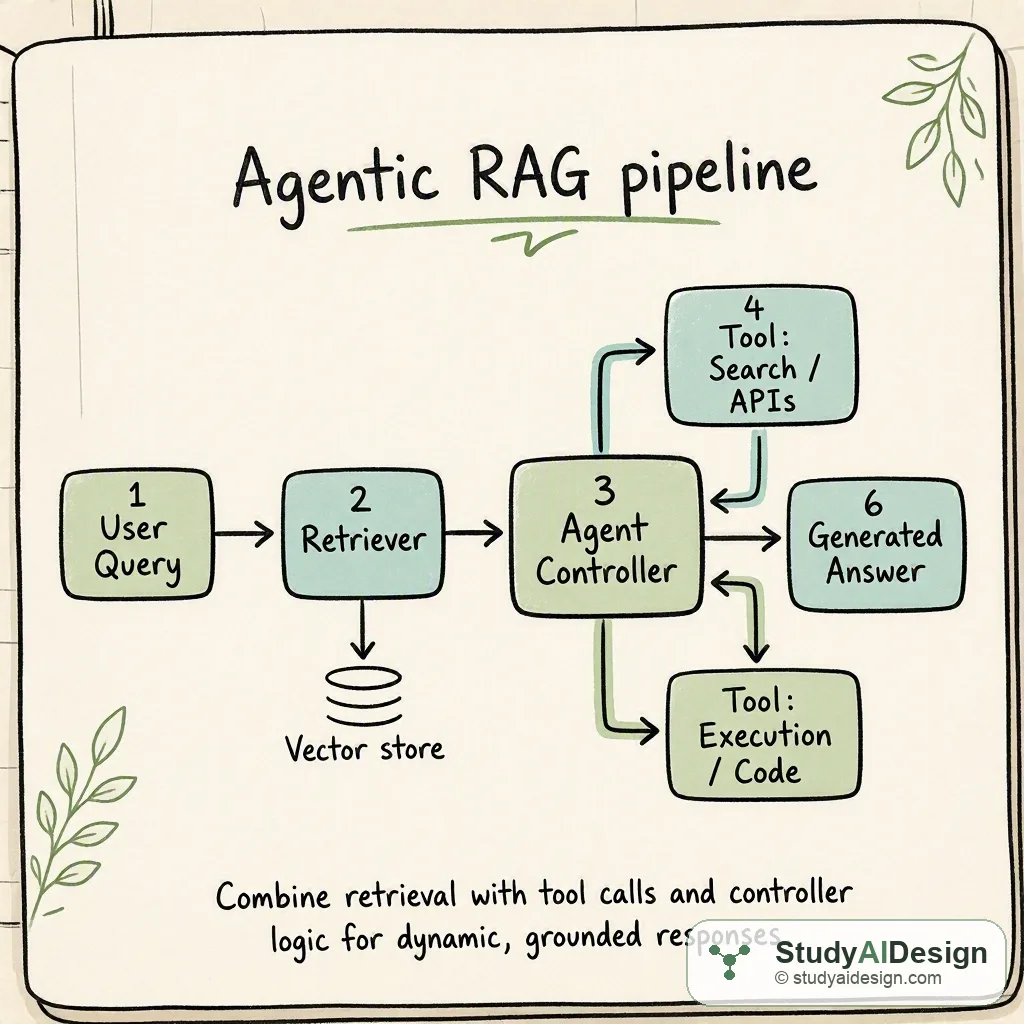
Agentic RAG explains how retrieval-augmented generation combined with agentic control uses retrievers, tools, and a controller to fetch relevant context and act. The page gives a clear architecture, a worked example, and tradeoffs you will need to explain in an interview.
TL;DR
- Agentic RAG combines retrieval-augmented generation with an agentic controller that decides which tools or retrievals to use.
- The controller orchestrates retrievers, tool calls, and composition of evidence to produce grounded, actionable outputs.
- It improves factuality and multi-step tasks but adds latency, complexity, and new failure modes. Key tradeoffs: higher reliability and capability versus more engineering and orchestration risk.
In this question, we will learn what Agentic RAG is, why you would use an agent layer on top of retrieval, and how the pieces interact in a concrete example.
We will cover the following:
- The intuition
- How it actually works
- Orchestration patterns and retrieval strategies
- Tradeoffs and failure modes
- Interview follow ups
Direct answer: Agentic RAG is a pattern that pairs retrieval-augmented generation with a lightweight agent controller that decides when and how to call retrievers and external tools, then composes the retrieved evidence into the final output. It improves multi-step task handling and grounding by introducing planning, tool use, and iterative retrieval, at the cost of added latency and system complexity.
The intuition (an analogy that makes it click)
Think of a librarian-helper pairing. The retriever is the librarian who knows the index and can fetch relevant documents. The generator is the writer who composes the final reply. The agent controller is the project manager who asks the librarian for more specific passages, sends parts to a calculator or an API, and keeps the conversation focused. When the task is simple, the writer can work with one fetch. For a multi-step task, the manager requests more precise evidence and calls specialist tools, then hands everything to the writer to produce a grounded answer.
How it actually works (the real mechanics, with one concrete worked example)
Core components:
- Retriever: vector or sparse retriever that returns passages relevant to a query.
- Agent controller: a policy that decides next actions: call retriever, call a tool, or respond.
- Tools: search endpoints, calculators, knowledge base updaters, or domain APIs.
- Generator: a language model that composes responses using evidence.
Worked example: "Update our product policy summary and list two action items for legal review." The agentic RAG flow looks like:
- Controller receives the user query and issues a broad retrieval for policy docs.
- Retriever returns top passages with similarity scores.
- Controller decides to call a policy-extraction tool to parse clauses, then a summarizer tool.
- Summaries and extracted clauses are fed to the generator to craft the final reply.
Performance table comparing a simple RAG vs Agentic RAG in this example:
| Step | Simple RAG | Agentic RAG |
|---|---|---|
| Initial retrieval | One call, top passages | One call, top passages |
| Decision logic | None | Controller: may request targeted retrievals or tools |
| Tool use | None | Calls extractor and summarizer tools |
| Latency | Low | Higher due to extra calls |
| Groundedness | Moderate | Higher when tools succeed |
A few practical notes on math and complexity. If retrieval cost is for documents and the controller may perform retrievals, retrieval cost can be unless you optimize with cached vectors or filtered candidate sets. The generator work is proportional to returned context size and token count, which we can denote as for tokens fed to the model.
Orchestration patterns
There are a few common controller designs.
- Single-pass planner. The controller decides a fixed plan up front: retrieve, call tool A, then generate. This is simpler and lower latency but less flexible.
- Iterative agent. The controller loops: inspect retrieved evidence, call a tool, revise the query, retrieve again. This supports complex reasoning but increases calls and failure surface.
- Hybrid memory-aware. The controller uses short-term memory to cache intermediate results and avoid redundant retrievals.
Choose the pattern by expected task complexity and latency constraints.
Retrieval and memory considerations
How you structure the retriever and store matters. Use hybrid retrieval for domain specificity. Practical knobs:
- Retrieval chunk size: smaller chunks improve pinpointing but increase index size.
- for top : larger increases evidence but also noise and token cost.
- Caching: memoize recent retrievals and tool outputs to reduce repeated work.
A simple heuristic table for and chunk sizes:
| Task type | Suggested | Chunk size |
|---|---|---|
| Short factual lookup | 200-400 tokens | |
| Policy synthesis | 400-800 tokens | |
| Multi-step planning | 200-600 tokens |
Tradeoffs and failure modes
Agentic RAG raises capability but also these issues:
- Latency and cost due to multiple retrievals and tool invocations.
- Fragility in controller policies that can loop or call irrelevant tools.
- Evidence mixing: the generator must correctly attribute and not hallucinate.
Questions the interviewer might ask
Some follow-up questions you might get:
How do you prevent the agent from hallucinating when composing evidence? Keep strict evidence attribution. The generator should only write claims supported by retrieved passages or tool outputs and include citations or confidence markers for anything uncertain.
How do you design a controller policy? Start with simple rules or a finite state machine, then add learning-based ranking if needed. Use timeouts, max iterations, and cost-aware scoring to avoid expensive loops.
When should you use an agentic pattern versus plain RAG? Use agentic RAG for multi-step tasks, tool integration, or when you need external APIs. Use simple RAG for single-shot Q and A where latency and cost are primary concerns.
How do you evaluate an agentic RAG system? Measure grounding accuracy, tool success rate, end-to-end latency, and cost per request. Also track failure cases such as infinite loops or contradictory outputs.
How do you secure tool calls and sensitive retrievals? Apply access control on the controller, sanitize inputs before calling external APIs, and redact or encrypt sensitive passages in the vector store.
Some things to note:
- Add iteration limits and validation hooks to the controller.
- Use provenance tracking so every claim maps to a retriever or tool source.
What the interviewer is really testing
They want to see if you can reason about systems that combine retrieval, planning, and tool use and trade off latency, cost, and reliability. Show that you understand practical controls: iteration budgets, caching, provenance, and when the added complexity actually improves outcomes. Give concrete examples and failure mitigations rather than only high level descriptions.
Further reading in the curriculum
Go deeper on the fundamentals behind this question.
- RAG Fundamentals Why retrieval-augmented generation works, and how to build a pipeline that actually grounds answers.
- Evaluating AI Systems How to measure, monitor, and improve LLM system quality from offline eval sets through production observability.
- AI Design Patterns A catalog of recurring architectural patterns for LLM systems, with tradeoffs, failure modes, and guidance on when to combine or avoid each.
Related questions
How would you rate the quality of this article?
Prepare for your AI engineering interview
This is one of many detailed questions and explainers on StudyAIDesign. Browse the full set, work through the curriculum, and walk into your interview ready.